


At his stand-up desk in a Silicon Valley office complex, Guido Nunez-Mujica’s telephone buzzes nonstop as he tries in vain to concentrate on his work.
The text messages are from 9,600km away in Santiago, Chile, where he is helping to resettle a group of young Venezuelans trying to retrace his own immigrant’s journey to a better future.
Between deciphering data and writing code, he fields questions that come flying fast: What is the fastest bus line downtown? How do you apply for an immigrant identity card? Any leads on a job?

Photo: AP
“Sometimes I’m rude and tell them to look on Google, or I have to just turn off my phone because I get five messages all at once,” Nunez-Mujica, 34, said.
The demands on his time and energy are part of his solitary battle to give those trapped by his homeland’s economic crisis a fresh start abroad.
Since the end of last year, he has shelled out about US$40,000 of his own money helping about 40 Venezuelans — most of them complete strangers — migrate to other South America nations.
The acts of generosity range from a few months of free rent at an apartment he manages in Santiago to bus fare for a surgeon, so he could move to Peru with his wife and daughter.
Nunez-Mujica has now launched the crowdfunded Salto (“Leap”) Project to scale up the assistance effort, convinced that the only immediate solution to Venezuela’s mess is helping those who can escape.
So far he has raised US$5,250, but the goal is more than US$40,000.
“There’s no way someone like me can do anything about the situation in Venezuela, but if I can do a little bit to help people leave that helps me to sleep at night,” he said in an interview from the offices of Slice Technologies, where he earns a modest tech worker’s salary coming up with solutions to improve e-shopping experiences. “I know it’s a drop in the ocean, but it’s something within my reach to do.”
It is a homespun solution to an ever more desperate situation. Mounting hunger, hyperinflation and an authoritarian government are increasingly driving Venezuelans abroad in one of the largest exoduses in Latin America’s history.
Independent groups have estimated that 3 million to 4 million Venezuelans have abandoned their home country over the past few years, with several hundred thousand fleeing last year alone.
Daniel Klie, 25, is one of the recipients of Nunez-Mujica’s “micro-sponsorships,” in his case US$200 for a plane ticket to Santiago.
With almost no savings to his name, Klie’s first two months in Chile were torment.
A college graduate with two degrees, in journalism and library sciences, he worked under the table at a butcher shop, toiling long hours seven days a week for less than the minimum wage.
Then, buoyed by Nunez-Mujica’s coaching and moral support, Klie won an internship at an advertising agency. He now has a full-time job earning about US$550 a month — five times as much as he made in an entire year holding down three jobs back home.
“In Venezuela, trying to save money is a titanic undertaking,” Klie said. “It’s all about trying to eat and survive each day. Planning ahead is impossible.”
Nunez-Mujica, who abandoned Venezuela in 2011, first for Chile and then three years ago for the US, said that the idea of helping others was born from the frustration he felt hearing stories and seeing pictures of friends who had lost weight struggling to feed themselves.
Born into a working class family in the Andean city of Merida, Nunez-Mujica recalls going days without eating as a struggling college student in Caracas during the early days of former Venezuelan president Hugo Chavez’s socialist revolution.
He said it was only thanks to the bag of groceries provided each month by his thesis adviser that he was able not only to survive, but eventually thrive while working toward a doctorate in biology.
Now it is his turn to pay it forward. The goal is not just to rescue Venezuelans from a collapsing economy.
While Nunez-Mujica has a fatalist view of Venezuela’s ability to regain its economic footing, his own experience has taught him how immigration can jumpstart one’s career and creativity.
“Everyone in Venezuela lives in a state of dependency — either on the government or remittances from abroad,” he said. “But if they move abroad, they have the chance at social mobility denied to them in Venezuela. There’s a multiplier effect.”
Many of those who Nunez-Mujica has helped came through friends of friends. Most he has never met, but developed a connection with based more on intuition than any deliberate screening process.
To avoid becoming too vested in what are frequently heartbreaking tales of exile, he tries his best to keep communications to a minimum, preferring text messages instead of Internet video calls.
The current group he is helping plans to stay in Chile, unable to obtain US visas and with little in the way of savings to relocate to the US or Europe, the preferred destination for earlier, wealthier waves of Venezuelan migrants.
With his American husband, Nunez-Mujica traveled to Santiago to meet in the flesh those he has helped evacuate. At an emotion-filled meeting in a downtown bar, the bond with people meeting for the first time was immediately apparent as he greeted Klie and three others he has helped with big hugs.
Over rounds of beer, the emigres laughed at their common clumsiness adapting to life outside Venezuela. For example, the experience of going to a supermarket at night without fear of being robbed or running into a military patrol.
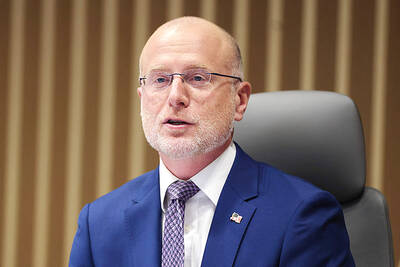
FAKE NEWS? ‘When the government demands the press become a state mouthpiece under the threat of punishment, something has gone very wrong,’ a civic group said The top US broadcast regulator on Saturday threatened media outlets over negative coverage of the Middle East war, after US President Donald Trump slammed critical headlines from the “Fake News Media.” The US president since his first term has derided mainstream media as “fake news” and has sued major outlets over what he sees as unfair coverage. Brendan Carr, head of the US Federal Communications Commission — which oversees the nation’s radio, television and Internet media — said broadcasters risked losing their licenses over news coverage. “The law is clear. Broadcasters must operate in the public interest, and they will
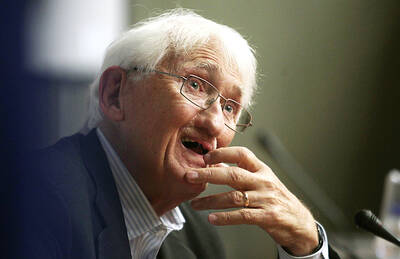
INFLUTENTIAL THEORIST: Habermas was particularly critical of the ‘limited interest’ shown by German politicians in ‘shaping a politically effective Europe Jurgen Habermas, whose work on communication, rationality and sociology made him one of the world’s most influential philosophers and a key intellectual figure in his native Germany, has died. He was 96. Habermas’ publisher, Suhrkamp, said he died on Saturday in Starnberg, near Munich. Habermas frequently weighed in on political matters over several decades. His extensive writing crossed the boundaries of academic and philosophical disciplines, providing a vision of modern society and social interaction. His best-known works included the two-volume Theory of Communicative Action. Habermas, who was 15 at the time of Nazi Germany’s defeat, later recalled the dawn of

The Chinese public maintains relatively warm sentiments toward Taiwan and strongly prefers non-military paths to improving cross-strait relations, a recent survey conducted by the Atlanta, Georgia-based Carter Center and Emory University showed. The “China Pulse” research project, which polled 2,506 adults between Oct. 27 last year and Jan. 1 this year, found that 86 percent of respondents support strengthening cultural ties, while 81 percent favor deepening economic interaction. The report, co-authored by political scientists at Emory University and advisors at the Carter Center, indicates that the Chinese public views Taiwan’s importance through a lens of shared history and culture rather than geopolitical

Cannabis-based medicines have shown little evidence of effectiveness for treating most mental health and substance-use disorders, according to a large review of past studies published in a major medical journal on Monday. Medical use of cannabinoids has been expanding, including in the US, Canada and Australia, where many patients report using cannabis products to manage conditions such as anxiety, post-traumatic stress disorder and sleep problems. Researchers reviewed data from 54 randomized clinical trials conducted between 1980 and May last year involving 2,477 participants for their analysis published in The Lancet. The studies assessed cannabinoids as a primary treatment for mental disorders or substance-use


 RSS
RSS