


China appears to be “winning” its war on air pollution, making so much progress that life expectancy could rise by more than two years, a US university study said.
The Chinese government has been waging a battle to clear its skies of smog that has cut life expectancy in some regions and prompted its citizens to buy masks and air purifiers to protect themselves during peak pollution days.
The University of Chicago says in a study released on Monday that while the world’s biggest polluter faces a long road to reach national and international air quality standards, the results “suggest the country is winning its war on pollution.”
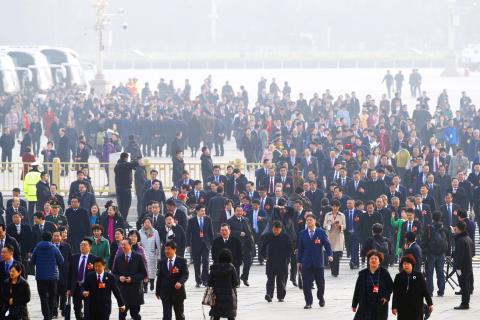
Photo: AP
Based on daily data from more than 200 monitors across China from 2013 to last year, the analysis found that cities have cut levels of PM2.5 — the tiny airborne particles considered most harmful to health — by an average of 32 percent in just four years.
If sustained, such reductions would increase the life expectancy of the average Chinese citizen by 2.4 years relative to 2013. PM2.5 can play a role in heart disease, stroke and lung ailments ,such as emphysema and cancer.
Another study published by the university last year found that air pollution in northern China had cut life expectancy by three years compared with the south of the country.
“We don’t have a historical example of a country achieving such rapid reductions in air pollution. It’s remarkable,” Michael Greenstone, the economist and director of the Energy Policy Institute at the University of Chicago that conducted the studies, said yesterday.
By contrast, it took the US a dozen years and a severe recession to attain similar improvements in air quality after it enacted its 1970 Clean Air Act, he said.
“What these last four years have demonstrated quite loudly is that things can change and they can change rapidly — it just requires political will,” he said.
As public discontent mounted over the nation’s choking smog, the Chinese Communist Party made clean air a priority. In 2013, it launched an ambitious air pollution action plan that sought to slash PM2.5 levels in key regions, such as the northern Beijing-Hebei-Tianjin area and the Yangtze River Delta, by up to a quarter.
In 2014, Chinese Premier Li Keqiang (李克強) declared “war” on pollution.
Since then, teams of inspectors have been deployed across major cities in north China to ensure compliance with pollution standards.
Highlighting the challenge facing the country, Beijing’s skies were a dismal gray yesterday, as PM2.5 levels soared to 270 micrograms per cubic meter — more than 10 times the maximum recommended by the WHO for a 24-hour period.
However, the capital and other places have made progress.
Beijing cut PM2.5 levels by 35 percent between 2013 and last year, increasing lifespans of its 20 million residents by 3.3 years, the study found.
Baoding, China’s most polluted city as of 2015, cut pollution by 38 percent, adding 4.5 years of life.
“China’s not held up as a democratic regime, and yet here we have a clear example of the public demanding something and the government delivering it,” Greenstone said.
Yet the war on smog has come with social costs. To clear the skies, authorities ordered thousands of polluting factories to leave urban centers, displacing hundreds of thousands of migrants.
They also designated “no-coal zones” that pushed more than 3 million households in the region around Beijing to abruptly switch over to gas or electric heating, often removing coal boilers before new systems were functional.

PHISHING: The con might appear convincing, as the scam e-mails can coincide with genuine messages from Apple saying you have run out of storage For a while you have been getting messages from Apple saying “your iCloud storage is full.” They say you have exceeded your storage plan, so documents are no longer being backed up, and photos you take are not being uploaded. You have been resisting Apple’s efforts to get you to pay a minimum of £0.99 (US$1.33) a month for more storage, but it seems that you cannot keep putting off the inevitable: You have received an e-mail which says your iCloud account has been blocked, and your photos and videos would be deleted very soon. To keep them you need

For two decades, researchers observed members of the Ngogo chimpanzee group of Kibale National Park in Uganda spend their days eating fruits and leaves, resting, traveling and grooming in their tropical rainforest abode, but this stable community then fractured and descended into years of deadly violence. The researchers are now describing the first clearly documented example of a group of wild chimpanzees splitting into two separate factions, with one launching a series of coordinated attacks against the other. Adult males and infants were targeted, with 28 deaths. “Biting, pounding the victim with their hands, dragging them, kicking them — mostly adult males,

The Israeli military has demolished entire villages as part of its invasion of south Lebanon, rigging homes with explosives and razing them to the ground in massive remote detonations. The Guardian reviewed three videos posted by the Israeli military and on social media, which showed Israel carrying out mass detonations in the villages of Taybeh, Naqoura and Deir Seryan along the Israel-Lebanon border. Lebanese media has reported more mass detonations in other border villages, but satellite imagery was not readily available to verify these claims. The demolitions came after Israeli Minister of Defense Israel Katz called for the destruction of

SUPERFAN: The Japanese PM played keyboard in a Deep Purple tribute band in middle school and then switched to drums at university, she told the British rock band Legendary British rock band Deep Purple yesterday made Japanese Prime Minister Sanae Takaichi’s day with a brief visit to their high-profile superfan as they returned to the nation they first toured more than half a century ago. Takaichi’s reputation as an amateur drummer, and a fan of hard rock and heavy metal has been well documented, and she has referred to Deep Purple as one of her favorite bands along with the likes of Black Sabbath and Iron Maiden. “You are my god,” a giddy Takaichi said in English to Deep Purple drummer Ian Paice, presenting him with a set of made-in-Japan


 RSS
RSS