


China has ramped up security along its border with North Korea, installing new surveillance cameras, deploying extra security forces and operating radiation detectors as it braces for a potential crisis.
Bellicose rhetoric between Washington and Pyongyang has raised fears in China of a conflict that could send millions of North Korean refugees across the 1,420km border, and of nuclear fallout that could hit Chinese towns.
While authorities have been coy about preparations, residents have seen an increase in patrols along the frontier.
Radiation monitors are running in border towns, and locals said interactions with North Koreans have been discouraged.
A red banner tacked to a border fence in Dandong — a major trading hub separated from North Korea by the Yalu River — has a Cold War-like message to residents: “Citizens or organizations who see spying activities must immediately report them to national security organs.”
Outside Dandong, new checkpoints dot the road running along the Yalu River.
Locals said they were installed in October last year.
Relations between China and North Korea have deteriorated as Beijing has backed a series of UN sanctions to punish its secretive ally over its repeated missile and nuclear tests.
In a previously unthinkable meeting, top US diplomats and military officials last year told their Chinese counterparts about US plans to send troops to North Korea and secure its nuclear weapons in case the regime fell.
“The China-North Korea relationship has some problems at present,” said Yang Xiyu (楊希雨), a former Chinese negotiator on Pyongyang’s nuclear issue. “It has brought about the current difficult situation in the relationship.”
At the massive Supung Dam, which provides power to both China and North Korea, surveillance cameras monitor the Yalu River.
Further north in Longjing, where the Tumen River freezes over in the winter, villages have established border protection units and cadres have taught self-defense to residents.
The local propaganda department last year said that hundreds of cameras were being installed to build a “second-generation border surveillance system.”
The measures are slashing the number of North Korean defectors who reach Seoul via a land route through China to Southeast Asia.
Fewer than 100 North Koreans per month reached the South last year — the lowest number in 15 years, the South Korean Ministry of Unification said.
Five of Pyongyang’s six nuclear tests have been carried out under Mount Mantap at Punggye-ri, about 80km from the border with northeast China, where citizens felt the accompanying earthquakes.
Some Chinese and foreign scientists worry that the 2,200m peak suffers from “tired mountain syndrome” and could collapse from further nuclear tests.
Fear of radiation from a test, accident or nuclear war spreading to China runs high.
After Pyongyang’s sixth nuclear test in September last year, the Chinese Ministry of Environmental Protection conducted emergency radiation monitoring, although nothing abnormal was found.
Last month, a state-run newspaper in Jilin Province published a full-page illustrated advisory detailing how to response in the event of a nuclear attack or disaster.
“If there is a river, lake or pond near you, jump in to protect yourself,” it read. “Flush out your nostrils, rinse your mouth and clean out you ear canals.”
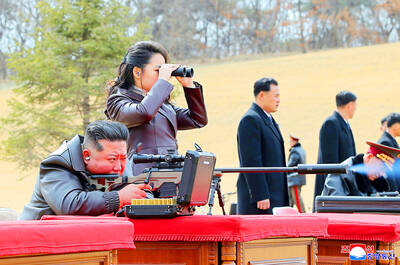
LIKE FATHER, LIKE DAUGHTER: By showing Ju-ae’s ability to handle a weapon, the photos ‘suggest she is indeed receiving training as a successor,’ an academic said North Korea on Saturday released a rare image of leader Kim Jong-un’s teenage daughter firing a rifle at a shooting range, adding to speculation that she is being groomed as his successor. Kim’s daughter, Ju-ae, has long been seen as the next in line to rule the secretive, nuclear-armed state, and took part in a string of recent high-profile outings, including last week’s military parade marking the closing stages of North Korea’s key party congress. Pyongyang’s official Korean Central News Agency (KCNA) released a photo of Ju-ae shooting a rifle at an outdoor shooting range, peering through a rifle scope
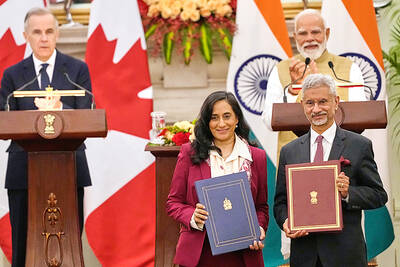
India and Canada yesterday reached a string of agreements, including on critical mineral cooperation and a “landmark” uranium supply deal for nuclear power, the countries’ leaders said in New Delhi. The pacts, which also covered technology and promoting the use of renewable energy, were announced after Indian Prime Minister Narendra Modi and Canadian Prime Minister Mark Carney hailed a fresh start in the relationship between their nations. “Our ties have seen a new energy, mutual trust and positivity,” Modi said. Carney’s visit is a key step forward in ties that effectively collapsed in 2023 after Ottawa accused New Delhi
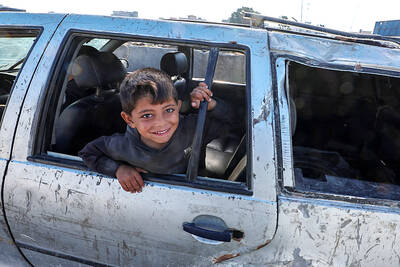
Gaza is rapidly running out of its limited fuel supply and stocks of food staples might become tight, officials said, after Israel blocked the entry of fuel and goods into the war-shattered territory, citing fighting with Iran. The Israeli military closed all Gaza border crossings on Saturday after announcing airstrikes on Iran carried out jointly with the US. Israeli authorities late on Monday night said that they would reopen the Kerem Shalom crossing from Israel to Gaza yesterday, for “gradual entry of humanitarian aid” into the strip, without saying how much. Israeli authorities previously said the crossings could not be operated safely during
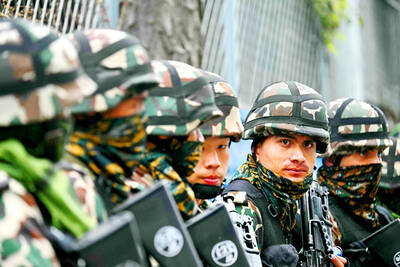
Counting was under way in Nepal yesterday, after a high-stakes parliamentary election to reshape the country’s leadership following protests last year that toppled the government. Key figures vying for power include former Nepalese prime minister K. P. Sharma Oli, rapper-turned-mayor Balendra Shah, who is bidding for the youth vote, and newly elected Nepali Congress party leader Gagan Thapa. In Kathmandu’s tea shops and city squares, people were glued to their phones, checking results as early trends flashed up — suggesting Shah’s centrist Rastriya Swatantra Party (RSP) was ahead. Nepalese Election Commission spokesman Prakash Nyupane said the counting was ongoing “in a peaceful manner”


 RSS
RSS