


Usually at a wedding, the biggest cheer follows the kiss. At the long-awaited wedding of Ron van Houwelingen and Antony McManus, the thunderous applause came somewhat earlier.
“Marriage as we know it in Australia — are you ready for this?” celebrant Coral Teague asked, standing beside the couple on the stage at the David Williamson Theatre at Melbourne Polytechnic in Prahran, where they met as students in 1987.
Teague paused before saying the words Van Houwelingen and McManus fought for 30 years to enact.

Photo: EPA
Until Dec. 7 last year, the Australian Marriage Act had specified that marriage was between a man and a woman.
The auditorium cheered. Many of the guests had campaigned alongside Van Houwelingen and McManus in Equal Love Victoria or have roots stretching further back, to the start of the HIV/AIDS epidemic, when one grand lady hosted annual Christmas dinners for men whose partners had gone and whose families did not want them.
The ceremony was more than just a wedding, more than a celebration of love. It was a triumphant victory party, a sincere thank you to the 61.6 percent of Australians who voted yes in the postal survey on marriage equality and a raised middle finger to the politicians who made that vote necessary.
“Ron, together we fought for this,” McManus said in his vows. “And, darling man, we won.”
It was the 17th time the couple of 30 years had tied the knot, but the first legal ceremony.
“I don’t know how many times I have actually illegally married people, but these two I have married a lot,” Teague said.
They held it at the earliest possible opportunity: yesterday was the first day that same-sex couples could marry, unless they had special circumstances to waive the 30-day waiting period to apply for a marriage license.
Ten-year-old Evie MacDonald, who is one of the faces of the Safe Schools campaign, was the ring bearer. A cast of musical friends, including Katie Underwood, dedicated songs to the couple.
With rainbow flags waving from the seats and the marriage certificate freshly signed, Van Houwelingen turned to the audience.
“Hey, have you met my husband?” he said.
It was a day crowded with nuptials in Australia.
Commonwealth Games relay runner Craig Burns married Luke Sullivan at 12:01am at Tweed Heads, timing their ceremony so that the official, legally binding words were said once the date had ticked over.
In Melbourne, Teegan Daly and Mahatia Minniecon did the same thing.
Three hours later, when midnight struck in Perth, Western Australia, Kelly and Sam Pilgrim-Byrne were married at 12:01am on the steps of state parliament with 10-year-old daughter Charlotte looking on.
Gillian Brady and Lisa Goldsmith, together for eight years, were married at the same time at Perth gay bar The Court.
Kelly Pilgrim-Byrne told Australia Broadcasting Corp after the ceremony that, despite being together for 24 years, the couple had never planned their wedding day.
“It was never anything we considered because it was never anything that was available to us,” she said. “So we never had those dreams about what would our wedding look like, we never, ever considered it, because we never thought it would happen in our lifetime.”
In Tasmania, Roz Kitschke and Lainey Carmichael were married in a 5:30am ceremony in the gardens of their Franklin home. Long-time marriage equality advocate Rodney Croome was there.
“The joy and happiness at this morning’s wedding was proof, should it still be needed, that love is love,” Croome said.
At the more civilized hour of 8am, Rebecca Hickson married her partner of nine years, Sarah Turnbull, in Newcastle. It was the second wedding for the couple — Hickson told Australian Associated Press they had their “big hoo-ha ceremony” three years ago and were reaffirming those vows.
At the Van Houwelingen and McManus wedding, cabaret artist Mama Alto, singing Etta James, put it best: “Equal love at last.”
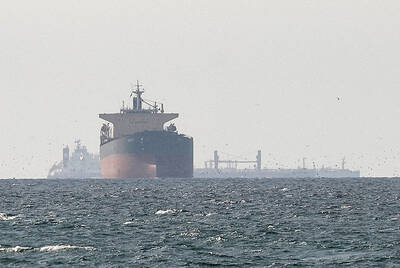
A ship that appears to be taking on the identity of a scrapped gas carrier exited the Strait of Hormuz on Friday, showing how strategies to get through the waterway are evolving as the Middle East war progresses. The vessel identifying as liquefied natural gas (LNG) carrier Jamal left the Strait on Friday morning, ship-tracking data show. However, the same tanker was also recorded as having beached at an Indian demolition yard in October last year, where it is being broken up, according to market participants and port agent’s reports. The ship claiming to be Jamal is likely a zombie vessel that

German Chancellor Friedrich Merz’s conservative Christian Democratic Union (CDU) yesterday faced a regional election battle in Rhineland-Palatinate, now held by the center-left Social Democratic Party (SPD). Merz’s CDU has enjoyed a narrow poll lead over the SPD — their coalition partners at the national level — who have ruled the mid-sized state for 35 years. Polling third is the far-right Alternative for Germany (AfD), which spells a greater threat to the two centrist parties in several state elections in September in the country’s ex-communist east. The picturesque state of Rhineland-Palatinate, bordering France, Belgium and Luxembourg and with a population of about 4 million,

LAW CONSTRAINTS: The US has been pressing allies to send warships to open the Strait, but Tokyo’s military actions are limited under its postwar pacifist constitution Japan could consider deploying its military for minesweeping in the Strait of Hormuz if a ceasefire is reached in the war on Iran, Japanese Minister of Foreign Affairs Toshimitsu Motegi said yesterday. “If there were to be a complete ceasefire, hypothetically speaking, then things like minesweeping could come up,” Motegi said. “This is purely hypothetical, but if a ceasefire were established and naval mines were creating an obstacle, then I think that would be something to consider.” Japan’s military actions are limited under its postwar pacifist constitution, but 2015 security legislation allows Tokyo to use its Self-Defense Forces overseas if an attack,

Ugandan wildlife authorities have reintroduced rhinos into a remote protected area where they were once poached into extinction, an event seen by conservationists as a milestone in efforts to support the recovery of a species threatened by poaching. On Tuesday, two southern white rhinos from a private ranch in the East African country were reintroduced into Kidepo Valley National Park in the country’s northeast. Two more rhinos in metallic crates arrived on Thursday. There have been no rhinos in the park since 1983, the result of poaching. However, a private ranch in central Uganda — the Ziwa Rhino Sanctuary — has been


 RSS
RSS