


Tributes to Chinese President Xi Jinping (習近平), the man now seen as China’s most powerful ruler since Mao Zedong (毛澤東), have come in myriad forms: Xi Jinping tapestries, oil paintings, pop songs, exhibitions and even university departments.
Now he has received a hardwood homage with reports that senior Chinese Communist Party (CCP) officials have made a pilgrimage to a tree honoring their country’s increasingly supreme leader.
Following what US President Donald Trump termed Xi’s “extraordinary elevation” at the CCP’s 19th National Congress last month, officials in Henan Province decided to express their allegiance by gathering around a Paulownia tree planted by then-CCP Politburo Standing Committee member Xi in April 2009.
As the cadres, includig CCP Henan Party Secretary Xie Fuzhan (謝伏瞻), gazed up at its branches in the morning on Sunday last week, “they were immersed in thought, filled with deep emotions,” a local propaganda report described.
“The tree is big, verdant and tall,” the author of the story gushed. “[Locals] warmly call it the Xi Paulownia tree.”
An accompanying video showed a group of almost entirely male leaders being escorted toward the arboricultural accolade by a female hostess.
“Eight years have passed [since Xi’s visit] and the tree has grown enormous and leafy,” she says.
The Xi tree is the latest exhibit in what some see as a mounting body of evidence suggesting a nascent Mao-style cult of personality is being built around China’s leader.
Those suspicions grew last month after Xi’s political ponderings were officially enshrined in the CCP constitution and Chinese universities began unveiling departments that would delve into what is now known as Xi Jinping Thought on Socialism with Chinese Characteristics in the New Era.
Speaking to reporters earlier this month, Xie Chuntao (謝春濤), an academic at the Central Party School in Beijing, admitted that Xi enjoyed “a larger individual role” in Chinese politics, but rejected the suggestion that the blind worship of one man was being revived.
“The Chinese Communist Party has had a cult of personality before,” Xie told Reuters reporters. “The lesson has long been had, and I believe this will not reoccur.”
However, Fordham University professor of law Carl Minzner, who wrote End of an Era, an upcoming book about Xi’s authoritarian tack, said he saw a clear and troubling shift back toward the elevation of a single figurehead.
“In the long term, that has really deleterious impacts for governance in China,” he said.
Beijing begs to differ and last week launched a sequel to Xi’s tome on exactly that topic, The Governance of China. The book’s second volume reportedly boasts no less than 29 photographs of Xi, as well as 99 of his texts.
The China Daily, the CCP’s English-language mouthpiece, described it as “groundbreaking” and “reader-friendly.”
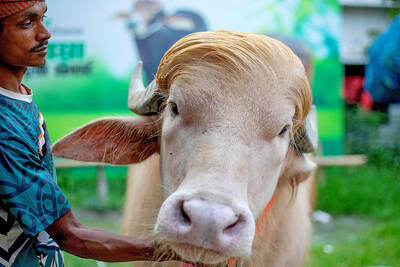
Crowds in Bangladesh are flocking to snap photographs with an unlikely social media star — an albino buffalo with flowing blond hair nicknamed “Donald Trump” that is due to be sacrificed within days. Owner Zia Uddin Mridha, 38, said his brother named the 700kg bull over its flowing helmet of hair resembling the signature look of the US president. “My younger brother picked this name because of the buffalo’s extraordinary hair,” he said at his farm in Narayanganj, just outside the capital, Dhaka. Mridha said that a constant stream of curious visitors — social media fans, onlookers and children — have come throughout

It began as a satirical online project. Now millions of young people in India are flocking to it as an outlet for their frustration. A parody political party called the Cockroach Janta Party, with the insect as its symbol, has exploded across India’s social media by turning absurdist humor into protest. Memes and short videos mocking corruption, joblessness and political dysfunction have flooded social media sites, where millions of users are embracing the cockroach — known for its ability to survive harsh conditions — as a tongue-in-cheek symbol of endurance. The online movement’s rise has been unusually rapid. The Cockroach Janta Party (CJP)
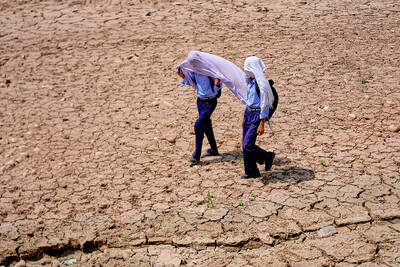
HOTTER: While Indians are accustomed to summer heat, climate change has caused northwestern India to warm faster than other parts of the country, an academic said Roads and markets have emptied during afternoons and some farmers have switched to nighttime work to avoid scorching temperatures as a heat wave grips large parts of India. The India Meteorological Department forecast maximum temperatures for yesterday of about 45°C in the capital, New Delhi, where authorities have opened temporary “cooling zones” to help people cope. The weather department warned that conditions would likely persist across several northern regions in the coming days, with temperatures staying well above seasonal averages. Authorities urged people to stay indoors during the hottest hours and take precautions against heat-related illnesses. India declares a heat wave whenever maximum temperatures

BIGGER ROLE: Beijing has said it maintains an impartial stance on the war in Ukraine, but by training Russian troops, China is far more involved than previously known China’s armed forces secretly trained about 200 Russian military personnel in China late last year, and some have since returned to fight in Ukraine, according to three European intelligence agencies and documents seen by Reuters. While China and Russia have held a number of joint military exercises since Moscow’s full-scale invasion of Ukraine in 2022, Beijing has repeatedly said that it is neutral in the conflict and presents itself as a peace mediator. The covert training sessions, which predominantly focused on the use of drones, were outlined in a dual-language Russian-Chinese agreement signed by senior Russian and Chinese officers in Beijing on


 RSS
RSS