


Claudia Colimoro still remembers the day she met Rosa, a 12-year-old girl sent to the shelter she runs after being sold into sex slavery twice and getting pregnant for the second time.
Rosa — a pseudonym — is one of hundreds of thousands of teens and preteens who get pregnant each year in Mexico, a worsening problem caused by minors having unprotected sex at an early age, but also by horrific violence against women and girls.
Colimoro runs a shelter called Casa Mercedes in Mexico City that takes in pregnant girls with nowhere else to go, pays for their education and helps them raise their babies if they decide to keep them.
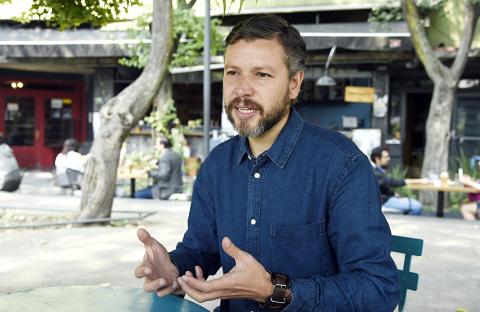
Photo: AFP
Rosa was not yet a teenager when she arrived at Casa Mercedes, but she had already been sold into prostitution twice by her own mother.
Her family comes from central Puebla State, which has a picturesque colonial capital that belies a much darker side: It is also home to networks of human traffickers who force women and girls into prostitution.
“She got pregnant from being forced into sex work, because her mother had sold her,” Colimoro said. “The first time, she refused to believe her own mother had sold her. She ran away, went home to her mom asking for help, and her mom sold her again.”
The second time Rosa got pregnant, she was sent by a court to Casa Mercedes.
As Colimoro does for all the girls who pass through her privately run shelter, she educated her about her options — adoption, abortion or motherhood.
Colimoro addressed the issue of teen pregnancy this week at Women’s Forum Mexico, a gathering of leaders and activists meant to generate creative ideas on gender issues in a country where inequality is rife and violence against women is soaring.
Mexico has the worst teen pregnancy rate in the Organisation for Economic Co-operation and Development at 77 births per 1,000 girls aged 15 to 19.
The statistic does not even capture the youngest girls affected.
“One in six pregnancies in this country, nearly 20 percent, are girls between 10 and 19 years old,” Mexican Secretary of the Interior Miguel Osorio Chong said recently.
Most girls who get pregnant before the age of 15 are victims of “some kind of physical violence,” he said.
And the problem is getting worse — the teen pregnancy rate rose by nearly 10 percent from 2014 to last year.
Early sexual activity has played a part in the increase, said Maria del Carmen Juarez of the National Women’s Institute.
However, the problem goes deeper.
There is also a “cluster of risk” involving crime, drugs, alcohol, physical abuse and child sex slavery, she said.
Those are the factors that tend to be involved in the cases of girls who end up at Casa Mercedes, such as Teresa Garcia.
Garcia, 25, arrived at the shelter when she was 14 years old. She gave birth to her son soon after, and has lived there with him since, studying for a law degree that she completed just days ago.
She grins when contemplating the new life that now awaits her, but it was not easy to get here.
“When you’re that age, all you want to do is talk with your friends, go out, but I couldn’t do any of that. I had to take care of my son,” she said.
In the courtyard, fellow resident Rosalba Vazquez is playing with her two kids, aged four and five.
She is 19 years old, but looks younger with her slender build and face partly hidden by a curly mane of hair. She has managed to finish high school since moving to the shelter and is now studying at a private university on a full scholarship.
“I dream of finishing my degree and becoming a professional dancer,” she said. “And as a mother, watching my kids grow up right and finishing their own education.”
That is the best hope for fighting teen pregnancy, said Christian Rodriguez, an Uruguayan photojournalist and child of a teenage mother who has traveled around Latin America documenting the subject.
Rodriguez, who also spoke at the forum, said the same problems can be seen throughout the region: poverty, gender violence and deep inequality.
“There are girls whose only prospect in life is to become mothers. One of the things we have to do is give those girls the same opportunities,” he said. “The best contraceptive out there is to give someone a real, possible dream in life.”

‘CROSSING THE LINE’: China’s embassy in Seoul criticized US Forces Korea Commander General Xavier Brunson, asking if his ‘hostile’ remarks were authorized by Washington South Korea and the US are in talks over recent public remarks by the commander of US Forces Korea, Seoul’s presidential office said yesterday, after the comments drew sharp criticism from China. In a recent podcast interview, US Forces Korea Commander General Xavier Brunson described South Korea as “the dagger in the heart of Asia” from China’s east coast, prompting the Chinese embassy in Seoul to say that he had “truly crossed the line.” The interview came amid growing speculation that Washington might seek to expand the role of US Forces Korea in countering the growing regional influence of China, a key

SEEKING ORDER: Rodrigo Paz said that ‘anyone who wants to destroy the nation will have to deal with this president and the full force of the constitution’ Bolivian President Rodrigo Paz on Wednesday said that the nation was at a “breaking point” after nearly a month of protests that have caused shortages of food, fuel and medicine. Paz, who took office six months ago amid the worst economic crisis there in four decades, is battling a groundswell of fury over his policies. The political capital, La Paz, has been besieged by low-income workers and members of the indigenous majority calling for his resignation. “The country needs order and is reaching breaking point,” the 58-year-old said at a public event in La Paz, renewing his appeal for dialogue. On Tuesday, the Bolivian

Forecasters in Europe yesterday warned of exceptional heat as record temperatures driven by a “heat dome” push temperatures well above seasonal norms across the continent. The surge follows a record-breaking Monday, with France logging its hottest day in the month of May on record, its weather agency said, and the UK also posting unprecedented highs. A so-called “heat dome” of warm air from northern Africa trapped under a high-pressure system over western Europe is behind the high temperatures not usually seen until high summer. Restrictions on outdoor work were imposed in parts of Italy, beaches in southwest France filled earlier than usual and

Australian researchers have trained lab-grown brain cells on a silicon computer chip to play the 1990s shooter game Doom and said they are just scratching the surface of what the neurons could be capable of doing. It is the science-fiction work of biotech boffins at Cortical Labs, who researched and developed the technology that harnesses the workings of the brain’s networking system. Each so-called “biological computer” contains about 200,000 living human brain cells, grown from stem cells that were harvested from blood donations. Having mastered the simple computer game Pong, where a paddle is moved up and down to send a ball


 RSS
RSS