


Armed groups in Central African Republic (CAR) are using rape and sexual slavery as weapons of war in an abuse that may amount to crimes against humanity, a rights group said yesterday.
Thousands have died and a fifth of Central Africans have been uprooted in a conflict that broke out after the mainly Muslim Seleka rebels ousted former Central African Republic president Francois Bozize in early 2013, provoking a backlash from Christian anti-balaka militias.
Both the Seleka and the anti-balaka have sexually assaulted, raped and enslaved civilians as revenge against those believed to be supporting the other side, Human Rights Watch (HRW) said.
Yet not a single militant on either side of the conflict has been arrested or tried for sexual violence, HRW said.
“Armed groups are using rape in a brutal, calculated way to punish and terrorize women and girls,” HRW researcher Hillary Margolis said following the release of a report documenting 305 cases of rape and sexual slavery against women and girls.
“Under international law, these offences ... may be considered crimes against humanity and war crimes,” HRW said.
Victims told HRW how militants often raped them in front of their children, and abused, attacked and killed their relatives.
Many women and girls were whipped, tied up and burned, and gang raped repeatedly while being held as sex slaves, HRW said.
“Every day we could not rest — every day there was rape, by different fighters,” 30-year-old Jeanne, who was held captive by Seleka fighters for six months in 2014, told the rights group.
Stigma, impunity for attackers and a dysfunctional justice system have prevented many victims from speaking out, HRW said.
Only 11 of the 296 survivors interviewed by HRW said they had tried to seek justice, with some victims blamed for their ordeal and others told to present their attackers for arrest.
Most victims said they had not received post-rape medical or mental healthcare — such as drugs to prevent HIV and unwanted pregnancy — due to a lack of health facilities, the cost of services or transport, and misconceptions about their options.
“Every day, survivors live with the devastating aftermath of rape, and the knowledge that their attackers are walking free, perhaps holding positions of power, and to date facing no consequences whatsoever,” Margolis said in a statement.
Widespread killings and rapes of civilians by militants in Central African Republic — where militia violence has risen this year — have also been documented by the UN and other rights groups, such as Amnesty International.
The UN is helping the government to establish a Special Criminal Court, agreed to in 2015, to try the worst crimes committed in the landlocked nation.

PHISHING: The con might appear convincing, as the scam e-mails can coincide with genuine messages from Apple saying you have run out of storage For a while you have been getting messages from Apple saying “your iCloud storage is full.” They say you have exceeded your storage plan, so documents are no longer being backed up, and photos you take are not being uploaded. You have been resisting Apple’s efforts to get you to pay a minimum of £0.99 (US$1.33) a month for more storage, but it seems that you cannot keep putting off the inevitable: You have received an e-mail which says your iCloud account has been blocked, and your photos and videos would be deleted very soon. To keep them you need

For two decades, researchers observed members of the Ngogo chimpanzee group of Kibale National Park in Uganda spend their days eating fruits and leaves, resting, traveling and grooming in their tropical rainforest abode, but this stable community then fractured and descended into years of deadly violence. The researchers are now describing the first clearly documented example of a group of wild chimpanzees splitting into two separate factions, with one launching a series of coordinated attacks against the other. Adult males and infants were targeted, with 28 deaths. “Biting, pounding the victim with their hands, dragging them, kicking them — mostly adult males,
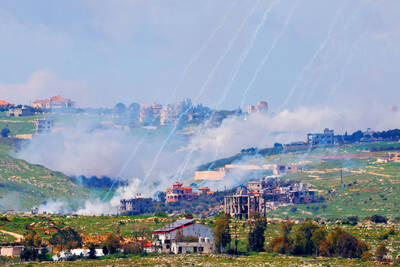
The Israeli military has demolished entire villages as part of its invasion of south Lebanon, rigging homes with explosives and razing them to the ground in massive remote detonations. The Guardian reviewed three videos posted by the Israeli military and on social media, which showed Israel carrying out mass detonations in the villages of Taybeh, Naqoura and Deir Seryan along the Israel-Lebanon border. Lebanese media has reported more mass detonations in other border villages, but satellite imagery was not readily available to verify these claims. The demolitions came after Israeli Minister of Defense Israel Katz called for the destruction of

SUPERFAN: The Japanese PM played keyboard in a Deep Purple tribute band in middle school and then switched to drums at university, she told the British rock band Legendary British rock band Deep Purple yesterday made Japanese Prime Minister Sanae Takaichi’s day with a brief visit to their high-profile superfan as they returned to the nation they first toured more than half a century ago. Takaichi’s reputation as an amateur drummer, and a fan of hard rock and heavy metal has been well documented, and she has referred to Deep Purple as one of her favorite bands along with the likes of Black Sabbath and Iron Maiden. “You are my god,” a giddy Takaichi said in English to Deep Purple drummer Ian Paice, presenting him with a set of made-in-Japan


 RSS
RSS