


They grew up in the US and are working or going to school in the nation. Some are building businesses or raising families of their own. Many have no memory of the nation where they were born.
Now, almost 800,000 young immigrants who were taken to the US illegally as children or overstayed their visas could see their lives upended after the administration of US President Donald Trump on Tuesday announced it is ending the Obama-era program that protected them from deportation.
“We are Americans in heart, mind and soul. We just don’t have the correct documentation that states we’re American,” said Jose Rivas, 27, who is studying for a master’s in counseling at the University of Wyoming.
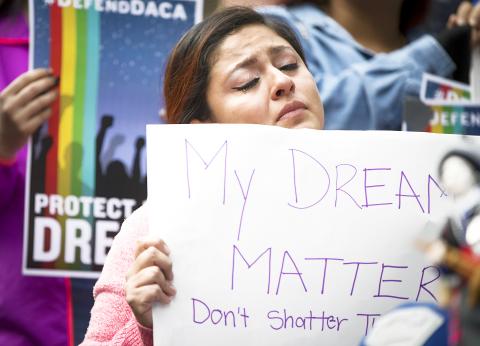
Photo: AP
The news that the US government is phasing out the Deferred Action for Childhood Arrivals (DACA) program was met with shock, anger and a sense of betrayal by its beneficiaries, often called “Dreamers.”
For opponents, many said they were pleased the Trump administration had put an end to former US president Barack Obama’s DACA program, calling it an unconstitutional abuse of executive power.
US Attorney General Jeff Sessions, who made Tuesday’s announcement, said DACA was an “overreach” that could not be defended by the US Department of Justice.
The Trump administration and other DACA opponents argue that it is up to the US Congress to decide how to deal with such immigrants.
However, late on Tuesday night, Trump tweeted that he might get involved in the issue if the US Congress does not come up with legislation.
“Congress now has 6 months to legalize DACA (something the Obama Administration was unable to do). If they can’t, I will revisit this issue!” Trump tweeted.
Demonstrations on Tuesday broke out in New York City, where police handcuffed and removed more than a dozen immigration activists who briefly blocked Trump Tower, and in other cities, including Salt Lake City, Denver, Los Angeles and Portland. Students walked out of class in protest in several cities, including Phoenix and Albuquerque.
Attorneys general for several states threatened to sue to protect the DACA beneficiaries.
“We stand ready to take all appropriate legal action to protect Oregon’s Dreamers,” Oregon Attorney General Ellen Rosenblum tweeted.
Utah Attorney General Sean Reyes, a Republican and an early Trump supporter, said the president has every right to end DACA, which was started by Obama in 2012, but he added that it would be unconscionable to deport those who benefited from the program.
“These children grew up believing they are American and so many of them have lived lives of which America can be proud,” Reyes said.
At a Los Angeles rally, handyman John Willis carried a sign saying: “American lives matter” and criticized the DACA program as an “unlawful tyrannical executive order that our previous president thrust upon us.”
“I don’t wish these kids to be sent back to Mexico or anything like that, but I don’t believe we should have two sets of laws,” Willis said. “We have one set of laws, we should follow them. Congress needs to get up off the pot and enact some legislation to take care of this mess.”
Trump’s action received harsh reviews among those in Houston, Texas, who have been helping immigrants navigate disaster relief amid fears of ramped-up deportations in the new administration.
The city is home to more than half a million immigrants in the US illegally and one DACA recipient described at a news conference how her family lost everything in the storm.
Another Houston DACA beneficiary, Ricardo Ortiz, who was brought to the US from Monterrey, Mexico, aged three, has been volunteering at the downtown convention center that sheltered thousands of storm victims.
“It’s crazy that people really think that we don’t belong here when we’ve been here all of our lives,” said Ortiz, a 21-year-old student at the University of Houston.
In Miami, Paola Martinez, 23, who is from Bogota, Colombia, sobbed as she attended a rally of about 100 immigrants. She said she will feel helpless without DACA. She recently graduated with a civil engineering degree from Florida International University.
“Instead of going a step forward, we are going a step backwards. We are hiding in the shadows again after my work [permit] expires. It’s just sadness,” Martinez said. “You just feel like you are empty. There is no support anymore.”
Martinez said she is not able to renew her permit because it expires in 2019, so she is hoping her employer or another company sponsors her so she can stay and help support her parents, who depend on her for rides and household expenses.
In Florida, immigrants who are illegally in the US cannot get driver’s licenses.
Karen Marin, a 26-year-old from New York whose parents took her to the US from Mexico before she was a year old, was in physics class at Bronx Community College when Sessions made the announcement.
“I honestly can’t even process it right now. I’m still trying to get myself together,” Marin said. “I just hope that they do change their mind and they realize what they’re doing is wrong.”
Carla Chavarria, 24, is a Phoenix entrepreneur who owns a digital marketing firm and a fitness apparel line. She traveled to the US from Mexico when she was seven.
Her permit expires in November and she is waiting for her renewal to be processed.
She is set to close on the purchase of a home later this month.
“It’s hard being a business owner as it is, especially with being young, and being a woman and someone who’s an immigrant. It’s already hard as it is. Now having DACA being taken away, I’m sort of like in limbo right now,” Chavarria said.
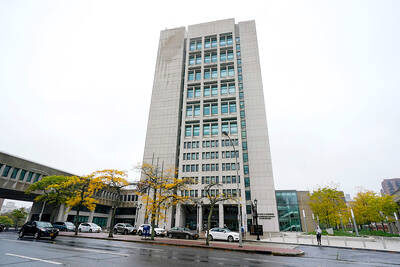
A coalition of civil rights groups on Tuesday asked a New York State judge to order one of its largest suburban counties to stop its deployment of nearly 600 license plate readers, calling it a warrantless and “indiscriminate surveillance system” that violates the state constitution. The class action lawsuit also alleged that Westchester County never got proper authorization to launch the program, which has amassed a database of 1.6 billion plate scans that has been shared with more than 50 outside law enforcement agencies. The complaint said the network “records the long-term travel patterns, daily habits, and intimate information of millions of

Pope Leo XIV on Wednesday blessed a giant new tower at Barcelona’s famed Sagrada Familia Basilica after celebrating mass inside what is now the world’s tallest church. A fireworks and light show illuminated the exterior of the temple at the end of the ceremony, bathing the unfinished basilica in shifting colours that highlighted its towering spires. A choir of 600 singers performed at the service which lasted around 90 minutes and was attended by Spanish Prime Minister Pedro Sanchez as well as King Felipe VI and Queen Letizia. The stained-glass windows in various colours shone brightly in between the tree-like

Voters in Switzerland yesterday cast their ballots on an initiative championed by the top right-wing party to cap the Alpine country’s population at 10 million. As of press time last night, early results showed that Swiss voters were leaning against it. The populist Swiss People’s Party, which has the most seats in parliament, has stirred up and fostered anti-migration sentiment over the years, notably about an influx of workers from the neighboring EU. Critics called the bid a self-inflicted wound, saying the boom in migration over the past generation has brought foreign labor and skills to sectors such as healthcare, finance, pharmaceuticals

Scientists have discovered communities of marine life — including jellyfish, tubeworms and brittle stars — thriving on a whale graveyard. The graveyards form when whale carcasses fall to the sea floor, becoming a sustaining snack for nearby critters. This one, which is up to 7km below the surface of the southeastern Indian Ocean, spans the largest area, and is so far the deepest found. A whale’s sheer size and the unique chemistry of its bones are the keys to forming these unique underwater neighborhoods, said Song Xikun (宋希坤), a biologist with the Chinese Academy of Sciences’ Institute of Deep-sea Science and Engineering


 RSS
RSS