


Within them sits about 80,000 years of history, offering researchers tantalizing clues about climate change and the Earth’s past. At least that was the case — until the precious cache of Arctic ice cores was hit by warming temperatures.
A freezer malfunction at the University of Alberta in Edmonton has melted part of the world’s largest collection of ice cores from the Canadian Arctic, reducing some of the ancient ice into puddles.
“For every ice-core facility on the planet, this is their No. 1 nightmare,” glaciologist Martin Sharp said.
The ice cores — long cylinders extracted from glaciers — contain trapped gases and particles that offer a glimpse into atmospheric history.
“When you lose part of an ice core,” Sharp said. “You lose part of the record of past climates, past environments — an archive of the history of our atmosphere. You just don’t have easy access to information about those past time periods.”
The university had recently acquired the dozen cores, or 1.4km of ice, drilled from five locations in the Canadian Arctic, and carefully transported them from Ottawa to Edmonton.
The samples were moved into the university’s brand new, custom-built C$4 million (US$3 million) facility earlier this month. Days later, one of the freezers tripped a high-heat alarm.
“The way in which the freezer failed meant that it started to pump heat into the freezer,” Sharp said. “So it wasn’t just a question of it gradually warming up... It was actually quite rapidly raised to a temperature of 40?C.”
Sharp rushed to the walk-in storage freezer to survey the damage and found steaming puddles gathered around the millennia-old ice.
“It was more like a changing room in a swimming pool than a freezer,” he said.
About 13 percent of the archive had been exposed to high heat, representing more than 180m of ice. None of the cores were completely destroyed.
“There are some which are clearly toast and there are others which are not obviously very much affected,” Sharp said.
An ice core from the Penny Ice Cap on Baffin Island lost about a third of its mass, amounting to about 22,000 years of history, while a core from Mount Logan, Canada’s tallest mountain, saw 16,000 years melted away.
However, much of the collection was unaffected by the malfunction, thanks to a stroke of luck.
A television crew had been documenting the ice core move and had asked that the samples be put in a second freezer because the lighting was better. The university complied, storing nearly 90 percent of the collection in an unaffected freezer.
“That’s basically what saved us,” Sharp said.
The question is now whether any research can be carried out on the affected cores.
“This incident will affect research, no question,” Sharp said. “It rules out certain studies that we might have wanted to conduct on the cores, such as reconstructing continuous long-term histories where parts of the cores have been lost or contaminated.”
As returning to the Arctic to replace the damaged ice cores would be a costly endeavor, the focus is now on regularly monitoring and safeguarding the ice cores that are left.
“It’s by no means a write-off from a scientific point of view,” Sharp said. “It’s just disappointing to have this happen at all.”

Through the noise of rushing papers and whirring belts at a print factory in Kyoto, two creators watch their photo essay come to life in broadsheet form — part of an effort to win new audiences in the age of artificial intelligence (AI). Despite the decline of the publishing industry, self-publication and handmade “zine” magazines are growing in popularity in Japan, reflecting the nation’s enduring love of paper in the digital era. While speaking to Agence France-Presse at the plant, his hands black with ink, one of the creators, Kazuma Obara, said: “I think [paper] is a medium that engages all five
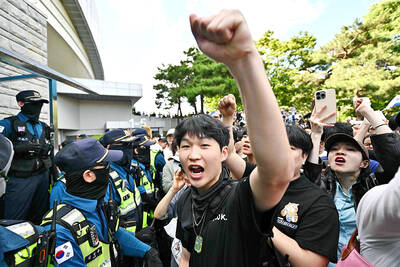
‘ABSURD MISTAKE’: The election commission said that there had been a failure to anticipate turnout after 14 polling stations ran short of ballot papers South Korean riot police yesterday cleared protesters from a Seoul polling station after a 35-hour blockade sparked by a shortage of ballot papers during local elections earlier this week. Wednesday’s election was the first nationwide vote since South Korean President Lee Jae-myung took office following the ouster of Yoon Suk-yeol over his short-lived martial law declaration. Lee’s ruling Democratic Party swept most races, but failed to flip the crucial Seoul mayoral seat. The South Korean National Election Commission apologized, blaming a failure to anticipate turnout after 14 polling stations in Seoul ran short of ballot papers. Some polling stations stayed open until 10pm to

Australian researchers have trained lab-grown brain cells on a silicon computer chip to play the 1990s shooter game Doom and said they are just scratching the surface of what the neurons could be capable of doing. It is the science-fiction work of biotech boffins at Cortical Labs, who researched and developed the technology that harnesses the workings of the brain’s networking system. Each so-called “biological computer” contains about 200,000 living human brain cells, grown from stem cells that were harvested from blood donations. Having mastered the simple computer game Pong, where a paddle is moved up and down to send a ball

France experienced its hottest spring on record, the French weather service said on Tuesday, after an exceptional early heat wave that also broke highs for the season in England and Wales. Meteo-France said the average nationwide temperature over March to May was 13.8°C — about 1.7°C above the norm, and surpassing records set in 2011 and 2020. “The warmest spring since records began in 1900,” it said in a bulletin. All three months were warmer than average, but the onset of an “unprecedented heatwave” late last month pushed the mercury to highs typically seen at the height of the summer. “Our country had never


 RSS
RSS