


Hunger, malnutrition and death threaten 6.5 million children in the impoverished drylands of Somalia, Ethiopia and Kenya due to back-to-back droughts, a charity said on Friday, with spring rains also predicted to be poor.
Repeated rain failures have pushed 15 million people across the three countries into crisis, and in need of aid, as their animals are dying and water is in short supply, Save the Children said.
“The situation for already desperate children and families in Somalia, Ethiopia and Kenya will only get worse — leaving millions at risk of hunger, and even death,” said John Graham, the charity’s Ethiopia country director.
The next rainy season is likely to bring more below-average rainfall across the region, experts predict.
About 500,000 children already have severe acute malnutrition, Save the Children said, which means they risk dying without emergency intervention.
Donors, political leaders and the UN Secretary-General Antonio Guterres are meeting at the African Union (AU) summit which opens tomorrow in Ethiopia.
Guterres was the UN’s refugee chief during Somalia’s 2011 famine, in which 260,000 died due to drought, conflict and a ban on food aid in territory held by the militant group al-Shabaab.
The UN warned this month that Somalia, crippled by decades of war, risks slipping back into famine as 5 million people, or more than four out of 10 residents, do not have enough food.
Fighting between al-Shabaab and Somalia’s AU-backed government continues. AU and Somalian troops have driven al-Shabaab from major urban strongholds and ports, but they have often struggled to defend smaller, more remote areas.
Thousands of Somalians are on the move in search of food and water, many crossing into Ethiopia for assistance, charities say.
Save the Children said there are high rates of malnutrition among children on arrival in Ethiopia’s vast Dollo Ado camp.
Many Somalians have been living in exile for three decades, with almost 1 million in refugee camps in nearby Ethiopia, Kenya, Djibouti and Uganda, where food is also in short supply due to lack of funding.
In Ethiopia, hard hit by drought last year, almost 6 million people need aid.
The Kenya Red Cross Society launched an appeal to the public on Friday for 1 billion Kenyan shillings (US$9.6 million) to provide food vouchers and cash to thousands of hungry families in the north and along the coast.
As livestock deaths are increasing, weak animals will also be slaughtered and the meat donated to schools, orphans, the elderly and sick, it said, adding that the number of Kenyans without enough to eat would almost double by April to 2.4 million from 1.3 million.
“The effects of the drought are escalating,” Kenya Red Cross Society secretary-general Abbas Gullet said. “This should worry us all.”
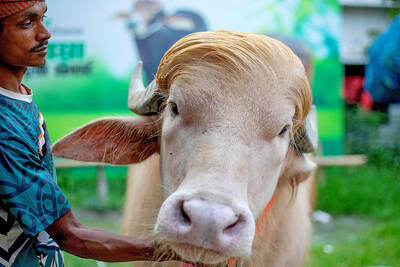
Crowds in Bangladesh are flocking to snap photographs with an unlikely social media star — an albino buffalo with flowing blond hair nicknamed “Donald Trump” that is due to be sacrificed within days. Owner Zia Uddin Mridha, 38, said his brother named the 700kg bull over its flowing helmet of hair resembling the signature look of the US president. “My younger brother picked this name because of the buffalo’s extraordinary hair,” he said at his farm in Narayanganj, just outside the capital, Dhaka. Mridha said that a constant stream of curious visitors — social media fans, onlookers and children — have come throughout

It began as a satirical online project. Now millions of young people in India are flocking to it as an outlet for their frustration. A parody political party called the Cockroach Janta Party, with the insect as its symbol, has exploded across India’s social media by turning absurdist humor into protest. Memes and short videos mocking corruption, joblessness and political dysfunction have flooded social media sites, where millions of users are embracing the cockroach — known for its ability to survive harsh conditions — as a tongue-in-cheek symbol of endurance. The online movement’s rise has been unusually rapid. The Cockroach Janta Party (CJP)

BIGGER ROLE: Beijing has said it maintains an impartial stance on the war in Ukraine, but by training Russian troops, China is far more involved than previously known China’s armed forces secretly trained about 200 Russian military personnel in China late last year, and some have since returned to fight in Ukraine, according to three European intelligence agencies and documents seen by Reuters. While China and Russia have held a number of joint military exercises since Moscow’s full-scale invasion of Ukraine in 2022, Beijing has repeatedly said that it is neutral in the conflict and presents itself as a peace mediator. The covert training sessions, which predominantly focused on the use of drones, were outlined in a dual-language Russian-Chinese agreement signed by senior Russian and Chinese officers in Beijing on
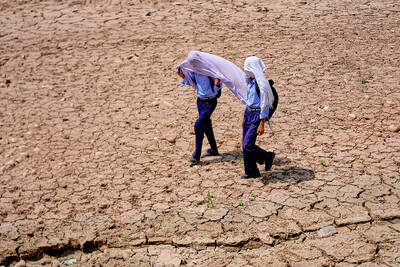
HOTTER: While Indians are accustomed to summer heat, climate change has caused northwestern India to warm faster than other parts of the country, an academic said Roads and markets have emptied during afternoons and some farmers have switched to nighttime work to avoid scorching temperatures as a heat wave grips large parts of India. The India Meteorological Department forecast maximum temperatures for yesterday of about 45°C in the capital, New Delhi, where authorities have opened temporary “cooling zones” to help people cope. The weather department warned that conditions would likely persist across several northern regions in the coming days, with temperatures staying well above seasonal averages. Authorities urged people to stay indoors during the hottest hours and take precautions against heat-related illnesses. India declares a heat wave whenever maximum temperatures


 RSS
RSS