


Warming at the top of the world has gone into overdrive, happening twice as fast as the rest of the globe and extending unnatural heating into fall and winter, according to a new US federal report.
In its annual Arctic Report Card, the National Oceanic and Atmospheric Administration on Tuesday tallied record after record of high temperatures, low sea ice, shrinking ice sheets and glaciers.
Study lead author Jeremy Mathis, the agency’s Arctic research chief, said it shows long-term Arctic warming trends deepening and becoming more obvious, with a disturbing creep into seasons beyond summer, when the Arctic usually rebuilds snow and ice.
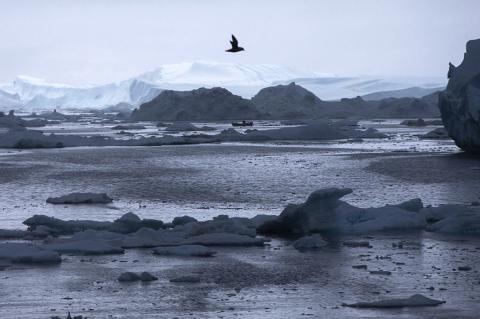
Photo: AP
Scientists have long said that human-induced climate change would hit the Arctic fastest.
Mathis and others said the data is showing that is what is now happening.
“Personally, I would have to say that this last year has been the most extreme year for the Arctic that I have ever seen,” said Mark Serreze, director of the National Snow and Ice Data Center in Boulder, Colorado, who was not part of the 106-page report. “It’s crazy.”
The agency’s peer-reviewed report said air temperatures over the Arctic from October last year to September were “by far the highest in the observational record beginning in 1900.” The average Arctic air temperature at that time was 2°C warmer than the 1981 to 2010 average. It is 3.5°C warmer than 1900.
Other extremes the report detailed: Ocean temperatures were 5°C higher than the 30-year average off the coasts of Greenland.
Arctic sea ice did not set a record for the annual minimum, but in October and last month when sea ice normally starts growing back, it did not.
Sea ice from mid-October through last month was the lowest on record.
Dartmouth University professor Donald Perovich, author of the chapter on sea ice, said sea ice conditions have sunk from a B-plus grade 11 years ago to a D-minus grade “and that’s because I’m an easy grader.”
Snow cover in North America reached a record low for spring, falling below 3.9 million square kilometers in May for the first time since satellite observations began in 1967.
Though not a record, Greenland’s ice sheet continued to shrink, starting early, on April 10. It was the second-earliest start of the Greenland melt season on record.
What is happening is due to artificial warming and a large El Nino that just ended, Mathis said.
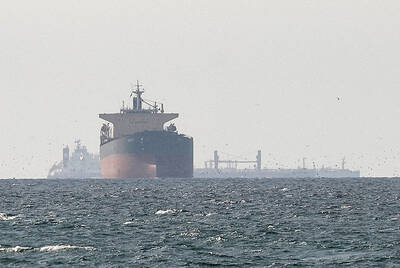
A ship that appears to be taking on the identity of a scrapped gas carrier exited the Strait of Hormuz on Friday, showing how strategies to get through the waterway are evolving as the Middle East war progresses. The vessel identifying as liquefied natural gas (LNG) carrier Jamal left the Strait on Friday morning, ship-tracking data show. However, the same tanker was also recorded as having beached at an Indian demolition yard in October last year, where it is being broken up, according to market participants and port agent’s reports. The ship claiming to be Jamal is likely a zombie vessel that
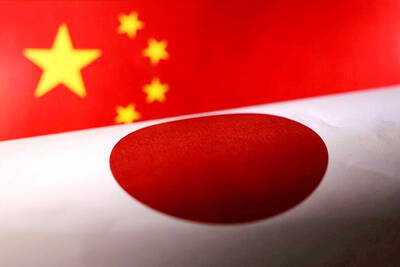
Japan is to downgrade its description of ties with China from “one of its most important” in an annual diplomatic report, according to a draft reviewed by Reuters, as relations with Beijing worsen. This year’s Diplomatic Bluebook, which Japanese Prime Minister Sanae Takaichi’s government is expected to approve next month, would instead describe China as an important neighbor and the relationship as “strategic” and “mutually beneficial.” The draft cites a series of confrontations with Beijing over the past year, including export controls on rare earths, radar lock-ons targeting Japanese military aircraft and increased pressure around Taiwan. The shift in tone underscores a deterioration
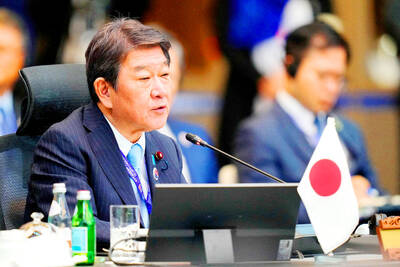
LAW CONSTRAINTS: The US has been pressing allies to send warships to open the Strait, but Tokyo’s military actions are limited under its postwar pacifist constitution Japan could consider deploying its military for minesweeping in the Strait of Hormuz if a ceasefire is reached in the war on Iran, Japanese Minister of Foreign Affairs Toshimitsu Motegi said yesterday. “If there were to be a complete ceasefire, hypothetically speaking, then things like minesweeping could come up,” Motegi said. “This is purely hypothetical, but if a ceasefire were established and naval mines were creating an obstacle, then I think that would be something to consider.” Japan’s military actions are limited under its postwar pacifist constitution, but 2015 security legislation allows Tokyo to use its Self-Defense Forces overseas if an attack,

German Chancellor Friedrich Merz’s conservative Christian Democratic Union (CDU) yesterday faced a regional election battle in Rhineland-Palatinate, now held by the center-left Social Democratic Party (SPD). Merz’s CDU has enjoyed a narrow poll lead over the SPD — their coalition partners at the national level — who have ruled the mid-sized state for 35 years. Polling third is the far-right Alternative for Germany (AfD), which spells a greater threat to the two centrist parties in several state elections in September in the country’s ex-communist east. The picturesque state of Rhineland-Palatinate, bordering France, Belgium and Luxembourg and with a population of about 4 million,


 RSS
RSS