


Leaving Yemen is now an unattainable dream for Abdulsalam Khaled, who cannot travel — despite being awarded a scholarship to pursue his education in India — because of a Saudi-led coalition blockade.
Khaled is one of thousands of people inside and outside Yemen who have been blocked from entering or leaving the war-torn country.
The 34-year-old had been hoping to obtain a master’s degree in English-language studies, but all he can do now is wander the streets of Yemen’s rebel-held capital, Sana’a, lamenting his bad luck.
“Because the airport is closed, I’m now stuck and can’t travel,” he said, showing reporters his scholarship documents.
“There are other airports in Yemen I could have flown from, but unfortunately we can’t reach them because of security problems,” he said.
Yemen has been rocked by conflict since Iran-backed rebels overran Sana’a and other large parts of the country, prompting military intervention by a Saudi-led coalition in March last year in support of the internationally recognized government.
The coalition has since enforced a maritime and air blockade on what was already the Arabian Peninsula’s poorest country.
Several rounds of UN-brokered peace talks aimed at ending the war have been fruitless.
Sana’a International Airport was shut when the coalition resumed airstrikes on Aug. 9 around the city after the last round of peace talks in Kuwait collapsed.
It reopened days later, but only for humanitarian flights, which have to notify the coalition in advance.
Before Aug. 9, the sole operator still serving Sana’a — national carrier Yemenia — ran only a few scheduled commercial flights to Amman, Cairo and Nairobi.
“There are thousands of cases — students, patients, passengers and many others cannot travel,” Sana’a airport chief Khaled al-Shayef said.
Many others have also been stranded outside the country, unable to return home.
Mazen al-Soufi, who directs air traffic at the facility, spoke of “huge damage” caused by the airport’s closure.
“More than 20,000 people stuck outside Yemen want to come home,” he said.
“Many people in critical medical condition die every day because of the siege of Sana’a International Airport,” he said.
Soufi confirmed that there are “students who have lost their seats in universities” because of the blockade.
UN humanitarian coordinator in Yemen Jamie McGoldrick has said that “one of the bigger problems we face” is that “Yemeni air flights still don’t come to Sana’a.”
“We call on all the parties to allow these flights to resume back into Sana’a so that people can get much needed respite,” he told reporters.
Damage to infrastructure has hampered aid deliveries, already threatened by the security situation across the country where al-Qaeda and the Islamic State group have gained ground, especially in the south.
Deputy director of the World Food Program in Yemen Adham Mussallam acknowledges “difficulties in humanitarian work” throughout the country, where millions need food and medical aid.
“Getting permission to bring in aid to Yemen needs four to five months,” he said. “There are a lot of difficulties.”
The warring parties ignored a UN call to renew a fragile 72-hour ceasefire to allow aid deliveries. It officially ended at midnight on Saturday.
The coalition had already said it would continue its air and maritime embargo to prevent weapons shipments reaching the rebels.
However, the coalition did make an exception following one of its deadliest attacks.
On Oct. 8, an air raid on a funeral ceremony killed 140 people and wounded 525, drawing severe criticism of the Arab alliance, which is logistically supported by Washington.
After the raid, which the coalition said took place because of “incorrect information,” the Arab alliance eased the blockade to allow an Omani aircraft to evacuate from Sana’a more than 100 of the most seriously wounded in the strike.
The same aircraft also flew home to Sana’a rebel negotiators, who had been stranded in the Omani capital, Muscat, because of the blockade since the collapse of the peace talks in Kuwait.
Sana’a resident Mohammed al-Wadee said that lifting the blockade is absolutely vital.
“It’s been [almost] two years that the Yemenis have been suffering from the siege and paying a high price” for the war, he said.
Among them is Khaled, his plans for further education shattered.
“I’m unable to get my master’s degree, even in the near future,” he said, shrugging hopelessly.
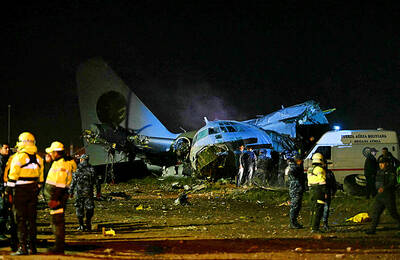
MONEY GRAB: People were rushing to collect bills scattered on the ground after the plane transporting money crashed, which an official said hindered rescue efforts A cargo plane carrying money on Friday crashed near Bolivia’s capital, damaging about a dozen vehicles on highway, scattering bills on the ground and leaving at least 15 people dead and others injured, an official said. Bolivian Minister of Defense Marcelo Salinas said the Hercules C-130 plane was transporting newly printed Bolivian currency when it “landed and veered off the runway” at an airport in El Alto, a city adjacent to La Paz, before ending up in a nearby field. Firefighters managed to put out the flames that engulfed the aircraft. Fire chief Pavel Tovar said at least 15 people died, but

LIKE FATHER, LIKE DAUGHTER: By showing Ju-ae’s ability to handle a weapon, the photos ‘suggest she is indeed receiving training as a successor,’ an academic said North Korea on Saturday released a rare image of leader Kim Jong-un’s teenage daughter firing a rifle at a shooting range, adding to speculation that she is being groomed as his successor. Kim’s daughter, Ju-ae, has long been seen as the next in line to rule the secretive, nuclear-armed state, and took part in a string of recent high-profile outings, including last week’s military parade marking the closing stages of North Korea’s key party congress. Pyongyang’s official Korean Central News Agency (KCNA) released a photo of Ju-ae shooting a rifle at an outdoor shooting range, peering through a rifle scope
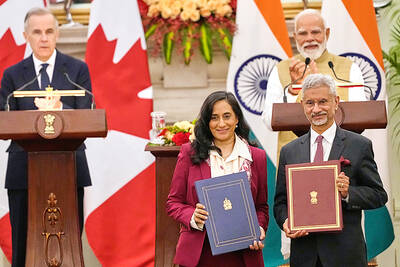
India and Canada yesterday reached a string of agreements, including on critical mineral cooperation and a “landmark” uranium supply deal for nuclear power, the countries’ leaders said in New Delhi. The pacts, which also covered technology and promoting the use of renewable energy, were announced after Indian Prime Minister Narendra Modi and Canadian Prime Minister Mark Carney hailed a fresh start in the relationship between their nations. “Our ties have seen a new energy, mutual trust and positivity,” Modi said. Carney’s visit is a key step forward in ties that effectively collapsed in 2023 after Ottawa accused New Delhi
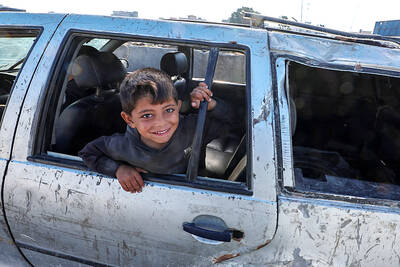
Gaza is rapidly running out of its limited fuel supply and stocks of food staples might become tight, officials said, after Israel blocked the entry of fuel and goods into the war-shattered territory, citing fighting with Iran. The Israeli military closed all Gaza border crossings on Saturday after announcing airstrikes on Iran carried out jointly with the US. Israeli authorities late on Monday night said that they would reopen the Kerem Shalom crossing from Israel to Gaza yesterday, for “gradual entry of humanitarian aid” into the strip, without saying how much. Israeli authorities previously said the crossings could not be operated safely during


 RSS
RSS