


The second time the overloaded bus stalled, passengers stayed put. They had already exited once to push. With the bus stuck on a one-lane mountain dirt road, its occupants stuffed inside and on the roof amid luggage and rice sacks, the driver backed up first to regain uphill momentum.
However, something was horribly wrong: The bus kept going in reverse.
The accident that killed 27 and injured 38 on Monday was not just another tragedy for Nepal, a poor Himalayan country where vehicles careening off unpaved roads are not uncommon.
For this was no ordinary bus trip. Many of the 70-plus passengers piled into the bus were on a journey of recovery after last year’s devastating earthquake that killed 9,000 people and destroyed more than 700,000 homes.
After months of waiting, many were en route to their village, Madan Pudari, 88km from Kathmandu, to sign agreements required to release government grant money to help rebuild their wrecked homes — and lives.
Because of widespread confusion, some mistakenly thought only a few days remained before a 45-day window to sign the agreements expired. Others thought, in error, they were nearing a deadline to receive the money, which will not be released until later.
Now, those who survived face another round of recovery, physical and emotional — and the bureaucratic quandary of having to find or duplicate lost documents needed to gain access to the grants of about US$1,900, a lot of money for a Nepalese homeowner.
“We thought we would get the grant today, so we left yesterday, both me and my husband,” Radhika Pariyaar, 43, said through an oxygen mask on Tuesday at the National Trauma Center in Kathmandu. “But where are our belongings now? Where are our victim identity cards?”
Pariyaar said people panicked as the bus inexplicably started accelerating backward.
“The passengers were screaming: ‘What is happening? Why isn’t the driver hitting the brakes?’” she said, recalling how she somersaulted twice before blacking out as glass shards pierced her head.
Tumbling at least 300m, the bus, carrying more than twice its 35-passenger limit, ripped into pieces. It took the police and soldiers more than an hour to arrive, working with local volunteers to pull bodies from the wreckage with ropes in the rain. Some said the driver, who survived, was found in a tree.
Sushant Adhikari, the deputy police superintendent in the area, said that it was still unclear how the driver had lost control and why the brakes had failed.
“Talking to other people, the bus couldn’t climb the inclined road, so it reversed downhill,” he said.
Devnath Gautam, who lives near the accident site and was among the first to call the police for help, said “there were dead bodies all over the place.”
Nepal’s National Reconstruction Authority, an agency established to distribute earthquake aid, sought to offer assurances that survivors would still be able to get the grants.
However, the agency is known for giving contradictory and confusing information — much of it conveyed by word-of-mouth. Some Nepalese mistakenly thought this week was a deadline set by the agency to get their rebuilding money.
The real deadline is Sept. 18, agency head Sushil Gyawali said.
Gyawali said survivors would need to get duplicate victim identity cards from their local village development committees.
“Those people who have victim identity cards and sign their agreements, the money will be transferred in the bank,” Gyawali said.
Under the earthquake compensation system, victims have to shuttle from their home villages to Kathmandu, then back to their villages, to fill out all the paperwork — even if they are not able to reside in the villages until their homes are livable again.
Asked if the agency had needlessly complicated life for villagers who have limited access to transportation, telephones and the Internet for information, Gyawali said he did not think so.
“The process is easy,” he said.
For many on the bus, this was the final push to recover enough money to at least partly rebuild.
After more than a year of living in a shed of donated tin, Pariyaar said that she and her husband, who is also being treated at the National Trauma Center, had been looking forward to obtaining the reconstruction money.
In Kathmandu, they had filled out their application and made photocopies of their earthquake victim identity cards. They had planned to claim the grant the day after the bus ride.
Pariyaar said she and her husband, along with his brother and his brother’s wife, had been sitting at the back of the bus. Her in-laws did not survive.
Jay Bahadur Pariyaar, 31, a survivor who had been riding on the roof, and is not related to the other Pariyaar couple, said he had read about the deadline for signing the grant agreements in a newspaper.
He was critical of the government for taking so long.
“They should have given this grant earlier, but we cannot blame the government for this accident,” he said at the trauma center, where he was treated for a head injury.
Jay Bahadur Pariyaar said he owned two homes, one of which collapsed; the other was unlivable.
He said he had already taken out a small loan to finance reconstruction, but with a family of eight, the reconstruction money would be a big help.
Ramesh Bardewa, whose wife, Sita, was killed, broke down in shock as he prepared to identify her body. The couple, with two children, had hoped the grant money would be enough to rebuild their home.
“She was going to get the grant, but that same grant killed her,” he said.

VAGUE: The criteria of the amnesty remain unclear, but it would cover political violence from 1999 to today, and those convicted of murder or drug trafficking would not qualify Venezuelan Acting President Delcy Rodriguez on Friday announced an amnesty bill that could lead to the release of hundreds of prisoners, including opposition leaders, journalists and human rights activists detained for political reasons. The measure had long been sought by the US-backed opposition. It is the latest concession Rodriguez has made since taking the reins of the country on Jan. 3 after the brazen seizure of then-Venezuelan president Nicolas Maduro. Rodriguez told a gathering of justices, magistrates, ministers, military brass and other government leaders that the ruling party-controlled Venezuelan National Assembly would take up the bill with urgency. Rodriguez also announced the shutdown

Civil society leaders and members of a left-wing coalition yesterday filed impeachment complaints against Philippine Vice President Sara Duterte, restarting a process sidelined by the Supreme Court last year. Both cases accuse Duterte of misusing public funds during her term as education secretary, while one revives allegations that she threatened to assassinate former ally Philippine President Ferdinand Marcos Jr. The filings come on the same day that a committee in the House of Representatives was to begin hearings into impeachment complaints against Marcos, accused of corruption tied to a spiraling scandal over bogus flood control projects. Under the constitution, an impeachment by the
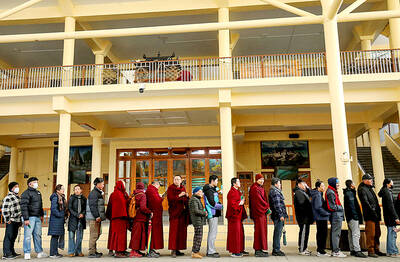
Exiled Tibetans began a unique global election yesterday for a government representing a homeland many have never seen, as part of a democratic exercise voters say carries great weight. From red-robed Buddhist monks in the snowy Himalayas, to political exiles in megacities across South Asia, to refugees in Australia, Europe and North America, voting takes place in 27 countries — but not China. “Elections ... show that the struggle for Tibet’s freedom and independence continues from generation to generation,” said candidate Gyaltsen Chokye, 33, who is based in the Indian hill-town of Dharamsala, headquarters of the government-in-exile, the Central Tibetan Administration (CTA). It

China executed 11 people linked to Myanmar criminal gangs, including “key members” of telecom scam operations, state media reported yesterday, as Beijing toughens its response to the sprawling, transnational industry. Fraud compounds where scammers lure Internet users into fake romantic relationships and cryptocurrency investments have flourished across Southeast Asia, including in Myanmar. Initially largely targeting Chinese speakers, the criminal groups behind the compounds have expanded operations into multiple languages to steal from victims around the world. Those conducting the scams are sometimes willing con artists, and other times trafficked foreign nationals forced to work. In the past few years, Beijing has stepped up cooperation


 RSS
RSS