


Chinese President Xi Jinping (習近平) yesterday warned against any moves in Taiwan toward independence, as he used the Chinese Communist Party’s (CCP) 95th birthday to also warn against corruption and threats to China’s security.
In a wide-ranging speech in Beijing’s Great Hall of the People, Xi said that China would “resolutely oppose Taiwan independence splitist forces,” without a direct mention of President Tsai Ing-wen (蔡英文) or the Democratic Progressive Party, which took control of both the legislative and executive branches of government following landslide victories in January’s presidential and legislative elections.
“The 1.3 billion [people] of China and the entire Chinese race will never agree to any person, at any time, using any method to carry out activities to split the country,” Xi said.
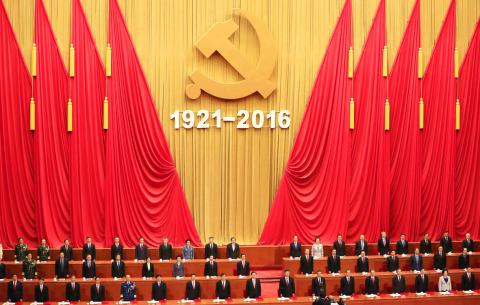
Photo: AP
China views Taiwan as a wayward province and has never renounced the use of force to bring it under Beijing’s control.
China’s Taiwan Affairs Office spokesperson An Fengshan (安峰山) on Sunday said that the mechanism for contact and communication between Beijing and Taipei “has been suspended” since May 20, as Taipei has not recognized the so-called “1992 consensus,” which he said is the foundation for cross-strait relations that embodies the “one China” principle.
Tsai has vowed to maintain peace with China.
Since Xi took power more than three years ago, he has mounted a sweeping campaign against deep-rooted graft, warning like others before him that it could threaten the party’s rule, and taken a muscular approach to protecting China’s sovereignty, including its contested claims in the South China Sea.
Xi said that history had chosen the CCP to lead China, but that if they did not manage the party properly and listen to the people, then history would discard them.
“As the ruling party, the biggest danger we face is corruption,” Xi said. “We must have a staunch will, not let up on our zero-tolerance attitude, investigate all cases and punish those who are corrupt, to give corrupt elements no place to hide in the party.”
Dozens of senior CCP officials have been jailed in Xi’s anti-graft campaign, including powerful former Chinese security head Zhou Yongkang (周永康).
However, China faces external challenges too.
Beijing has been infuriated by a case lodged by the Philippines at an international arbitration court over the South China Sea, vowing neither to participate in the case nor accept the ruling, which is due July 12.
Without making direct reference to the South China Sea, Xi said that while China was not a troublemaker, no foreign country should think China would trade away its core interests.
“Do not expect that we will swallow the bitter fruit of damage to our sovereignty, security and development interests,” he said to an audience including military officers, model workers and ethnic minorities.
Taiwan, Vietnam, Malaysia and Brunei also have South China Sea claims.
Additional reporting by staff writer

‘CROSSING THE LINE’: China’s embassy in Seoul criticized US Forces Korea Commander General Xavier Brunson, asking if his ‘hostile’ remarks were authorized by Washington South Korea and the US are in talks over recent public remarks by the commander of US Forces Korea, Seoul’s presidential office said yesterday, after the comments drew sharp criticism from China. In a recent podcast interview, US Forces Korea Commander General Xavier Brunson described South Korea as “the dagger in the heart of Asia” from China’s east coast, prompting the Chinese embassy in Seoul to say that he had “truly crossed the line.” The interview came amid growing speculation that Washington might seek to expand the role of US Forces Korea in countering the growing regional influence of China, a key

SEEKING ORDER: Rodrigo Paz said that ‘anyone who wants to destroy the nation will have to deal with this president and the full force of the constitution’ Bolivian President Rodrigo Paz on Wednesday said that the nation was at a “breaking point” after nearly a month of protests that have caused shortages of food, fuel and medicine. Paz, who took office six months ago amid the worst economic crisis there in four decades, is battling a groundswell of fury over his policies. The political capital, La Paz, has been besieged by low-income workers and members of the indigenous majority calling for his resignation. “The country needs order and is reaching breaking point,” the 58-year-old said at a public event in La Paz, renewing his appeal for dialogue. On Tuesday, the Bolivian

Through the noise of rushing papers and whirring belts at a print factory in Kyoto, two creators watch their photo essay come to life in broadsheet form — part of an effort to win new audiences in the age of artificial intelligence (AI). Despite the decline of the publishing industry, self-publication and handmade “zine” magazines are growing in popularity in Japan, reflecting the nation’s enduring love of paper in the digital era. While speaking to Agence France-Presse at the plant, his hands black with ink, one of the creators, Kazuma Obara, said: “I think [paper] is a medium that engages all five

Australian researchers have trained lab-grown brain cells on a silicon computer chip to play the 1990s shooter game Doom and said they are just scratching the surface of what the neurons could be capable of doing. It is the science-fiction work of biotech boffins at Cortical Labs, who researched and developed the technology that harnesses the workings of the brain’s networking system. Each so-called “biological computer” contains about 200,000 living human brain cells, grown from stem cells that were harvested from blood donations. Having mastered the simple computer game Pong, where a paddle is moved up and down to send a ball


 RSS
RSS