


Social pressures are forcing people to cut back on their sleep, contributing to a “global sleep crisis,” according to a new study based on research collected through a smartphone app.
It enabled scientists from the University of Michigan to track sleep patterns around the world — gathering data about how age, gender and the amount of natural light to which people are exposed affect sleep patterns in 100 countries — and better understand how cultural pressures can override biological rhythms.
“The effects of society on sleep remain largely unquantified,” the study published on Friday in the journal Science Advances said. “We find that social pressures weaken and/or conceal biological drives in the evening, leading individuals to delay their bedtime and shorten their sleep.”
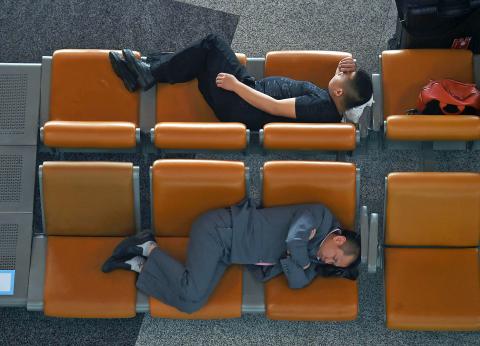
Photo: AFP
Lack of sleep is mostly affected by the time people go to bed, the study found.
Middle-aged men get the least sleep, less than the recommended seven to eight hours.
And age is the main factor determining amount of sleep.
The research is based on data collected through the free smartphone app Entrain, launched in 2014 to help users fight jetlag.
Scientists asked about 6,000 people 15 and older to send anonymous data about sleep, wake-up and lighting environment, enabling the scientists to obtain a large amount of data about sleep patterns worldwide.
The app also asks users to input information about their ages, gender, countries and time zones.
Sleep is driven by an internal circadian clock, a cluster of 20,000 nerve cells the size of a grain of rice located behind the eyes, and adjusted according to the amount of light captured, especially natural light.
The average amount of sleep in the world varies from a minimum of seven hours, 24 minutes in Singapore and Japan to a maximum of eight hours, 12 minutes in the Netherlands, the study found.
Although a difference of 48 minutes may seem inconsequential, a lack of sleep for half an hour can have significant effects on cognitive function and health, the researchers said.
People who need sleep suffer a reduction in their cognitive abilities without really being conscious of it, the new study said.
“Impaired sleep presents an immediate and pressing threat to human health,” it said.

An American scientist convicted of lying to US authorities about payments from China while he was at Harvard University has rebuilt his research lab in Shenzhen, China, to pursue technology the Chinese government has identified as a national priority: embedding electronics into the human brain. Charles Lieber, 67, is among the world’s leading researchers in brain-computer interfaces. The technology has shown promise in treating conditions such as amyotrophic lateral sclerosis and restoring movement in paralyzed people. It also has potential military applications: Scientists at the Chinese People’s Liberation Army have investigated brain interfaces as a way to engineer super soldiers by boosting

Indonesian police have arrested 13 people after shocking images of alleged abuse against small children at a daycare center went viral, sparking outrage across the nation, officials said on Monday. Police on Friday last week raided Little Aresha, a daycare center in Yogyakarta on Java island, following a report from a former employee. CCTV footage circulating on social media showed children, most younger than two, lying on the floor wearing only diapers, their hands and feet bound with rags. The police have confirmed that the footage is authentic. Police said they also found 20 children crammed into a room just 3m by 3m. “So
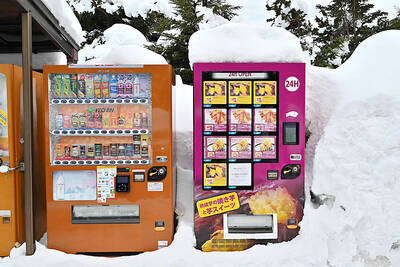
From post offices and parks to stations and even the summit of Mount Fuji, Japan’s vending machines are ubiquitous, but with the rapid pace of inflation cooling demand for their drinks, operators are being forced to rethink the business. Last month beverage giant DyDo Group Holdings announced it would remove about 20,000 vending machines — about 7 percent of their stock nationwide — by January next year, to “reconstruct a profitable network.” Pokka Sapporo Food & Beverage, based in Nagoya, also said last month it would sell its 40,000-machine operation to Osaka-based Lifedrink Co. “The strength of the vending machine

A highway bomb attack in a restive region of southwestern Colombia on Saturday killed 14 people and injured at least 38, the latest spate of violence ahead of next month’s presidential election. Authorities blamed the attack in the Cauca department — a conflict-ridden, coca-growing region — on dissidents of the now-disbanded FARC guerrilla army, who have been sowing violence across the country. “Those who carried out this attack ... are terrorists, fascists and drug traffickers,” Colombian President Gustavo Petro said on social media. “I want our very best soldiers to confront them,” he added. The leftist leader blamed the bombing


 RSS
RSS