


About 60 percent of voters cast ballots in Iran’s elections after polling stations were kept open to allow millions of latecomers to participate, the Iranian Ministry of the Interior said yesterday.
Coming just a month after sanctions were lifted under Iran’s nuclear deal with world powers, the outcome of Friday’s vote is being seen as a de facto referendum on Iranian President Hassan Rouhani’s government.
A political moderate, Rouhani is hoping an alliance with reformists can eliminate or at least curtail conservative dominance of parliament, giving him a chance of passing social and political reforms.
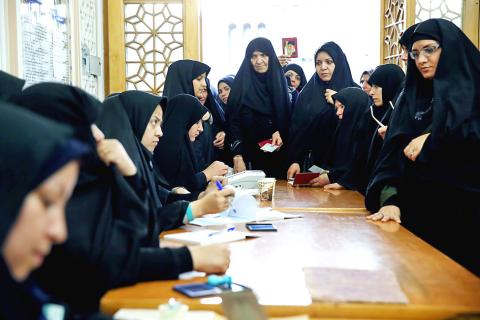
Photo: AP
At least 33 million out of 55 million eligible voters took part in polls for the parliament and the Iranian Assembly of Experts — a powerful clerical body that appoints the country’s supreme leader — ministry spokesman Hossein-Ali Amiri told state TV.
“The numbers will increase” as not all ballots have been counted, Amiri added.
A second round is to be organized in a number of cities for seats where no candidate received more than 25 percent of votes, he said, without providing further details.
Results must be confirmed by the conservative-dominated Iranian Guardian Council — charged with monitoring the vote — and are not expected for several days.
As well as 290 lawmakers, voters were also selecting the Assembly of Experts, an 88-member committee of clerics responsible for monitoring the work of Iranian Supreme Leader Ayatollah Ali Khamenei.
Lawmakers are elected for four years, but the assembly has an eight-year term. Should Khamenei, who is 76, die during that time, its members would choose his replacement.
The first results are expected to come from the provinces, but the vote tally in the capital, which has a population of 12 million and was electing 30 lawmakers, is to take about three days.
Khamenei, who is the nation’s ultimate authority, was among the first to vote and he urged the country’s 55-million-strong electorate to follow suit, as “it’s both a duty and a right.”
Participation in parliamentary elections four years ago was 64 percent nationwide and 48 percent in Tehran.
A higher turnout would help Rouhani and his reformist allies, after many moderate voters stayed away in 2012 in protest at the re-election three years earlier of hardline former Iranian president Mahmoud Ahmadinejad.
Known as the “diplomat sheikh” because of his clerical credentials and willingness to negotiate, Rouhani was the driving force behind the nuclear deal, which he delivered despite political pressure at home.
The agreement with powers led by the US, the Islamic republic’s bete noire, raised hopes of recovery in Iran. However, although the economy exited a deep recession in 2014-2015, growth has stagnated in the past year.
A pro-government coalition of moderate and reformist candidates called “The List of Hope” is representing the president’s ambitions in the polls.
If voters support the pro-Rouhani ticket, the president could swing the balance of power among lawmakers and potentially pass economic, social and political legislation that has so far been blocked.
The run-up to polling day was largely overshadowed by controversies over who was allowed to stand. Thousands of candidates were excluded.
Reformists said they were worst hit, with the barring of their most prominent faces leaving them with untested hopefuls.
A total of 4,844 candidates, about 10 percent of whom are women, stood in the parliamentary election. Only 159 clerics — one-fifth of applicants — were vying for the Assembly of Experts.
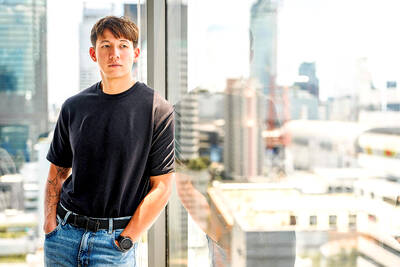
SPEAKING OUT: After Siranudh Scott’s allegations surfaced, celebrities and public figures took to social media to share their own experiences of sexual misconduct and abuse A high-profile alleged sexual abuse case within a wealthy Thai beer brewing family has prompted a wave of painful accounts from survivors of unconnected abuse in the conservative nation. Siranudh Scott, a member of the billionaire Thai family that founded the ubiquitous Singha beer brand, posted an emotional video this month accusing his elder brother Sunit of repeatedly abusing him when he was a teenager. Sunit, who is in his 30s, later denied the allegations in a video posted online, but Singha parent Boonrawd dismissed him from his executive role with the company on Tuesday last week. “I felt I needed to speak

SEEKING ORDER: Rodrigo Paz said that ‘anyone who wants to destroy the nation will have to deal with this president and the full force of the constitution’ Bolivian President Rodrigo Paz on Wednesday said that the nation was at a “breaking point” after nearly a month of protests that have caused shortages of food, fuel and medicine. Paz, who took office six months ago amid the worst economic crisis there in four decades, is battling a groundswell of fury over his policies. The political capital, La Paz, has been besieged by low-income workers and members of the indigenous majority calling for his resignation. “The country needs order and is reaching breaking point,” the 58-year-old said at a public event in La Paz, renewing his appeal for dialogue. On Tuesday, the Bolivian

‘CROSSING THE LINE’: China’s embassy in Seoul criticized US Forces Korea Commander General Xavier Brunson, asking if his ‘hostile’ remarks were authorized by Washington South Korea and the US are in talks over recent public remarks by the commander of US Forces Korea, Seoul’s presidential office said yesterday, after the comments drew sharp criticism from China. In a recent podcast interview, US Forces Korea Commander General Xavier Brunson described South Korea as “the dagger in the heart of Asia” from China’s east coast, prompting the Chinese embassy in Seoul to say that he had “truly crossed the line.” The interview came amid growing speculation that Washington might seek to expand the role of US Forces Korea in countering the growing regional influence of China, a key
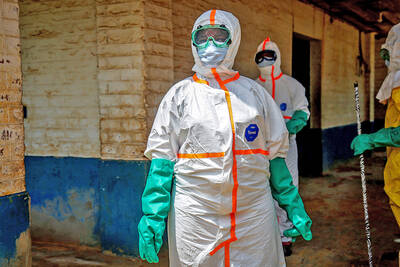
COMMUNITY CONFLICT: Concerns about disease spread from corpses has run up against friends and families’ desire to bury their dead as infection spreads in the area Angry residents of a town at the epicenter of the Ebola outbreak in the Democratic Republic of the Congo (DR Congo) attacked and burned a tent that was part of a health center where people are being treated for the virus, the staff there said Saturday. It was the second such attack in the region in a week. No one was hurt in the attack, according to reports but as patients ran out to escape the fire, 18 people with suspected Ebola infections fled the facility and are unaccounted for, a hospital director said. Angry residents arrived at the clinic in the


 RSS
RSS