


Whether you are a night owl or an early bird, do not bother fighting the impulse because it is probably in your genes, a study said on Tuesday.
Scientists have long known that all plants and animals — from lowly phytoplankton to homo sapiens — have internal biological clocks attuned to a 24-hour cycle.
However, within this so-called circadian rhythm, individuals of some species, including ours, may have a natural preference for day or night.
Previous research had singled out genes with an unspecified influence on these rhythms.
However, very little was known about which parts of our genetic code determine whether you are more likely to be a creature of the night or a morning lark.
A research team led by David Hinds of California-based biotechnology company 23andMe trawled the genomes — the unique genetic blueprint of an organism — of 89,283 people for clues.
The team compared the findings with responses to a Web survey in which the same individuals were asked to indicate whether they preferred mornings or evenings.
The study, published in Nature Communications, found a clear link between more than a dozen gene variants, and healthy individuals who said they were at their best in the morning.
Early risers were significantly less likely to have insomnia or need more than eight hours of shut-eye per night. They were also less prone to depression than individuals — about 56 percent of respondents — who described themselves as night owls.
The researchers also found that, after taking into account the effect of age and sex, morning persons are likely to have lower — and thus generally more healthy — body mass index, a measure of the ratio between height and weight.
None of these correlation necessarily imply a cause-and-effect relationship, the researchers said.
Nor did the team find genetic links with sleep disorders, such as insomnia, apnea or sweating while slumbering.
The mechanism controlling circadian rhythms is found in neurons located in a part of the brain called the suprachiasmatic nuclei, in the hypothalamus.
The same process is involved in jetlag, which is the feeling of being out of phase — too sleepy or wide awake — with a given time cycle.

An American scientist convicted of lying to US authorities about payments from China while he was at Harvard University has rebuilt his research lab in Shenzhen, China, to pursue technology the Chinese government has identified as a national priority: embedding electronics into the human brain. Charles Lieber, 67, is among the world’s leading researchers in brain-computer interfaces. The technology has shown promise in treating conditions such as amyotrophic lateral sclerosis and restoring movement in paralyzed people. It also has potential military applications: Scientists at the Chinese People’s Liberation Army have investigated brain interfaces as a way to engineer super soldiers by boosting

Indonesian police have arrested 13 people after shocking images of alleged abuse against small children at a daycare center went viral, sparking outrage across the nation, officials said on Monday. Police on Friday last week raided Little Aresha, a daycare center in Yogyakarta on Java island, following a report from a former employee. CCTV footage circulating on social media showed children, most younger than two, lying on the floor wearing only diapers, their hands and feet bound with rags. The police have confirmed that the footage is authentic. Police said they also found 20 children crammed into a room just 3m by 3m. “So
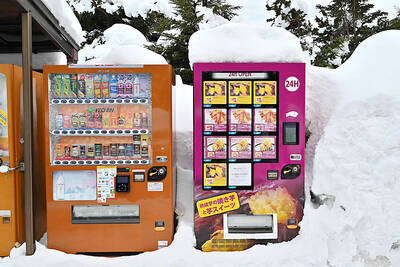
From post offices and parks to stations and even the summit of Mount Fuji, Japan’s vending machines are ubiquitous, but with the rapid pace of inflation cooling demand for their drinks, operators are being forced to rethink the business. Last month beverage giant DyDo Group Holdings announced it would remove about 20,000 vending machines — about 7 percent of their stock nationwide — by January next year, to “reconstruct a profitable network.” Pokka Sapporo Food & Beverage, based in Nagoya, also said last month it would sell its 40,000-machine operation to Osaka-based Lifedrink Co. “The strength of the vending machine

A highway bomb attack in a restive region of southwestern Colombia on Saturday killed 14 people and injured at least 38, the latest spate of violence ahead of next month’s presidential election. Authorities blamed the attack in the Cauca department — a conflict-ridden, coca-growing region — on dissidents of the now-disbanded FARC guerrilla army, who have been sowing violence across the country. “Those who carried out this attack ... are terrorists, fascists and drug traffickers,” Colombian President Gustavo Petro said on social media. “I want our very best soldiers to confront them,” he added. The leftist leader blamed the bombing


 RSS
RSS