


With the sting of a mosquito bite and a fever, many pregnant women might not know that they caught the Zika virus — until it strikes their unborn child.
However, thousands of cases of birth defects linked to the disease over recent months are now sowing alarm in the US and in Latin America.
Babies have been born with abnormally smaller heads, a condition doctors call microcephaly, which often causes brain damage.
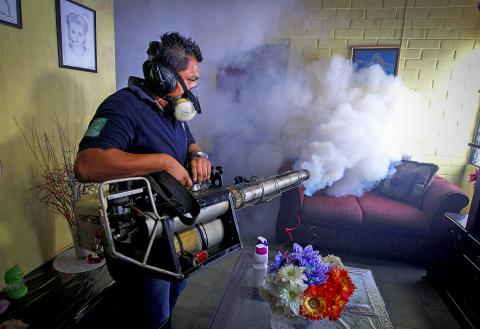
Photo: EPA
The scare has struck hardest in Brazil, which hosts the summer Olympic Games in August.
It is one of 14 Latin American and Caribbean countries that the US has warned pregnant women not to visit because of the Zika risk.
“I am very afraid,” said Jacinta Silva Goes, a 39-year-old cleaning lady in Sao Paulo who is expecting her third child.
“For the moment I am not using mosquito repellent because the doctor has not told me to. He has not spoken to me about Zika,” she said.
Zika used to be thought just a poor relation of dengue fever, another mosquito-borne virus.
The WHO said it is transmitted by the same mosquito that spreads the dengue, chikungunya and yellow fever.
However, the WHO this week noted a surge in cases of microcephaly in Brazil, the country most affected by the epidemic.
It said that “the causal link between Zika infection and microcephaly has not yet been proven,” though the rise in cases is striking.
In the past year there were 3,530 cases of microcephaly reported, compared with a yearly average of 163 over the four preceding years.
Scientists from Brazil’s Fiocruz Institute and Parana Catholic University published a study of a case that showed the virus had passed from an infected woman to her baby through the placenta.
Goes says she feels uninformed about how to protect herself against Zika. “I can’t decide by myself to take anything until the doctor tells me to because it could be dangerous.”
However, across the vast region of Latin America, citizens and officials have taken a variety of measures in response to the scare.
The price of mosquito repellent has risen in Brazil.
In the Peruvian capital Lima, authorities disinfected a big cemetery for fear that Zika-bearing mosquitos were breeding in the flower pots.
In Colombia, the government simply advised couples to avoid pregnancy until at least June. El Salvador, which has reported more than 5,500 cases, said avoid getting pregnant until next year.
Originating in East Africa, Zika landed in Latin America last year and has spread across virtually the whole region via Aedes aegypti, a species of mosquito, the Panamerican Health Organization said.
It says Zika is present in 18 countries in the region. There is no overall figure for the number of cases detected.
With its high number of microcephaly cases, Brazil is by far the worst affected. It is followed by Colombia, which has reported 13,531 cases and is predicting up to 700,000 this year.

Kouri Richins, a Utah mother who published a children’s book about grief after the death of her husband is to serve a life sentence for his murder without the possibility of parole, a judge ruled on Wednesday. Richins was convicted in March of aggravated murder for lacing a cocktail given to her husband, Eric Richins, with five times the lethal dose of fentanyl at their home near Park City in 2022. A jury also found her guilty of four other felonies, including insurance fraud, forgery and attempted murder for trying to poison her husband weeks earlier on Feb. 14, 2022, with a

DELA ROSA CASE: The whereabouts of the senator, who is wanted by the ICC, was unclear, while President Marcos faces a political test over the senate situation Philippine authorities yesterday were seeking confirmation of reports that a top politician wanted by the International Criminal Court (ICC) had fled, a day after gunfire rang out at the Philippine Senate where he had taken refuge fearing his arrest. Senator Ronald “Bato” dela Rosa, the former national police chief and top enforcer of former Philippine president Rodrigo Duterte’s “war on drugs,” has been under Senate protection and is wanted for crimes against humanity, the same charges Duterte is accused of. “Several sources confirmed that the senator, Senator Bato, is no longer in the Senate premises, but we are still getting confirmation,” Presidential

HELP DENIED? The US Department of State said that the Cuban leadership refuses to allow the US to provide aid to Cubans, ‘who are in desperate need of assistance’ US Secretary of State Marco Rubio on Wednesday said that Cuba’s leadership must change, as Washington renewed an offer of US$100 million in aid if the communist nation agrees to cooperate. Cuba has been suffering severe economic tumult led by an energy shortage that plunged 65 percent of the country into darkness on Tuesday. Cuba’s leaders have blamed US sanctions, but Rubio, a Cuban American and critic of the government established by Fidel Castro, said the system was to blame, including corruption by the military. “It’s a broken, nonfunctional economy, and it’s impossible to change it. I wish it were different,” he told

Myanmar yesterday published a parliamentary bill proposing the death sentence for those who detain or violently coerce people into working in online scam centers. Internet fraud factories have flourished in Myanmar, part of Southeast Asia’s scam economy, targeting Internet users worldwide with romance and cryptocurrency investment cons. The multibillion-dollar black market attracts many willing employees, but repatriated foreigners have also reported being trafficked to sites in Myanmar and tortured by scam center operators. The draft legislation would allow capital punishment for “violence, torture, unlawful arrest and detention, or cruel treatment against another person for the purpose of forcing them to commit online scams.” The


 RSS
RSS