


Turkey issued a statement on Friday saying that comments by Turkish President Recep Tayyip Erdogan — in which he cited Adolf Hitler in response to a question about whether a strong presidency was possible in Turkey — had been misinterpreted.
Erdogan, who is pushing to imbue the largely ceremonial presidency with sweeping executive powers, told reporters late on Thursday that “there are already examples in the world.”
“You can see it when you look at Hitler’s Germany,” he said.
Erdogan did not elaborate, but his comparison with Hitler drew immediate criticism because of what many view as his increasing authoritarianism. His comment also raised the issue of how the leader of one of the world’s most influential countries, a US ally and member of NATO, would mention Hitler in the context of his own tenure.
On Friday, the office of the presidency said that “Erdogan’s ‘Hitler’s Germany’ metaphor has been distorted by media outlets and has been used in the opposite sense.”
It said Erdogan had used the example to demonstrate that an executive presidency does not depend on a federal system of government.
“If the system is abused, it may lead to bad management resulting in disasters as in Hitler’s Germany,” the statement said.
“The important thing is to pursue fair management that serves the nation,” the statement added.
Erdogan became Turkey’s first popularly elected president in August 2014, having dominated Turkish politics for more than a decade as prime minister. Since assuming the new post, he has aggressively campaigned to rewrite the Turkish constitution and establish an executive system of government.
His consolidation of power has had a potent effect on Turkey. Critics say Erdogan’s comments denigrating opponents as terrorists or traitors has helped polarize the country.
A government crackdown on dissent — including a growing campaign of intimidation against the opposition news media, with a mob of his supporters last year attacking newspaper offices before a November election — has raised concerns domestically and abroad about Turkey’s commitment to democracy.
To change the constitution, Erdogan’s Justice and Development Party, which regained its parliamentary majority in November, needs support from opposition parties.
Turkey’s main opposition party last week said it would back some changes to an outdated constitution, which was drawn up by the military after a 1980 coup, but it does not support an all-powerful presidential system envisioned by Erdogan.
Turkish Prime Minister Ahmet Davutoglu told Kemal Kilicdaroglu, leader of Turkey’s main opposition party, that a presidential system would not lead to a dictatorship.
“What is right for Turkey is to adopt the presidential system in line with the democratic spirit,” he said in a TV interview this week. “This system will not evolve into dictatorship, but if we do not have this spirit, even the parliamentary system can turn into this dictatorship.”
In Turkey, reaction to Erdogan’s remarks was strong on social media.
Comparing the president with Hitler, one person wrote on Twitter: “The difference is that Hitler was a bit shorter.”
The post later appeared to have been deleted. People also shared an animated image of Erdogan’s face changing to Hitler’s.


Through the noise of rushing papers and whirring belts at a print factory in Kyoto, two creators watch their photo essay come to life in broadsheet form — part of an effort to win new audiences in the age of artificial intelligence (AI). Despite the decline of the publishing industry, self-publication and handmade “zine” magazines are growing in popularity in Japan, reflecting the nation’s enduring love of paper in the digital era. While speaking to Agence France-Presse at the plant, his hands black with ink, one of the creators, Kazuma Obara, said: “I think [paper] is a medium that engages all five
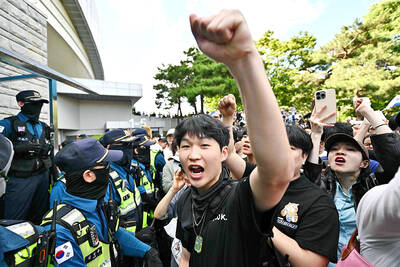
‘ABSURD MISTAKE’: The election commission said that there had been a failure to anticipate turnout after 14 polling stations ran short of ballot papers South Korean riot police yesterday cleared protesters from a Seoul polling station after a 35-hour blockade sparked by a shortage of ballot papers during local elections earlier this week. Wednesday’s election was the first nationwide vote since South Korean President Lee Jae-myung took office following the ouster of Yoon Suk-yeol over his short-lived martial law declaration. Lee’s ruling Democratic Party swept most races, but failed to flip the crucial Seoul mayoral seat. The South Korean National Election Commission apologized, blaming a failure to anticipate turnout after 14 polling stations in Seoul ran short of ballot papers. Some polling stations stayed open until 10pm to

France experienced its hottest spring on record, the French weather service said on Tuesday, after an exceptional early heat wave that also broke highs for the season in England and Wales. Meteo-France said the average nationwide temperature over March to May was 13.8°C — about 1.7°C above the norm, and surpassing records set in 2011 and 2020. “The warmest spring since records began in 1900,” it said in a bulletin. All three months were warmer than average, but the onset of an “unprecedented heatwave” late last month pushed the mercury to highs typically seen at the height of the summer. “Our country had never
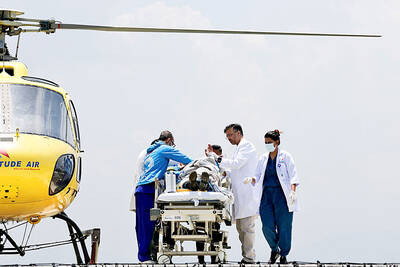
A Sherpa guide was found crawling to base camp on Mount Everest a week after he went missing and was reunited with his family, who had given up hope he would return. Dawa Sherpa was last seen on Friday last week descending the mountain, but he did not reach base camp even though his client did. The pair were among the last climbers on the mountain as the climbing season came to an end and the route was dismantled. Dawa was located by a cleaning crew on Thursday morning as he was crawling down the snowy slopes around the Khumbu Icefall, just above


 RSS
RSS