


As Chinese President Xi Jinping (習近平) makes his first state visit to Washington this week, the outlook for relations is decidedly murkier than when he hosted US President Barack Obama at their previous summit less than a year ago.
Tensions are rising over allegations of Beijing-directed cyberattacks on the US and China’s moves to assert its South China Sea territorial claims. Much of the American public sees China as an economic threat and criticisms are rising over a sweeping crackdown on civil rights.
“US suspicions regarding Chinese intentions are growing,” Princeton University professor of politics and international affairs Aaron Friedberg said.
“The atmosphere surrounding this summit may be more negative than any in the post-Tiananmen period,” Friedberg added, referring to China’s bloody crackdown on pro-democracy protesters in 1989, known as the Tiananmen Square Massacre, which marked a nadir in relations.
At the same time, belief in China’s inexorable rise has been shaken by a stock market plunge and an economic slowdown that have sent shockwaves through global markets. Last month’s catastrophic chemical warehouse explosion in Tianjin — a city just east of Beijing — that killed 173 people have also underscored concerns about corruption and incompetence, increasing doubts about the viability of China’s model of authoritarian governance.
Circumstances were different when the two leaders met in November last year at an Asia-Pacific summit in Beijing. Then, they could point to a much-heralded consensus on climate change, while China had just recently taken part in the premier US naval exercise in the Pacific and appeared to be assuming greater responsibility for the global commons.
Not all is gloomy. Beijing and Washington have found common cause in restraining Iran and North Korea’s nuclear ambitions, even if China has been unable to restart six-nation talks with Pyongyang.
“We should actually take a closer look at any kind of possible cooperation, to leverage our resources and to do the utmost,” Xi’s chief foreign policy adviser, Chinese State Councilor Yang Jiechi (楊潔篪), said in a recent interview with the China Daily newspaper.
In Washington, meaningful discussions are expected on trade, North Korea and Iran. US officials say they have little hope for major breakthroughs on the tough issues bedeviling ties, but that there might be conciliatory gestures, such as restarting dialogue on cybersecurity and a pact on avoiding unintended incidents between military aircraft.
“To me, the most important thing about the meeting is that it is an acknowledgment of the importance of the relationship,” University of Virginia professor of foreign affairs and China expert Brantly Womack said.
‘LIGHTSABER POSES’
Other than that, it is likely to be mostly posturing, Womack said: “I imagine it will be more lightsaber poses than deliverables.”
Chinese officials and academics say that the world’s top economies should maintain close contact and operate under a new “major power” relationship, a concept that seeks to bring China up to parity with the US.
“The key is that the both sides need to make concessions and the meeting is a venue for negotiation,” Peking University expert on US-China relations Zhu Feng (朱鋒) said.
Before arriving in Washington on Friday, Xi is scheduled to attend business-related events in Seattle. After meeting Obama, he is to travel to New York to deliver a speech before the UN General Assembly on Monday next week.
For Xi, who became president in 2013, the visit comes as his standing both at home and abroad has grown slightly more ambiguous.
Earlier this month, he presided over a massive military parade in Beijing that showcased the growing might of China’s People’s Liberation Army. However, while a few luminaries, such as Russian President Vladimir Putin and UN Secretary-General Ban Ki-moon, attended, most leaders of the world’s major democracies stayed away, with the US sending only its Beijing ambassador.
The event was a hit among the Chinese public, but it was criticized abroad as threatening in appearance and unhelpful to reconciliation with World War II antagonist Japan.
MILITARY PARADE
The parade came on the heels of a Chinese stock market plunge, eroding trade figures, and an unexpected currency devaluation, prompting concerns about the state of the world’s second-largest economy. The warehouse explosion in Tianjin also prompted questions about the strength of government institutions.
“The [Chinese] Communist Party regime’s reputation for competent economic management has taken a hit. Still, Xi appears to be firmly in control for now,” Friedberg said.
At home, Xi’s enduring strengths include his total authority over the military and security services, and a growing cult of personality. That has allowed him to pursue a thorough campaign against corruption, while pressing a wide-ranging crackdown on Western democratic concepts and non-governmental, religious and other groups outside party control. Scores of human rights lawyers have been questioned or detained. Some have disappeared.
Overseas, it is a different story. His visit comes as Obama is under growing pressure to take a tougher stance on China.
Rights groups have called on Obama to press Xi over a human rights crackdown. On a visit to China last month, US Ambassador at Large for International Religious Freedom David Saperstein urged China to end a campaign of cross removals and church demolitions, and end harassment of members of unregistered religious groups.
The latest survey of US attitudes toward China by the Pew Research Center showed that 54 percent of Americans have an unfavorable view of Beijing, continuing a rising trend dating back to 2010.
Topping those concerns are the US$1.27 trillion in US debt held by China and the loss of American jobs blamed on Chinese competition. Close behind are hacking attacks originating from China that US officials say are approaching epidemic levels, including the theft of millions of US federal personnel records that US lawmakers have said was engineered by Beijing.
Yet, despite US warnings of legal action, China has shown no serious sign of acting on Washington’s concerns, preferring to portray itself as a victim of hacking.
While exchanges between their militaries have grown more frequent, Washington still has grave doubts about Beijing’s intentions. China’s Sept. 3 military parade featured upgraded bombers and a pair of anti-ship ballistic missiles that analysts say could pose a direct threat to the US Navy, US bases in Asia and to allies such as Japan and the Philippines.
Also of recent concern has been China’s program of turning reefs in the South China Sea into islands complete with airstrips capable of accommodating those bombers.
Washington has repeatedly called on Beijing to halt such moves, only to be told they are not a threat and not of US concern.
“The United States is not part of these disputes, and we do hope that the United States does not get involved,” Yang said.
The level of distrust, especially over hacking and espionage, was displayed in a unique way recently when the US Department of State ended a decades-long tradition of housing top officials at the iconic Waldorf-Astoria hotel while they are in New York.
No reason was given for the change, although officials pointed to Hilton Worldwide’s sale of the hotel to a Chinese insurance conglomerate in a deal that prompted concerns over Chinese eavesdropping.
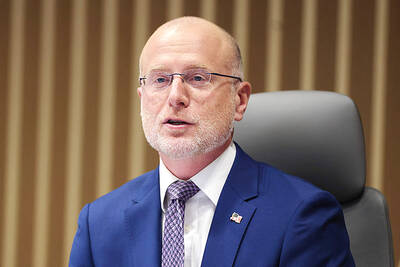
FAKE NEWS? ‘When the government demands the press become a state mouthpiece under the threat of punishment, something has gone very wrong,’ a civic group said The top US broadcast regulator on Saturday threatened media outlets over negative coverage of the Middle East war, after US President Donald Trump slammed critical headlines from the “Fake News Media.” The US president since his first term has derided mainstream media as “fake news” and has sued major outlets over what he sees as unfair coverage. Brendan Carr, head of the US Federal Communications Commission — which oversees the nation’s radio, television and Internet media — said broadcasters risked losing their licenses over news coverage. “The law is clear. Broadcasters must operate in the public interest, and they will
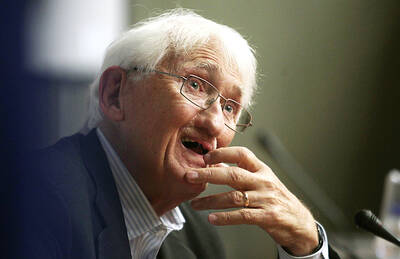
INFLUTENTIAL THEORIST: Habermas was particularly critical of the ‘limited interest’ shown by German politicians in ‘shaping a politically effective Europe Jurgen Habermas, whose work on communication, rationality and sociology made him one of the world’s most influential philosophers and a key intellectual figure in his native Germany, has died. He was 96. Habermas’ publisher, Suhrkamp, said he died on Saturday in Starnberg, near Munich. Habermas frequently weighed in on political matters over several decades. His extensive writing crossed the boundaries of academic and philosophical disciplines, providing a vision of modern society and social interaction. His best-known works included the two-volume Theory of Communicative Action. Habermas, who was 15 at the time of Nazi Germany’s defeat, later recalled the dawn of
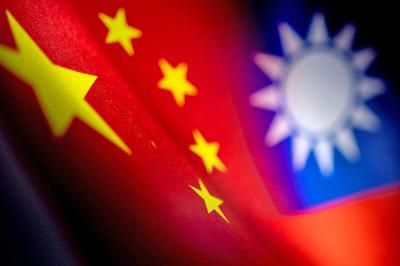
The Chinese public maintains relatively warm sentiments toward Taiwan and strongly prefers non-military paths to improving cross-strait relations, a recent survey conducted by the Atlanta, Georgia-based Carter Center and Emory University showed. The “China Pulse” research project, which polled 2,506 adults between Oct. 27 last year and Jan. 1 this year, found that 86 percent of respondents support strengthening cultural ties, while 81 percent favor deepening economic interaction. The report, co-authored by political scientists at Emory University and advisors at the Carter Center, indicates that the Chinese public views Taiwan’s importance through a lens of shared history and culture rather than geopolitical

Cannabis-based medicines have shown little evidence of effectiveness for treating most mental health and substance-use disorders, according to a large review of past studies published in a major medical journal on Monday. Medical use of cannabinoids has been expanding, including in the US, Canada and Australia, where many patients report using cannabis products to manage conditions such as anxiety, post-traumatic stress disorder and sleep problems. Researchers reviewed data from 54 randomized clinical trials conducted between 1980 and May last year involving 2,477 participants for their analysis published in The Lancet. The studies assessed cannabinoids as a primary treatment for mental disorders or substance-use


 RSS
RSS