


Thousands of South Koreans marched in Seoul for the second straight day yesterday to protest government labor policies and the handling of a ferry disaster that killed more than 300 people a year ago.
Thousands of demonstrators supporting the relatives of ferry disaster victims gathered for a rally on the same downtown street where they violently clashed with police last weekend, leaving dozens injured.
They were joined by some of the estimated 40,000 unionized workers who had demonstrated in front of Seoul City Hall hours earlier to denounce government policies that they fear will reduce wages, job security and retirement benefits for state employees, Korean Confederation of Trade Unions spokesman Park Seong-shik said.
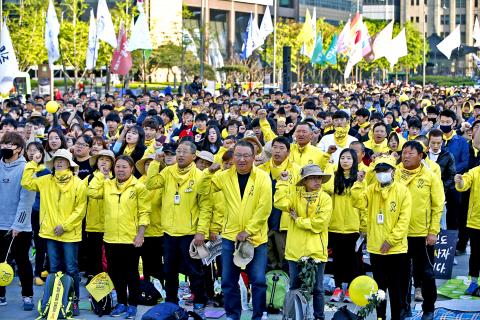
Photo: EPA
Hundreds of people marched in silence from several locations to participate in the rally, many of them wearing face masks and yellow scarfs and jackets, the color that has come to symbolize the plight of the families.
A large number of police officers closely watched the demonstrators, many of them wearing helmets and body armor and holding riot shields. Dozens of police buses were parked nearby, as were some vehicles that appeared to be equipped with water cannons.
South Korean police often use their vehicles to create tight perimeters to block protesters from advancing, as they did last week when more than 70 police buses were destroyed.
The ferry disaster continues to haunt the presidency of increasingly unpopular South Korean President Park Geun-hye, despite her bowing to relatives’ demands to proceed with a difficult and potentially dangerous operation to salvage the 6,170-tonne ferry.
In addition to the salvaging of the ship, relatives have been calling for a new investigation into the government’s responsibility for the disaster. They accuse Park of ignoring the alleged incompetence and corruption they believe contributed to the sinking and high death toll.
A total of 304 people, most of them students from a single high school, died when the ferry MV Sewol sank off South Korea’s southwest coast on April 16 last year.
Prosecutors blamed negligence by crew members, excessive cargo and improper storage for the sinking, along with slow rescue efforts.
Relatives of the victims claim the investigation was insufficient, because they believe high-level authorities were not held accountable.

It began as a satirical online project. Now millions of young people in India are flocking to it as an outlet for their frustration. A parody political party called the Cockroach Janta Party, with the insect as its symbol, has exploded across India’s social media by turning absurdist humor into protest. Memes and short videos mocking corruption, joblessness and political dysfunction have flooded social media sites, where millions of users are embracing the cockroach — known for its ability to survive harsh conditions — as a tongue-in-cheek symbol of endurance. The online movement’s rise has been unusually rapid. The Cockroach Janta Party (CJP)

SPEAKING OUT: After Siranudh Scott’s allegations surfaced, celebrities and public figures took to social media to share their own experiences of sexual misconduct and abuse A high-profile alleged sexual abuse case within a wealthy Thai beer brewing family has prompted a wave of painful accounts from survivors of unconnected abuse in the conservative nation. Siranudh Scott, a member of the billionaire Thai family that founded the ubiquitous Singha beer brand, posted an emotional video this month accusing his elder brother Sunit of repeatedly abusing him when he was a teenager. Sunit, who is in his 30s, later denied the allegations in a video posted online, but Singha parent Boonrawd dismissed him from his executive role with the company on Tuesday last week. “I felt I needed to speak

A Hong Kong astronaut is to join a Chinese space mission for the first time as part of a three-person crew launching today, as Beijing edges closer to its goal of landing people on the moon. The Tiangong space station — crewed by teams of three astronauts that are typically rotated every six months — is the crown jewel of China’s space program, boosted by billions in state investment in a bid to catch up with the US and Russia. The Shenzhou-23 mission is to blast off at 11:08pm from the Jiuquan Satellite Launch Center in northwestern China, carrying three astronauts to
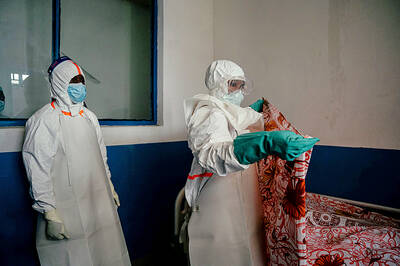
UPGRADED ALERT: The risk inside DR Congo is now considered ‘very high,’ while neighboring countries face a ‘high’ threat as the outbreak continues, the WHO said Ebola is spreading faster than responders can track it in eastern Congo, where health workers managed to follow up with barely one in five identified contacts in a single day. Authorities in the Democratic Republic of the Congo (DR Congo) reported 83 confirmed infections, 746 suspected cases and 1,603 identified contacts as of Thursday, but health workers were able to follow up on only 342 contacts that day — about 21 percent of the total under monitoring — data released by the DR Congo Ministry of Public Health on Friday showed. The figures suggest the response is falling behind the outbreak itself,


 RSS
RSS