


In April 2012, Indonesia’s Banda Aceh, the city worst hit by the tsunami that killed at least 226,000 people on Dec. 26, 2004, received a terrifying reminder of how unprepared it was for the next disaster.
As a magnitude 8.6 earthquake struck at sea, thousands of residents shunned purpose-built shelters and fled by car and motorcycle, clogging streets with traffic. A network of powerful warning sirens stayed silent.
No wave came. However, if it had, the damage would have been “worse than 2004, if it was the same magnitude of tsunami,” Bandung Institute of Technology’s Harkunti Rahayu said.

Photo: EPA
As the 10th anniversary of the disaster approaches, experts and officials say weaknesses remain across the region in a system designed to warn people and get them to safety.
For millions of people living in coastal areas, warnings do not always get through, thanks to bureaucratic confusion and geography. The most vulnerable areas lack infrastructure and many people do not have basic knowledge about how to keep safe from deadly waves.
Since the disaster, a sophisticated early warning system has been constructed from next to nothing, costing more than US$400 million and encompassing 28 countries.
With 101 sea-level gauges, 148 seismometers and nine buoys, the Indian Ocean Tsunami Warning System can send alerts to countries’ tsunami warning centers within 10 minutes of a quake, said Tony Elliott, the head of the UNESCO secretariat that oversees the system.
However, there has also been mismanagement and waste.
In Indonesia, a German-funded detection initiative built an expensive network of buoys — and then scrapped them — after reports of cost overruns and signs they were ineffective.
All but one of nine Indonesian-operated buoys has been lost or damaged by fishermen, Indonesia’s Agency for the Assessment and Application of Technology official Velly Asvaliantina said.
The remaining buoy is not operational, she said.
Elliott said technological advances mean the lack of buoys is not a significant impediment in tsunami detection. A far bigger concern is getting warnings to at-risk coastal communities, and making sure people get to safety in time.
In some of the countries worst affected in 2004 — Thailand, Indonesia and India — much progress has been made, officials said. However, concerns remain about this final, crucial stage.
The 2012 failure in Aceh prompted a reassessment in Thailand, where 5,395 people died in 2004, Thai National Disaster Warning Center head Somsak Khaosuwan said.
“We put our systems to the test each day. Our warning system is one of the best in the world, but I must admit we lack maintenance,” he said.
Former agency head Samit Thammasarot, who was ousted from his position following a 2006 coup against then-prime minister Thaksin Shinawatra, was more damning.
“If a tsunami happened today, would we be prepared? No, we would not,” Samit told reporters. “On an official level there has been, in the past, corruption and cut-price equipment bought that does not meet international standards.”
In India, the new system struggles to communicate alerts by fax, text message and e-mail to remote locations, Indian National Centre for Ocean Information Services official Ajay Kumar said.
“Some of the people, officials, are not getting the alert,” he said. “Secondly, one thing that has come out from the drills is that the last mile connectivity is still missing. If [a] tsunami is coming, even now people don’t know what is to be done, where to move.”
In Indonesia, where at least 168,000 people died in Aceh Province in 2004, the warning and evacuation system is beset by bureaucratic infighting.
“Of course I’m worried. I’m hoping there is no tsunami again,” said Mochammad Riyadi, the head of the Earthquake and Tsunami Centre at Indonesia’s Meteorology and Geophysics Agency (BMKG).
Aceh provincial authorities have resisted calls to conduct monthly sound checks of the six sirens in operation, despite their failure in 2012, Riyadi said.
The BMKG has also tried for the past seven years to hand control of the warning system to the local government, but has been rebuffed, he said.
Local authorities dispute this account. Aceh’s disaster agency head Said Rasul said the BMKG should be doing the tests.
“If the BMKG wants to hand over management of the tsunami sirens, then they have to give us the human resources,” he said.
Building standards in Indonesia, including Aceh, are also still dangerously below par, Singapore’s S. Rajaratnam School of International Studies research fellow Jonatan Lassa said.
The 2012 alarm showed people did not trust the warning system, he added.
“People were saved by chance, by the tsunami not happening, and not by the warning system,” he said.
Some communities have also been rebuilt in particularly vulnerable coastal areas.
“Should there be a tsunami, I think the impact will be the same [as 2004],” Lassa said.

An American scientist convicted of lying to US authorities about payments from China while he was at Harvard University has rebuilt his research lab in Shenzhen, China, to pursue technology the Chinese government has identified as a national priority: embedding electronics into the human brain. Charles Lieber, 67, is among the world’s leading researchers in brain-computer interfaces. The technology has shown promise in treating conditions such as amyotrophic lateral sclerosis and restoring movement in paralyzed people. It also has potential military applications: Scientists at the Chinese People’s Liberation Army have investigated brain interfaces as a way to engineer super soldiers by boosting

Indonesian police have arrested 13 people after shocking images of alleged abuse against small children at a daycare center went viral, sparking outrage across the nation, officials said on Monday. Police on Friday last week raided Little Aresha, a daycare center in Yogyakarta on Java island, following a report from a former employee. CCTV footage circulating on social media showed children, most younger than two, lying on the floor wearing only diapers, their hands and feet bound with rags. The police have confirmed that the footage is authentic. Police said they also found 20 children crammed into a room just 3m by 3m. “So
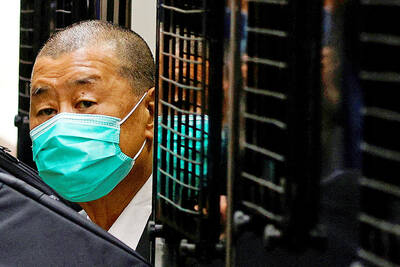
Jailed media entrepreneur Jimmy Lai (黎智英) has been awarded Deutsche Welle’s (DW) freedom of speech award for his contribution to Hong Kong’s pro-democracy movement. The German public broadcaster on Thursday said Lai would be presented in absentia with the 12th iteration of the award on June 23 at the DW Global Media Forum in Bonn. Deutsche Welle director-general Barbara Massing praised the 78-year-old founder of the now-shuttered news outlet Apple Daily for standing “unwaveringly for press freedom in Hong Kong at great personal risk.” “With Apple Daily, he gave journalists a platform for free reporting and a voice to the democracy movement in

PHILIPPINE COMMITTEE: The head of the committee that made the decision said: ‘If there is nothing to hide, there is no reason to hide, there is no reason to obstruct’ A Philippine congressional committee on Wednesday ruled that there was “probable cause” to impeach Philippine Vice President Sara Duterte after hearing allegations of unexplained wealth, misuse of state funds and threats to have the president assassinated. The unanimous decision of the 53-member committee in the Philippine House of Representatives sends the two impeachment complaints to deliberations and voting by the entire lower chamber, which has more than 300 lawmakers. The complaints centered on Duterte’s alleged illegal use and mishandling of intelligence funds from the vice president’s office, and from her time as education secretary under Philippine President Ferdinand Marcos Jr. Duterte and the


 RSS
RSS