


As Berliners watched 8,000 balloons being released into the night sky yesterday evening, old divisions between East and West symbolically vanished into thin air with them.
Yet the run-up to the festivities already served up plenty of reminders that, 25 years after the fall of the wall that divided the city for three decades, the scars of history are hurting more than ever.
Speaking at a symposium near the Brandenburg Gate on Saturday morning, former Soviet president Mikhail Gorbachev warned that the world was “on the brink of a new Cold War” and strongly criticized the West for having sown the seeds of the current crisis by mishandling the fallout from the collapse of the Iron Curtain.

Photo: EPA
“Instead of building new mechanisms and institutions of European security and pursuing a major demilitarization of European politics ... the West, and particularly the United States, declared victory in the Cold War,” said the man behind the Soviet Union’s glasnost and perestroika reforms.
“Euphoria and triumphalism went to the heads of Western leaders. Taking advantage of Russia’s weakening and the lack of a counterweight, they claimed monopoly leadership and domination in the world,” he said.
The enlargement of NATO, Kosovo, missile defense plans and wars in the Middle East had led to a “collapse of trust,” said Gorbachev, now 83. “To put it metaphorically, a blister has now turned into a bloody, festering wound.”
Previously an outspoken critic of Russian President Vladimir Putin, Gorbachev backed the Russian leader’s stance over Ukraine, urging Western leaders to “consider carefully” Putin’s recent remarks at the Valdai forum.
“Despite the harshness of his criticism of the West, and of the United States in particular, I see in his speech a desire to find a way to lower tensions and ultimately to build a new basis for partnership,” Gorbachev said.
Such strong words of criticism, voiced by the man still affectionately known as “Gorbi” to many in Germany, came at the end of a week which has seen the value of the rouble tumbling dramatically as a result of Western sanctions.
Friday afternoon had seen another reminder of the old East-West tensions still running through Germany when the usually rather staid proceedings of the Bundestag had been shaken up by a musical guest performance.
Songwriter Wolf Biermann, who was kicked out of the German Democratic Republic (GDR) in 1976, performed a protest song called Ermutigung (Encouragement) and took a number of swipes at politicians from Die Linke (the Left party), successors to East Germany’s ruling Sozialistische Einheitspartei Deutschlands (Socialist Unity Party of Germany).
“Your punishment is to have to listen to me here — enjoy”, Biermann said, while gesturing toward the party’s parliamentarians.
He went on to describe Die Linke MPs as “dragon spawn” and “the miserable dregs of something that had luckily been overcome.”
Only last week German President Joachim Gauck, a former head of the Stasi archives, had questioned whether the leftist party had “really distanced itself from the ideas the SED once had about repression of people.”
Die Linke is on the verge of gaining its first state premier, in Thuringia, something Gauck said “people of my age who lived through the GDR find quite hard to accept.”
At the very least, such score-settling should stop the weekend’s festivities, taking place under the motto “courage for freedom,” from turning into a merely nostalgic affair.
Events in Berlin will mark the culmination of a remarkable chain of events which resulted in the opening of border checkpoints in Berlin on the night of Nov. 9, 1989.
On Saturday night, German Chancellor Angela Merkel, who grew up in East Germany, attended a memorial concert at the Berliner Ensemble, the theater founded by the playwright Bertolt Brecht.
Yesterday, Merkel was to open a new exhibition center at Bernauer Strasse, near the Bornholmer Strasse checkpoint where she as a 35-year-old crossed over to the West for the first time.
“I think you never forget how you felt that day — at least I will never forget it,” Merkel said in a recent podcast. “I had to wait 35 years for that feeling of liberty. It changed my life.”


Through the noise of rushing papers and whirring belts at a print factory in Kyoto, two creators watch their photo essay come to life in broadsheet form — part of an effort to win new audiences in the age of artificial intelligence (AI). Despite the decline of the publishing industry, self-publication and handmade “zine” magazines are growing in popularity in Japan, reflecting the nation’s enduring love of paper in the digital era. While speaking to Agence France-Presse at the plant, his hands black with ink, one of the creators, Kazuma Obara, said: “I think [paper] is a medium that engages all five
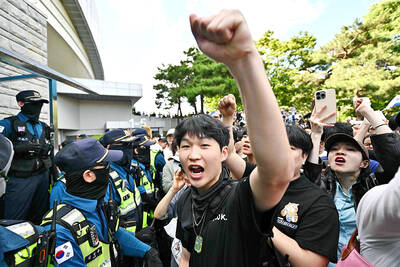
‘ABSURD MISTAKE’: The election commission said that there had been a failure to anticipate turnout after 14 polling stations ran short of ballot papers South Korean riot police yesterday cleared protesters from a Seoul polling station after a 35-hour blockade sparked by a shortage of ballot papers during local elections earlier this week. Wednesday’s election was the first nationwide vote since South Korean President Lee Jae-myung took office following the ouster of Yoon Suk-yeol over his short-lived martial law declaration. Lee’s ruling Democratic Party swept most races, but failed to flip the crucial Seoul mayoral seat. The South Korean National Election Commission apologized, blaming a failure to anticipate turnout after 14 polling stations in Seoul ran short of ballot papers. Some polling stations stayed open until 10pm to

France experienced its hottest spring on record, the French weather service said on Tuesday, after an exceptional early heat wave that also broke highs for the season in England and Wales. Meteo-France said the average nationwide temperature over March to May was 13.8°C — about 1.7°C above the norm, and surpassing records set in 2011 and 2020. “The warmest spring since records began in 1900,” it said in a bulletin. All three months were warmer than average, but the onset of an “unprecedented heatwave” late last month pushed the mercury to highs typically seen at the height of the summer. “Our country had never
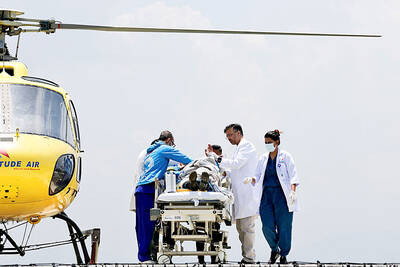
A Sherpa guide was found crawling to base camp on Mount Everest a week after he went missing and was reunited with his family, who had given up hope he would return. Dawa Sherpa was last seen on Friday last week descending the mountain, but he did not reach base camp even though his client did. The pair were among the last climbers on the mountain as the climbing season came to an end and the route was dismantled. Dawa was located by a cleaning crew on Thursday morning as he was crawling down the snowy slopes around the Khumbu Icefall, just above


 RSS
RSS