


Thousands of dead fish have begun mysteriously washing up in the polluted Rio de Janeiro bay that is to host sailing events at the 2016 Olympics — and experts are at a loss to explain why.
Guanabara Bay has already been the subject of concern among sailors who are to compete in Rio because of the human sewage that gets pumped into its waters.
The International Olympic Committee (IOC) has expressed confidence that Guanabara will be fit for purpose by the time of the Games.
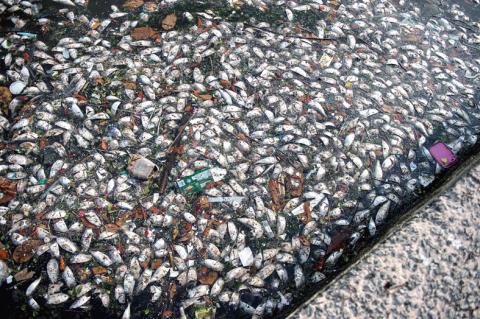
Photo: AFP
However, the recent appearance of thousands of dead fish, and the foul stench of their rotting carcasses, has attracted further scrutiny with the Olympics less than two years away.
Scientists are baffled by the phenomenon, but say there is no evidence so far to suggest pollution is the cause.
The foul odor first took over the usually peaceful Paqueta Island, where cars are banned and the population of 4,500 people travels on horseback or bicycle among the only baobab trees in Brazil.
With the help of a bulldozer, a municipal company has removed 20 tonnes of dead sabalo fish — from the Clupeidae family of herrings and sardines — and four dead sea turtles.
“Tests showed that this is not a matter of chemical or toxic water pollution,” Rio do Janeiro State University oceanographer David Zee told reporters.
Leandro Daemon of the Brazilian National Institute for the Environment, or INEA, agreed that water testing had not identified any toxic chemicals or any unusual change in the water’s pH (potential of hydrogen), salinity or oxygen.
“We have no answer yet about what happened, but we can certainly exclude the hypothesis of a chemical pollution killing the fish,” Daemon said.
Not everyone is so sure.
Worried fishermen and islanders are pointing the finger at the petrochemical activities of state giant Petrobras.
Five of the fish were sent on Tuesday to the Federal University of Rio de Janeiro’s biology department for analysis, and the results are to be announced in a week.
Experts want to know if there are any signs of pollution or disease in the entrails or gills.
However, Zee said the likeliest scenario was that the deaths are caused by “thermal pollution” of the water.
“Sabalo are very sensitive to any lack of oxygen. Warm water temperatures such as those recorded several days ago — ranging from 27oC to 30oC — in shallow water decrease the solubility of oxygen,” Zee said.

Australians were downloading virtual private networks (VPNs) in droves, while one of the world’s largest porn distributors said it was blocking users from its platforms as the country yesterday rolled out sweeping online age restriction. Australia in December became the first country to impose a nationwide ban on teenagers using social media. A separate law now requires artificial intelligence (AI)-powered chatbot services to keep certain content — including pornography, extreme violence and self-harm and eating disorder material — from minors or face fines of up to A$49.5 million (US$34.6 million). The country also joined Britain, France and dozens of US states requiring

Hungarian authorities temporarily detained seven Ukrainian citizens and seized two armored cars carrying tens of millions of euros in cash across Hungary on suspicion of money laundering, officials said on Friday. The Ukrainians were released on Friday, following their detention on Thursday, but Hungarian officials held onto the cash, prompting Ukraine to accuse Hungary’s Russia-friendly government of illegally seizing the money. “We will not tolerate this state banditism,” Ukrainian Minister of Foreign Affairs Andrii Sybiha said. The seven detained Ukrainians were employees of the Ukrainian state-owned Oschadbank, who were traveling in the two armored cars that were carrying the money between Austria and

Kosovar President Vjosa Osmani on Friday after dissolving the Kosovar parliament said a snap election should be held as soon as possible to avoid another prolonged political crisis in the Balkan country at a time of global turmoil. Osmani said it is important for Kosovo to wrap up the upcoming election process and form functional institutions for political stability as the war rages in the Middle East. “Precisely because the geopolitical situation is that complex, it is important to finish this electoral process which is coming up,” she said. “It is very hard now to imagine what will happen next.” Kosovo, which declared

MORE BANS: Australia last year required sites to remove accounts held by under-16s, with a few countries pushing for similar action at an EU level and India considering its own ban Indonesia on Friday said it would ban social media access for children under 16, citing threats from online pornography, cyberbullying, online fraud and Internet addiction. “Accounts belonging to children under 16 on high-risk platforms will start to be deactivated, beginning with YouTube, TikTok, Facebook, Instagram, Threads, X, Bigo Live and Roblox,” Indonesian Minister of Communications and Digital Meutya Hafid said. “The government is stepping in so that parents no longer have to fight alone against the giants of the algorithm. Implementation will begin on March 28, 2026,” she said. The social media ban would be introduced in stages “until all platforms fulfill their


 RSS
RSS