


Is a violent criminal born that way, or shaped by childhood experiences and circumstances?
Delving into one of oldest questions in psychology, some scientists have suggested genes may contribute to about half of the influence — by affecting complex brain chemistry, for instance.
However, until now, DNA clues to support this have been sketchy.
Scientists in Europe and the US on Tuesday fingered two genes which in a mutated form are found in a “substantially higher frequency” in violent offenders.
A study of nearly 800 Finns jailed for both violent and non-violent crimes, and compared with the general population, found variants of two genes, called MAOA and CDH13, to be “associated with extremely violent behavior.”
“No substantial signal was observed for either MAOA or CDH13 among non-violent offenders, indicating that findings were specific for violent offending,” said the study, published in the journal Molecular Psychiatry.
The scientists took into account environmental factors — whether people had a history of substance abuse, antisocial personality disorders or childhood maltreatment.
However, this did not alter the outcome.
The study was not designed to explain the impact of genetic variants and the authors believe there could be many other genes which play a role, directly or indirectly, in the molecular cascade.
And, they say, the two mutated gene versions or genotypes are “rather common.”
As many as one in five people have them, of whom the vast majority never commit rape, assault or murder.
Similarly, people without the variants were found in the ultra-violent trial group.
“Although the high-risk genotype combination of MAOA and CDH13 has a risk of about 13-fold compared with the ‘usual’ genotype combination, still the vast majority [of] high-risk genotype individuals do not commit severe violent crimes,” study co-author Jari Tiihonen of the neuroscience department at Sweden’s Karolinska Institutet said.
The MAOA gene has been linked to the metabolism of dopamine, a neurotransmitter that plays a role in addiction and the ability to experience pleasure.
The CDH13 is believed to be involved in impulse control and has been associated with attention deficit hyperactivity disorder.
The probe sheds some light in the nature-vs-nurture debate, but the intellectual jousting is bound to continue.
“I think that we have found two genes which have the largest effect on aggressive behavior and that there are probably tens or hundreds other genes having smaller effects,” Tiihonen said.
The finding should not make a difference to our notion of criminal responsibility, he added
“According to the basic principles of forensic psychiatry, any risk factors such as genotype or brain injury in car accident, must not have any effect per se on convictions or prison sentences,” he said. “The mental capacity to understand the nature and consequences of one’s deeds, and ability to control one’s behavior are the only things that matter.”

An American scientist convicted of lying to US authorities about payments from China while he was at Harvard University has rebuilt his research lab in Shenzhen, China, to pursue technology the Chinese government has identified as a national priority: embedding electronics into the human brain. Charles Lieber, 67, is among the world’s leading researchers in brain-computer interfaces. The technology has shown promise in treating conditions such as amyotrophic lateral sclerosis and restoring movement in paralyzed people. It also has potential military applications: Scientists at the Chinese People’s Liberation Army have investigated brain interfaces as a way to engineer super soldiers by boosting

Indonesian police have arrested 13 people after shocking images of alleged abuse against small children at a daycare center went viral, sparking outrage across the nation, officials said on Monday. Police on Friday last week raided Little Aresha, a daycare center in Yogyakarta on Java island, following a report from a former employee. CCTV footage circulating on social media showed children, most younger than two, lying on the floor wearing only diapers, their hands and feet bound with rags. The police have confirmed that the footage is authentic. Police said they also found 20 children crammed into a room just 3m by 3m. “So

A highway bomb attack in a restive region of southwestern Colombia on Saturday killed 14 people and injured at least 38, the latest spate of violence ahead of next month’s presidential election. Authorities blamed the attack in the Cauca department — a conflict-ridden, coca-growing region — on dissidents of the now-disbanded FARC guerrilla army, who have been sowing violence across the country. “Those who carried out this attack ... are terrorists, fascists and drug traffickers,” Colombian President Gustavo Petro said on social media. “I want our very best soldiers to confront them,” he added. The leftist leader blamed the bombing
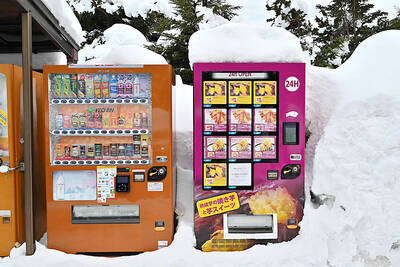
From post offices and parks to stations and even the summit of Mount Fuji, Japan’s vending machines are ubiquitous, but with the rapid pace of inflation cooling demand for their drinks, operators are being forced to rethink the business. Last month beverage giant DyDo Group Holdings announced it would remove about 20,000 vending machines — about 7 percent of their stock nationwide — by January next year, to “reconstruct a profitable network.” Pokka Sapporo Food & Beverage, based in Nagoya, also said last month it would sell its 40,000-machine operation to Osaka-based Lifedrink Co. “The strength of the vending machine


 RSS
RSS