


The Philippines yesterday said that it has shelved planned improvements on a military airstrip in the disputed South China Sea to support its bid for a UN ruling against Beijing over the tense territorial confrontation.
The Philippines infuriated China in March by asking a UN tribunal to declare Beijing’s territorial claims in the South China Sea a violation of international law.
China claims almost all of the sea, a vital avenue for world trade that is also believed to harbor vast oil and gas reserves.
However, its claims overlap in parts with those of Taiwan, the Philippines, Brunei, Malaysia and Vietnam.
Philippine President Benigno Aquino III’s spokeswoman Abigail Valte said that the government had suspended long-planned upgrades on a military runway in the disputed Spratly Islands (Nansha Islands, 南沙群島) to boost chances of a favorable ruling at the UN.
“We wanted to maintain the moral high ground in light of the case we filed at the [UN] arbitration tribunal regarding the West Philippine Sea,” Valte said, using the Filipino name for the area.
“We chose... to ease tensions and avoid any incident that may be construed as ramping up tensions or trying to provoke any of the claimant countries,” Valte said yesterday over Philippine government radio.
The small runway lies on Thitu Island (Jhongye Island, 中業島), the largest of several islands and reefs in the Spratly group that are garrisoned by Filipino soldiers, but also claimed by Taiwan and China.
China has refused to take part in UN arbitration with the Philippines and told Manila that bilateral ties would suffer.
Valte dismissed suggestions that suspending the airstrip project would allow China to ramp up its increasingly assertive efforts to stake its claims in the South China Sea.
“In our view, it will not weaken our position,” she added.

Crowds in Bangladesh are flocking to snap photographs with an unlikely social media star — an albino buffalo with flowing blond hair nicknamed “Donald Trump” that is due to be sacrificed within days. Owner Zia Uddin Mridha, 38, said his brother named the 700kg bull over its flowing helmet of hair resembling the signature look of the US president. “My younger brother picked this name because of the buffalo’s extraordinary hair,” he said at his farm in Narayanganj, just outside the capital, Dhaka. Mridha said that a constant stream of curious visitors — social media fans, onlookers and children — have come throughout

It began as a satirical online project. Now millions of young people in India are flocking to it as an outlet for their frustration. A parody political party called the Cockroach Janta Party, with the insect as its symbol, has exploded across India’s social media by turning absurdist humor into protest. Memes and short videos mocking corruption, joblessness and political dysfunction have flooded social media sites, where millions of users are embracing the cockroach — known for its ability to survive harsh conditions — as a tongue-in-cheek symbol of endurance. The online movement’s rise has been unusually rapid. The Cockroach Janta Party (CJP)
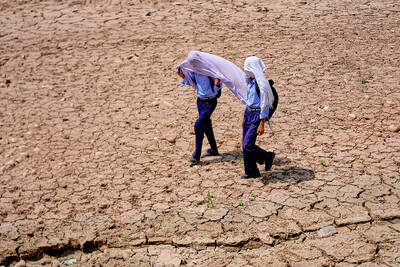
HOTTER: While Indians are accustomed to summer heat, climate change has caused northwestern India to warm faster than other parts of the country, an academic said Roads and markets have emptied during afternoons and some farmers have switched to nighttime work to avoid scorching temperatures as a heat wave grips large parts of India. The India Meteorological Department forecast maximum temperatures for yesterday of about 45°C in the capital, New Delhi, where authorities have opened temporary “cooling zones” to help people cope. The weather department warned that conditions would likely persist across several northern regions in the coming days, with temperatures staying well above seasonal averages. Authorities urged people to stay indoors during the hottest hours and take precautions against heat-related illnesses. India declares a heat wave whenever maximum temperatures

SPEAKING OUT: After Siranudh Scott’s allegations surfaced, celebrities and public figures took to social media to share their own experiences of sexual misconduct and abuse A high-profile alleged sexual abuse case within a wealthy Thai beer brewing family has prompted a wave of painful accounts from survivors of unconnected abuse in the conservative nation. Siranudh Scott, a member of the billionaire Thai family that founded the ubiquitous Singha beer brand, posted an emotional video this month accusing his elder brother Sunit of repeatedly abusing him when he was a teenager. Sunit, who is in his 30s, later denied the allegations in a video posted online, but Singha parent Boonrawd dismissed him from his executive role with the company on Tuesday last week. “I felt I needed to speak


 RSS
RSS