


Sierra Leoneans on Sunday celebrated the end of a three-day lockdown aimed at stemming the world’s worst ever Ebola epidemic, as authorities claimed the controversial operation had identified dozens of new infections and located scores of bodies.
In the most extreme strategy employed by a nation since the epidemic began, Sierra Leone ordered its 6 million residents to stay indoors as volunteers circulated to educate households as well as isolate the sick and remove the dead.
In the early evening, even before the lockdown officially ended at midnight, residents in some parts of the capital, Freetown, emerged onto the streets to sing and dance. Police in the western part of the city said they had made a number of arrests in an attempt to enforce the measure in its final hours.
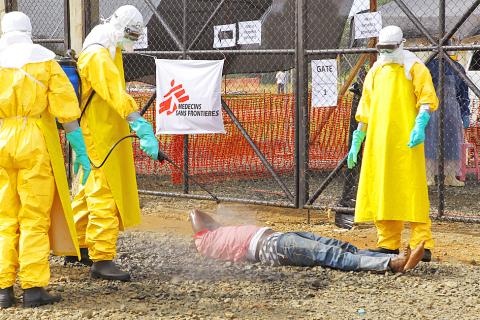
Photo: EPA
Earlier in the day, Stephen Gaojia, head of the Emergency Operations Center that leads the national Ebola response, said a few areas had still not been reached by the government’s teams
“Even though the exercise has been a huge success so far, it has not been concluded in some metropolitan cities like Freetown and Kenema,” he said.
Gaojia said 92 bodies had been recovered across the country by the end of Saturday, the second day of the lockdown.
A total of 123 people had contacted authorities during the drive, believing they might be infected. Of these, 56 tested positive for Ebola, 31 tested negative and 36 were still awaiting their results, he said.
The center announced in the evening that it would not extend the campaign in order to reach the remaining households as it had earlier said might be required.
“It cannot be extended because its objectives have largely been met,” Gaojia said.
Ebola has infected at least 5,357 people in West Africa since March, mainly in Sierra Leone, Guinea and Liberia, killing 2,630 of those, the WHO said. At least 562 have died in Sierra Leone.
The outbreak of the hemorrhagic fever is the worst since it was identified in 1976 in the forests of central Africa.
The lockdown was intended to allow 30,000 health workers, volunteers and teachers to visit every household in the country.
Some criticized the measure before it began on Friday as a rush to stock up on provisions caused a spike in prices, leaving many of Sierra Leone’s poor unable to buy food.
The medical charity Medecins Sans Frontieres has also warned that the lockdown could lead people to conceal cases.
Residents have largely complied with the plan, and the streets of the capital have remained mostly deserted, except for ambulances and police vehicles.
However, a team burying Ebola victims was attacked in Freetown on Saturday, as a small group defied the lockdown.
Liberia, meanwhile, opened a new 150-bed Ebola treatment center in the capital, Monrovia, on Sunday. The country is the worst hit by the epidemic, which was first identified in neighbouring Guinea in March.
The crisis has swamped the already struggling health sectors of Guinea, Sierra Leone and Liberia. In Monrovia, a lack of beds in treatment centers has forced health workers to turn away infected patients, raising the risk of the disease’s further spread.
About 50 patients were immediately transferred to the facility at the city’s Island Clinic from another overflowing hospital, and the government has plans to build 17 new centers across the country.

Kouri Richins, a Utah mother who published a children’s book about grief after the death of her husband is to serve a life sentence for his murder without the possibility of parole, a judge ruled on Wednesday. Richins was convicted in March of aggravated murder for lacing a cocktail given to her husband, Eric Richins, with five times the lethal dose of fentanyl at their home near Park City in 2022. A jury also found her guilty of four other felonies, including insurance fraud, forgery and attempted murder for trying to poison her husband weeks earlier on Feb. 14, 2022, with a

‘GROSS NEGLIGENCE?’ Despite a spleen typically being significantly smaller than a liver, the surgeon said he believed Bryan’s spleen was ‘double the size of what is normal’ A Florida surgeon who is facing criminal charges after allegedly removing a patient’s liver instead of his spleen has said he is “forever traumatized” by that person’s death. In a deposition from November last year that was recently obtained by NBC, 44-year-old Thomas Shaknovsky described the death of 70-year-old William Bryan as an “incredibly unfortunate event that I regret deeply.” Bryan died after the botched surgery; and last month, a grand jury in Tallahassee indicted Shaknovsky on a charge of manslaughter. “I’m forever traumatized by it and hurt by it,” Shaknovsky added, also saying that wrong-site surgeries can happen “during

‘PERSONAL MISTAKES’: Eileen Wang has agreed to plead guilty to the felony, which comes with a maximum sentence of 10 years in federal prison A southern California mayor has agreed to plead guilty to acting as an illegal agent for the Chinese government and has resigned from her city position, officials said on Monday. Eileen Wang (王愛琳), mayor of Arcadia, was charged last month with one count of acting in the US as an illegal agent of a foreign government. She was accused of doing the bidding of Chinese officials, such as sharing articles favorable to Beijing, without prior notification to the US government as required by law. The 58-year-old was elected in November 2022 to a five-person city council, from which the mayor is selected
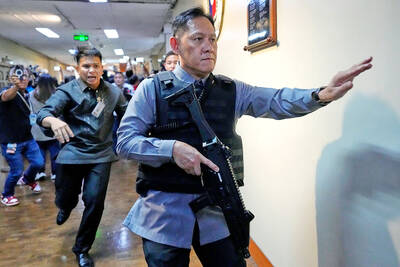
DELA ROSA CASE: The whereabouts of the senator, who is wanted by the ICC, was unclear, while President Marcos faces a political test over the senate situation Philippine authorities yesterday were seeking confirmation of reports that a top politician wanted by the International Criminal Court (ICC) had fled, a day after gunfire rang out at the Philippine Senate where he had taken refuge fearing his arrest. Senator Ronald “Bato” dela Rosa, the former national police chief and top enforcer of former Philippine president Rodrigo Duterte’s “war on drugs,” has been under Senate protection and is wanted for crimes against humanity, the same charges Duterte is accused of. “Several sources confirmed that the senator, Senator Bato, is no longer in the Senate premises, but we are still getting confirmation,” Presidential


 RSS
RSS