


A state-run Chinese newspaper yesterday called for “coercive measures” to be taken against pro-democracy demonstrators in Hong Kong, as China’s rubber-stamp legislature mulls the election method for the territory’s chief executive.
Lawmakers on the standing committee of the National People’s Congress on Monday started reviewing a report from Hong Kong Chief Executive Leung Chun-ying (梁振英) on the issue, Xinhua news agency said earlier.
The meeting comes with public discontent in the territory at its highest for years over perceived interference by Beijing and growing divisions over how its next leader should be chosen in 2017.
Universal suffrage has been promised, but the pro-democracy Occupy Central group has pledged to mobilize thousands of protesters to block the financial district later this year if authorities reject a public right to nominate candidates for the post, currently chosen by a pro-Beijing committee.
Beijing and the territory’s officials have criticized the Occupy Central movement as illegal, radical and potentially violent.
The Global Times, which is owned by the Chinese Communist Party’s mouthpiece the People’s Daily and often adopts a nationalist tone, called on authorities to take a hard line against protest, urging Beijing not to give in to pressure.
“If these activities pose a shocking threat to Hong Kong or continue unabated, enormously dampening the city’s functions, it is imperative that the Hong Kong government adopt coercive measures,” it said in an editorial.
“Even the worst situation is much better than a constitutional crisis with the rise of a chief executive confronting Beijing that will later be compelled to outlaw him,” it said.
The government must knock out the campaigners’ “unrealistic illusions” and make the most aggressive activists “pay for their illegal confrontational behavior,” it said in the editorial, headlined “No compromise of rule on HK chief.”
“As long as we do not allow Hong Kong to fall into the Western sphere of influence, the Chinese mainland and Hong Kong will have inexhaustible resources to make extreme opposition groups and their supporting forces desperate,” it added.

FAKE NEWS? ‘When the government demands the press become a state mouthpiece under the threat of punishment, something has gone very wrong,’ a civic group said The top US broadcast regulator on Saturday threatened media outlets over negative coverage of the Middle East war, after US President Donald Trump slammed critical headlines from the “Fake News Media.” The US president since his first term has derided mainstream media as “fake news” and has sued major outlets over what he sees as unfair coverage. Brendan Carr, head of the US Federal Communications Commission — which oversees the nation’s radio, television and Internet media — said broadcasters risked losing their licenses over news coverage. “The law is clear. Broadcasters must operate in the public interest, and they will
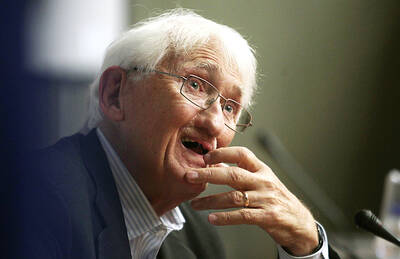
INFLUTENTIAL THEORIST: Habermas was particularly critical of the ‘limited interest’ shown by German politicians in ‘shaping a politically effective Europe Jurgen Habermas, whose work on communication, rationality and sociology made him one of the world’s most influential philosophers and a key intellectual figure in his native Germany, has died. He was 96. Habermas’ publisher, Suhrkamp, said he died on Saturday in Starnberg, near Munich. Habermas frequently weighed in on political matters over several decades. His extensive writing crossed the boundaries of academic and philosophical disciplines, providing a vision of modern society and social interaction. His best-known works included the two-volume Theory of Communicative Action. Habermas, who was 15 at the time of Nazi Germany’s defeat, later recalled the dawn of
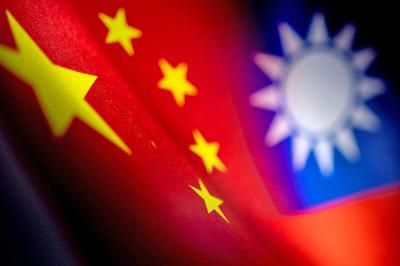
The Chinese public maintains relatively warm sentiments toward Taiwan and strongly prefers non-military paths to improving cross-strait relations, a recent survey conducted by the Atlanta, Georgia-based Carter Center and Emory University showed. The “China Pulse” research project, which polled 2,506 adults between Oct. 27 last year and Jan. 1 this year, found that 86 percent of respondents support strengthening cultural ties, while 81 percent favor deepening economic interaction. The report, co-authored by political scientists at Emory University and advisors at the Carter Center, indicates that the Chinese public views Taiwan’s importance through a lens of shared history and culture rather than geopolitical

Cannabis-based medicines have shown little evidence of effectiveness for treating most mental health and substance-use disorders, according to a large review of past studies published in a major medical journal on Monday. Medical use of cannabinoids has been expanding, including in the US, Canada and Australia, where many patients report using cannabis products to manage conditions such as anxiety, post-traumatic stress disorder and sleep problems. Researchers reviewed data from 54 randomized clinical trials conducted between 1980 and May last year involving 2,477 participants for their analysis published in The Lancet. The studies assessed cannabinoids as a primary treatment for mental disorders or substance-use


 RSS
RSS