


Authorities arrested about 100 people as part of a global crackdown on malicious software used to infect half a million computers, US and European authorities said on Monday.
The software, created by an organization called “BlackShades,” allows hackers to control other people’s computers remotely, recording keystrokes, stealing passwords and gaining access to their personal files.
In some cases, users employed the inexpensive software, known as BlackShades’ remote access tool or RAT, to take over the computers’ cameras and spy on their owners, US officials said at a press conference in New York. They said in other cases, users sent a ransom note, requiring payment before unlocking their victims’ documents.
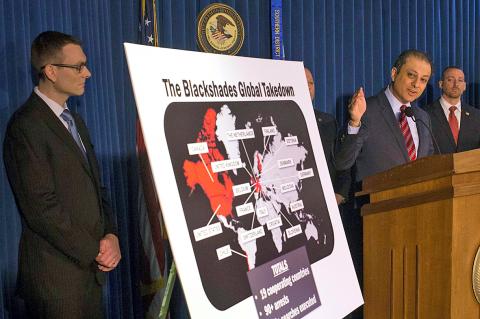
Photo: Reuters
“For just US$40, BlackShades’ RAT enabled anyone, anywhere in the world, to become a dangerous cybercriminal,” US Attorney for the Southern District of New York Preet Bharara told reporters.
In a series of raids over two days, police searched 359 homes in 16 countries in Europe and the Americas, according to Eurojust, the EU’s judicial cooperation agency. In addition to computer hardware, police in Europe seized cash, illegal firearms and drugs, Eurojust said.
A spokeswoman for the FBI said 19 different countries were involved in the investigation.
The crackdown was one of the largest for cybercrime in terms of the number of arrests and countries involved, former computer crimes prosecutor Mark Rasch said.
Swedish man Alex Yucel, 24, owned and operated BlackShades using the alias “marjinz,” according to US authorities, who unsealed charges against him and four others on Monday.
Yucel was arrested in November in Moldova and is awaiting extradition. It was not immediately clear whether he had a lawyer.
Yucel ran the organization as a business, paying a marketing director, a Web site developer and a team of customer service representatives, court documents showed. The group’s Web site included advertisements boasting of its software’s capabilities and ease of use.
BlackShades generated more than US$350,000 in sales between September 2010 and April this year, the documents said. It was not clear how much money users of the software may have stolen from their alleged victims.
The BlackShades investigation arose from a different cybercrime sting by the FBI, called “Operation Cardshop,” in which authorities created a fake Web site to entice criminals to buy and sell credit card numbers.
One of the individuals arrested in 2012 as a result of that probe was Michael Hogue, an Arizona man who the FBI said is the co-creator of BlackShades’ RAT.
Hogue pleaded guilty last year to two computer-related crimes and agreed to cooperate with investigators, providing crucial details about the inner workings of BlackShades, according to court documents unsealed on Monday.
The prosecutor’s office said another BlackShades employee, Brendan Johnston, 23, was arrested in California on Monday. His lawyer could not immediately be identified.

PHISHING: The con might appear convincing, as the scam e-mails can coincide with genuine messages from Apple saying you have run out of storage For a while you have been getting messages from Apple saying “your iCloud storage is full.” They say you have exceeded your storage plan, so documents are no longer being backed up, and photos you take are not being uploaded. You have been resisting Apple’s efforts to get you to pay a minimum of £0.99 (US$1.33) a month for more storage, but it seems that you cannot keep putting off the inevitable: You have received an e-mail which says your iCloud account has been blocked, and your photos and videos would be deleted very soon. To keep them you need
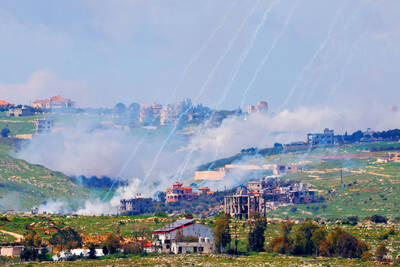
The Israeli military has demolished entire villages as part of its invasion of south Lebanon, rigging homes with explosives and razing them to the ground in massive remote detonations. The Guardian reviewed three videos posted by the Israeli military and on social media, which showed Israel carrying out mass detonations in the villages of Taybeh, Naqoura and Deir Seryan along the Israel-Lebanon border. Lebanese media has reported more mass detonations in other border villages, but satellite imagery was not readily available to verify these claims. The demolitions came after Israeli Minister of Defense Israel Katz called for the destruction of

A US YouTuber who caused outrage for filming himself kissing a statue commemorating Korean wartime sex slaves has been sentenced to six months in prison, a court in Seoul said yesterday. Johnny Somali, 25, gained notoriety several years ago for recording himself doing a series of provocative stunts in South Korea and Japan, and streaming them on platforms such as YouTube and Twitch. South Korean authorities indicted Somali — whose real name is Ramsey Khalid Ismael — in 2024 on public order violations and obstruction of business, and banned him from leaving the country. “The court has sentenced him to six months in
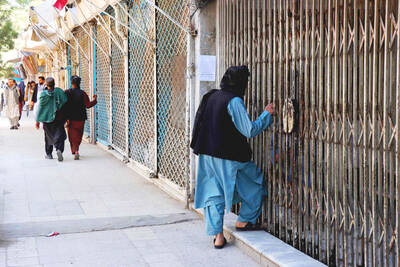
The death toll from a shooting in western Afghanistan rose to 11 on Saturday, after gunmen targeted civilians at a picnic spot in Herat, the provincial authority said. Bullet marks were visible on a wall of the Sayed Mohammad Agha Shia shrine, while bloodstains marked a blanket abandoned at the scene. “Eleven people have been recorded dead and eight others wounded from Friday’s incident, with the condition of two of the wounded reported as critical,” Herat’s information office said in a statement. The update raises a toll of seven killed provided on Friday by the Afghan Ministry of Interior Affairs


 RSS
RSS