


A politically fraught Chinese Communist Party corruption investigation focusing on the former head of the domestic security apparatus, Zhou Yongkang (周永康), has reached into the sensitive realm of the Chinese intelligence services, with the detention of a senior official, people close to party and military leaders said this week.
Beijing Municipal Bureau of State Security Director Liang Ke (梁可) was taken into custody last month by the Central Commission for Discipline Inspection, the party’s arm for investigating official misconduct, according to three people who cited information from leaders notified of the decision. They said the allegations against Liang involved corruption, as well as his ties to Zhou, whose former portfolio included the Chinese Ministry of State Security.
Li Dong (李東) replaces Liang Ke as head of the Beijing’s state security bureau, a statement on the city’s official Web site yesterday, citing a local People’s Congress decision.
A former security official and a policy adviser to party leaders, both speaking on the condition of anonymity, said senior officials had told them that Liang was suspected of aiding Zhou by illicitly passing on information gathered by the bureau’s network of agents, telephone taps and informants in the Chinese capital.
“The official message sent down was that Liang Ke was suspected of corruption,” the former security official said. “But as well, Liang Ke was detained because he is suspected of assisting Zhou Yongkang beyond approved means and channels.”
A businessman whose investments bring him in contact with senior police and military officials also confirmed Liang’s detention, which was said to have occurred in the first half of last month.
The detention takes the investigation encircling Zhou into especially sensitive terrain: The Ministry of State Security and its local bureaus are unaccountable even by China’s standards and rarely discussed in public. In addition to conducting espionage overseas, the service gathers intelligence on officials at home, monitors threats to party control and keeps foreign diplomats and journalists under surveillance. State security officials’ names and comments almost never appear in the media.
Before retiring in November 2012, Zhou was one of nine men on the Politburo Standing Committee — the party’s top decisionmaking body — and headed the committee that oversees China’s courts, police and other arms of domestic security. In his five years in those two posts, he accumulated considerable clout as the party made maintaining social stability a top priority and devoted ever greater resources to the security forces under his control.
The government has not announced any investigation into Zhou, but people close to senior officials have said that Chinese President Xi Jinping (習近平) and other leaders approved the inquiry late last year.
If Zhou is tried and convicted of corruption, he would be the first former or sitting member of the Politburo Standing Committee to confront such a fate.
Liang was appointed director of state security for Beijing in 2008, after rising through the ranks of the city bureau, according to a government Web site. At the time, a report in the Beijing News newspaper said he was 42 and came from Jilin City in northeast China. Since then, few details about his activities have appeared.
After Zhou stepped down in 2012, party anti-corruption officials began removing and investigating a succession of officials and company executives who had career links with him. They started in Sichuan Province, where Zhou was party secretary from 1999 to 2002. The authorities also detained executives, present and previous, of the China National Petroleum Corp, where Zhou had risen to become general manager in the 1990s.
After Zhou retired, his successor in charge of domestic security was not elevated to the Politburo Standing Committee.
Many political insiders have said senior officials were alarmed by Zhou’s tenacious support for disgraced former Chongqing party boss Bo Xilai (薄熙來), the former Politburo member who in September last year was sentenced to life imprisonment for corruption and abuse of power.
The party investigation of Zhou, Liang and others under suspicion may not result in the police filing charges. The police usually take up a criminal investigation only after party disciplinary investigators have finished their inquiry and leaders have recommended such legal proceedings.
Additional reporting by Bloomberg

Crowds in Bangladesh are flocking to snap photographs with an unlikely social media star — an albino buffalo with flowing blond hair nicknamed “Donald Trump” that is due to be sacrificed within days. Owner Zia Uddin Mridha, 38, said his brother named the 700kg bull over its flowing helmet of hair resembling the signature look of the US president. “My younger brother picked this name because of the buffalo’s extraordinary hair,” he said at his farm in Narayanganj, just outside the capital, Dhaka. Mridha said that a constant stream of curious visitors — social media fans, onlookers and children — have come throughout

The Bolivian government on Friday struck a deal with protesting miners, but was still grappling with blockades and demonstrations by other workers across La Paz. Other groups are still blocking access roads into the city, which is also the seat of the government. Police on Thursday prevented the miners from entering the main square by using tear gas, while the demonstrators hurled stones and explosives with slingshots. Protests against the policies of Bolivian President Rodrigo Paz have convulsed the Andean nation since early this month, and roadblocks were choking routes into La Paz throughout Friday, the national road authority said. Miners demanded that Paz
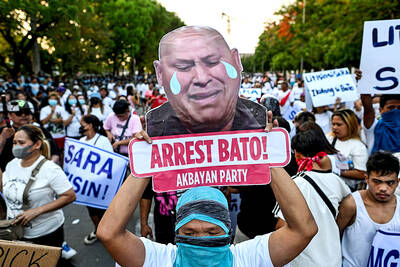
The Philippines said it has asked the country’s Supreme Court to allow it to arrest former Philippine president Rodrigo Duterte’s chief drug war enforcer to stand trial in an international tribunal. The International Criminal Court (ICC) last week unsealed an arrest warrant against Philippine Senator Ronald dela Rosa, accusing him along with Duterte and other “coperpetrators” of the “crime against humanity of murder.” Dela Rosa briefly sought refuge in the Philippine Senate last week while asking the Philippine Supreme Court to stop an ongoing attempt by government agents to arrest him. “By his own conduct, he has placed himself outside the protection of

The researchers in Ireland looked at their computer screen, marveling at a medieval book tracked down in a Roman library. They flipped through its digitized pages and found their sought-after treasure: the oldest surviving English poem. “We were extremely surprised. We were speechless. We couldn’t believe our eyes when we first saw that,” said Elisabetta Magnanti, a visiting research fellow at Trinity College Dublin’s school of English. The poem was also within the main body of Latin text, she said, calling it “extraordinary.” Composed in Old English by a Northumbrian agricultural worker in the 7th century, Caedmon’s Hymn appears within some copies of


 RSS
RSS