


Brazil has no plans to grant asylum to Edward Snowden even after the former US National Security Agency (NSA) contractor offered on Tuesday to help investigate revelations of spying on Brazilians and their president, a local newspaper reported.
The Folha de S.Paulo, citing unnamed government officials, said that the Brazilian government has no interest in investigating the mass Internet surveillance programs Snowden revealed in June and does not intend to give him asylum.
In an “Open Letter to the Brazilian People” published by Folha and social media, Snowden offered to help a congressional probe into NSA spying on the country, including the personal communications of Brazilian President Dilma Rousseff.
“I have expressed my willingness to assist wherever appropriate and lawful, but unfortunately the United States government has worked very hard to limit my ability to do so,” the letter said.
Snowden is living in Russia under temporary asylum that is due to expire in August next year. He has previously asked for asylum in Brazil, among other countries, but Brasilia did not answer his request.
While Snowden stopped short of asking for asylum again in the letter, he suggested that any collaboration with the Brazilian authorities would hinge on them granting him asylum.
“Until a country grants [me] permanent political asylum, the US government will continue to interfere with my ability to speak,” he wrote.
The revelations of NSA spying damaged relations between the US and Latin America’s largest country and prompted Rousseff to cancel a state visit to Washington in October. The spying also led Rousseff to become a global advocate for curbs on Internet surveillance.
Evidence that the NSA monitored Rousseff’s e-mail and cellphone, as well as hacked the network of state-run oil company Petrobras, angered Brazilians and led the Brazilian Senate to investigate the extent of US spying.
Some members of Brazil’s Congress have asked Russia for permission to interview Snowden, but have received no reply, a congressional aide said.
In a Twitter post, Brazilian Senator Ricardo Ferraco, chairman of the Senate’s Committee on Foreign Relations, said “Brazil should not miss the opportunity to grant asylum to Edward Snowden, who was key to unraveling the US espionage system.”
Other politicians — mainly opponents of Rousseff’s leftist government — said granting Snowden asylum would be counterproductive and would lead to further deterioration of ties with the US, Brazil’s largest trading partner after China.
Rights watchdog Amnesty International said Brazil should give “full consideration” to Snowden’s claim for asylum.
A Brazilian Ministry of Foreign Affairs spokesman said Brazil has never received a formal application for asylum from Snowden and so had nothing to consider.
The original English-language version of Snowden’s letter was published on the Facebook of David Miranda, partner of journalist and blogger Glenn Greenwald, who first brought the Snowden leaks to the world’s attention.
Miranda has started a petition on the Web site Avaaz, pressing Rousseff to grant asylum to the “courageous” Snowden.

Crowds in Bangladesh are flocking to snap photographs with an unlikely social media star — an albino buffalo with flowing blond hair nicknamed “Donald Trump” that is due to be sacrificed within days. Owner Zia Uddin Mridha, 38, said his brother named the 700kg bull over its flowing helmet of hair resembling the signature look of the US president. “My younger brother picked this name because of the buffalo’s extraordinary hair,” he said at his farm in Narayanganj, just outside the capital, Dhaka. Mridha said that a constant stream of curious visitors — social media fans, onlookers and children — have come throughout
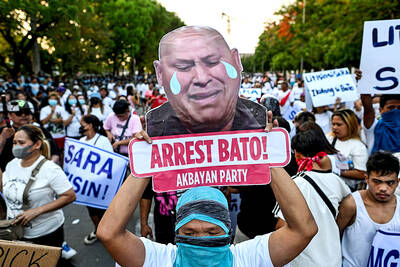
The Philippines said it has asked the country’s Supreme Court to allow it to arrest former Philippine president Rodrigo Duterte’s chief drug war enforcer to stand trial in an international tribunal. The International Criminal Court (ICC) last week unsealed an arrest warrant against Philippine Senator Ronald dela Rosa, accusing him along with Duterte and other “coperpetrators” of the “crime against humanity of murder.” Dela Rosa briefly sought refuge in the Philippine Senate last week while asking the Philippine Supreme Court to stop an ongoing attempt by government agents to arrest him. “By his own conduct, he has placed himself outside the protection of

The researchers in Ireland looked at their computer screen, marveling at a medieval book tracked down in a Roman library. They flipped through its digitized pages and found their sought-after treasure: the oldest surviving English poem. “We were extremely surprised. We were speechless. We couldn’t believe our eyes when we first saw that,” said Elisabetta Magnanti, a visiting research fellow at Trinity College Dublin’s school of English. The poem was also within the main body of Latin text, she said, calling it “extraordinary.” Composed in Old English by a Northumbrian agricultural worker in the 7th century, Caedmon’s Hymn appears within some copies of

It began as a satirical online project. Now millions of young people in India are flocking to it as an outlet for their frustration. A parody political party called the Cockroach Janta Party, with the insect as its symbol, has exploded across India’s social media by turning absurdist humor into protest. Memes and short videos mocking corruption, joblessness and political dysfunction have flooded social media sites, where millions of users are embracing the cockroach — known for its ability to survive harsh conditions — as a tongue-in-cheek symbol of endurance. The online movement’s rise has been unusually rapid. The Cockroach Janta Party (CJP)


 RSS
RSS