


Residents on the tiny Italian island of Lampedusa fought back tears as they spoke of the desperate rush to haul dozens of drowning immigrants out of the sea as hundreds around them sank into the black waters.
“We were spending the night on our boat. We heard screams, and we rushed to see what was going on and found a nightmarish situation,” said Alessandro Marino, a shopkeeper on Lampedusa.
“There were between 150 and 200 people in the water. We managed to save 47 of them. Any more and we risked sinking too,” he said.
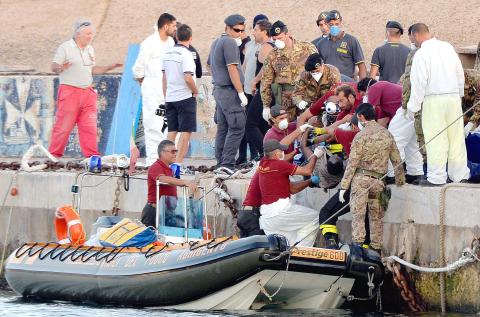
Photo: EPA
Marino and his friend Sharanna Buonocorso were the first on the scene after a boat with up to 500 African asylum seekers caught fire and sank just a few hundred meters off shore in the worst recent refugee disaster in the Mediterranean.
“Many of them were crying. Lots were naked, to give themselves the best chance of staying afloat,” an exhausted-looking Buonocorso said, gazing out over the port where rescuer workers had laid the first victims out in black body bags.
“Many helped pull others from the water; those who couldn’t climb aboard by themselves because they had no strength left,” she said, describing how the cries for help grew weaker as the minutes passed.
About 150 survivors were rescued, and more than 130 corpses found.
Those rescued said people on board had set fire to a blanket to attract the attention of coast guards after the boat began taking on water, and when the flames spread, panicked passengers rushed to one side of the vessel, flipping it over.
Dozens of people were trapped inside as it rolled over and sank and after a day’s frantic search, officials said they doubted anyone else would be found alive.
The blue-and-white flashing lights of coast guard boats could be seen through the darkness as rescue workers continued to trawl the sea where the boat sank, and more divers were being flown in to begin a fresh search of the sunken vessel at dawn.
Local doctor Pietro Bartolo said he had been treating arriving immigrants on Lampedusa since 1991 and had helped survivors of many shipwrecks, but had “never seen such a human tragedy on this scale.”
“The hardest thing was seeing the bodies of the children. They had no chance. They came here in hope of a future which was snatched from them in a moment. It doesn’t take long to succumb to the waves and the cold,” he said.
Preparations were under way to receive hundreds of coffins being shipped in from the mainland, and Red Cross workers moved back and forth from the port to the airport, where bodies were laid out in a temporary morgue.
Local fishermen and inhabitants of the remote island, where about 6,000 people live among the normally tranquil hills and white-sand shores, said they were used to desperate immigrants washing up on their shores, but had never before felt so helpless.
“There was no time. We mobilized boats as soon as we heard what had happened, but for many, for most of the poor souls, it was too late,” waitress Rossella Manuci said.
Survivors said they were from Eritrea and Somalia, and had left from the Libyan port of Misrata. Many were believed to be heading beyond Italy’s borders for other parts of Europe.
Islanders preparing a ceremony to pay homage to the dead yesterday said their biggest fear was that the good weather and calm seas would lead other desperate refugees to attempt the perilous journey in the coming days.
“May god protect them,” Manuci said.

An American scientist convicted of lying to US authorities about payments from China while he was at Harvard University has rebuilt his research lab in Shenzhen, China, to pursue technology the Chinese government has identified as a national priority: embedding electronics into the human brain. Charles Lieber, 67, is among the world’s leading researchers in brain-computer interfaces. The technology has shown promise in treating conditions such as amyotrophic lateral sclerosis and restoring movement in paralyzed people. It also has potential military applications: Scientists at the Chinese People’s Liberation Army have investigated brain interfaces as a way to engineer super soldiers by boosting

Indonesian police have arrested 13 people after shocking images of alleged abuse against small children at a daycare center went viral, sparking outrage across the nation, officials said on Monday. Police on Friday last week raided Little Aresha, a daycare center in Yogyakarta on Java island, following a report from a former employee. CCTV footage circulating on social media showed children, most younger than two, lying on the floor wearing only diapers, their hands and feet bound with rags. The police have confirmed that the footage is authentic. Police said they also found 20 children crammed into a room just 3m by 3m. “So
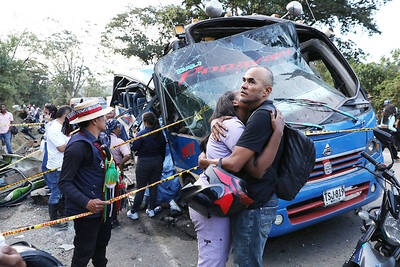
A highway bomb attack in a restive region of southwestern Colombia on Saturday killed 14 people and injured at least 38, the latest spate of violence ahead of next month’s presidential election. Authorities blamed the attack in the Cauca department — a conflict-ridden, coca-growing region — on dissidents of the now-disbanded FARC guerrilla army, who have been sowing violence across the country. “Those who carried out this attack ... are terrorists, fascists and drug traffickers,” Colombian President Gustavo Petro said on social media. “I want our very best soldiers to confront them,” he added. The leftist leader blamed the bombing
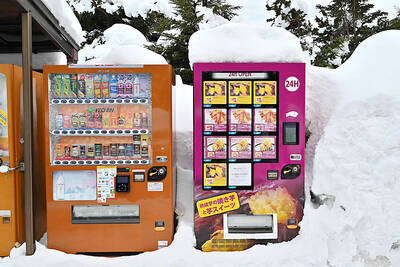
From post offices and parks to stations and even the summit of Mount Fuji, Japan’s vending machines are ubiquitous, but with the rapid pace of inflation cooling demand for their drinks, operators are being forced to rethink the business. Last month beverage giant DyDo Group Holdings announced it would remove about 20,000 vending machines — about 7 percent of their stock nationwide — by January next year, to “reconstruct a profitable network.” Pokka Sapporo Food & Beverage, based in Nagoya, also said last month it would sell its 40,000-machine operation to Osaka-based Lifedrink Co. “The strength of the vending machine


 RSS
RSS