


Red-faced officials issued an embarrassed apology to Japan’s prime minister on Friday after spelling his name wrong during a high-profile tour of the battered Fukushima nuclear plant.
Shinzo Abe was given a specially printed suit to protect him from radiation during the tour on Thursday, on which he was accompanied by a large press pack.
Yet plant operator TEPCO, which has been lambasted internationally for what critics say is its hapless handling of the catastrophe at Fukushima, used the wrong Chinese character for part of Abe’s name.
The first three of the four characters used to write his name were correct; however, the final one represented the same sound, but had a different meaning.
“It was a typing error,” a TEPCO spokesman said. “We are very sorry for the mistake. We sincerely apologize to the prime minister for printing an inaccurate name.”
TEPCO has repeatedly come under fire for its approach to managing the aftermath of the disaster at Fukushima, with a government minister describing it as akin to someone playing “whack-a-mole.”
The giant utility was pilloried on Twitter over the gaffe on Friday.
User @YuriSakamoto tweeted: “They can’t get anything right, can they?”
“Isn’t it a big deal that TEPCO didn’t think twice about misspelling the name of the country’s prime minister and had him wear it,” @PsychoQueen59 said, while @ShoHgo_chirpy said: “TEPCO cannot even check on something as trivial as this.”
Abe’s visit was part of a public relations push that the government has launched to prove the battered plant is no danger to Japan or to the rest of the world.
Earlier this month, the premier, during Tokyo’s successful pitch to host the 2020 Games, told Olympic chiefs: “Let me assure you, the situation is under control.”

SPEAKING OUT: After Siranudh Scott’s allegations surfaced, celebrities and public figures took to social media to share their own experiences of sexual misconduct and abuse A high-profile alleged sexual abuse case within a wealthy Thai beer brewing family has prompted a wave of painful accounts from survivors of unconnected abuse in the conservative nation. Siranudh Scott, a member of the billionaire Thai family that founded the ubiquitous Singha beer brand, posted an emotional video this month accusing his elder brother Sunit of repeatedly abusing him when he was a teenager. Sunit, who is in his 30s, later denied the allegations in a video posted online, but Singha parent Boonrawd dismissed him from his executive role with the company on Tuesday last week. “I felt I needed to speak

SEEKING ORDER: Rodrigo Paz said that ‘anyone who wants to destroy the nation will have to deal with this president and the full force of the constitution’ Bolivian President Rodrigo Paz on Wednesday said that the nation was at a “breaking point” after nearly a month of protests that have caused shortages of food, fuel and medicine. Paz, who took office six months ago amid the worst economic crisis there in four decades, is battling a groundswell of fury over his policies. The political capital, La Paz, has been besieged by low-income workers and members of the indigenous majority calling for his resignation. “The country needs order and is reaching breaking point,” the 58-year-old said at a public event in La Paz, renewing his appeal for dialogue. On Tuesday, the Bolivian

‘CROSSING THE LINE’: China’s embassy in Seoul criticized US Forces Korea Commander General Xavier Brunson, asking if his ‘hostile’ remarks were authorized by Washington South Korea and the US are in talks over recent public remarks by the commander of US Forces Korea, Seoul’s presidential office said yesterday, after the comments drew sharp criticism from China. In a recent podcast interview, US Forces Korea Commander General Xavier Brunson described South Korea as “the dagger in the heart of Asia” from China’s east coast, prompting the Chinese embassy in Seoul to say that he had “truly crossed the line.” The interview came amid growing speculation that Washington might seek to expand the role of US Forces Korea in countering the growing regional influence of China, a key
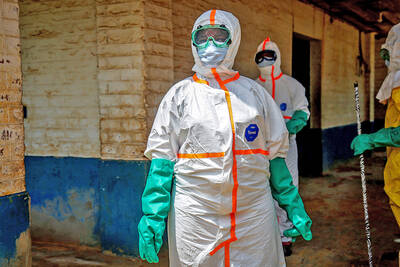
COMMUNITY CONFLICT: Concerns about disease spread from corpses has run up against friends and families’ desire to bury their dead as infection spreads in the area Angry residents of a town at the epicenter of the Ebola outbreak in the Democratic Republic of the Congo (DR Congo) attacked and burned a tent that was part of a health center where people are being treated for the virus, the staff there said Saturday. It was the second such attack in the region in a week. No one was hurt in the attack, according to reports but as patients ran out to escape the fire, 18 people with suspected Ebola infections fled the facility and are unaccounted for, a hospital director said. Angry residents arrived at the clinic in the


 RSS
RSS