


Russia yesterday warned of a potential “manmade catastrophe” if North Korea restarts an aging plutonium reactor to boost its stockpile of nuclear weapons, after US experts spotted steam rising from the Yongbyon facility.
The reactor, which was completed in 1986, is outdated and North Korea could suffer a major disaster if it is restarted, a Russian diplomatic source told the Interfax news agency.
The warning came after researchers at the US-Korea Institute said on Wednesday that satellite images taken on Aug. 31 showed plumes of white steam rising from a building next to the reactor.
“Our main concern is linked to a very likely manmade disaster as a consequence. The reactor is in a nightmarish state, it is a design dating back to the 1950s,” the Russian source said. “For the Korean Peninsula this could entail terrible consequences, if not a manmade catastrophe.”
Meanwhile, the US envoy on North Korea said the reported restart of the reactor would be “a misstep on the part of North Korea.”
“If it turns out that these reports are true that North Korea has restarted the five-megawatt plutonium reactor, this would be a very serious matter,” Glyn Davies told reporters after meeting Japanese foreign ministry officials in Tokyo.
The Russian diplomat speaking to Interfax said he did not know for sure whether North Korea had relaunched the facility mothballed in 2007.
“It is obvious that some works are being conducted, and for a long time at that. According to some signs, steps were indeed being taken to relaunch it,” the diplomat said. “We do not have any information that the reactor has been relaunched.”
The image examined by researchers at the US-Korea Institute shows that North Korea “appears to have put the reactor into operation,” researchers Nick Hansen and Jeffrey Lewis wrote on the institute’s blog, 38 North.
However, the white steam picked up by satellites “could simply be testing of the generator,” the Russian diplomatic source cited by Interfax cautioned.
The International Atomic Energy Agency (IAEA) said it was unable to verify whether the reactor had been restarted since North Korea has barred its inspectors since 2009.
“We are aware of the media report,” IAEA spokeswoman Gill Tudor said.
“The agency continues its monitoring of the DPRK’s [Democratic People’s Republic of Korea] nuclear activities by available means, such as satellite imagery analysis,” he said.
The restart of the plutonium reactor would undermine years of efforts by the international community to stall and roll back North Korea’s pursuit of an advanced nuclear deterrent. It would also call into question the effectiveness of the current policy of non-engagement with Pyongyang.


Showcasing phallus-shaped portable shrines and pink penis candies, Japan’s annual fertility festival yesterday teemed with tourists, couples and families elated by its open display of sex. The spring Kanamara Matsuri near Tokyo features colorfully dressed worshipers carrying a trio of giant phallic-shaped objects as they parade through the street with glee. The festival, as legend has it, honors a local blacksmith in the Edo Period (1603-1868) who forged an iron dildo to break the teeth of a sharp-toothed demon inhabiting a woman’s vagina that had been castrating young men on their wedding nights. A 1m black steel phallus sits in the courtyard of

JAN. 1 CLAUSE: As military service is voluntary, applications for permission to stay abroad for over three months for men up to age 45 must, in principle, be granted A little-noticed clause in sweeping changes to Germany’s military service policy has triggered an uproar after it emerged that the law requires men aged up to 45 to get permission from the armed forces before any significant stay abroad, even in peacetime. The legislation, which went into effect on Jan. 1 aims to bolster the military and demands all 18-year-old men fill out a questionnaire to gauge their suitability to serve in the armed forces, but stops short of conscription. If the “modernized” model fails to pull in enough recruits, parliament will be compelled to discuss the reintroduction of compulsory service, German
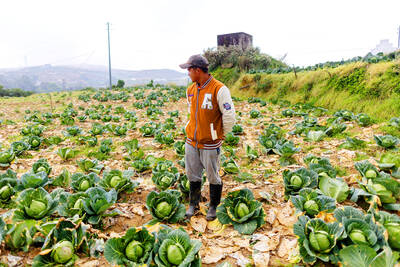
Filipino farmers like Romeo Wagayan have been left with little choice but to let their vegetables rot in the field rather than sell them at a loss, as rising oil prices linked to the Iran war drive up the cost of harvesting, labor and transport. “There’s nothing we can do,” said Wagayan, a 57-year old vegetable farmer in the northern Philippine province of Benguet. “If we harvest it, our losses only increase because of labor, transportation and packing costs. We don’t earn anything from it. That’s why we decided not to harvest at all,” he said. Soaring costs caused by the Middle East

Hungarian Prime Minister Viktor Orban’s officially declared wealth is fairly modest: some savings and a jointly owned villa in Budapest. However, voters in what Transparency International deems the EU’s most corrupt country believe otherwise — and they might make Orban pay in a general election this Sunday that could spell an end to his 16-year rule. The wealth amassed by Orban’s inner circle is fueling the increasingly palpable frustration of a population grappling with sluggish growth, high inflation and worsening public services. “The government’s communication machine worked well as long as our economic situation remained relatively good,” said Zoltan Ranschburg, a political analyst


 RSS
RSS