


Spanish police yesterday detained the driver of a train that crashed in northwestern Spain, lowered the death toll from 80 to 78 and took possession of the “black boxes” of the train expected to shed light on why it was going faster than the speed limit on the curve where it derailed.
And in an interview with the Associated Press, an US passenger injured on the train said he saw on a TV monitor screen inside his car that the train was traveling 194kph seconds before the crash — far above the 80kph speed limit on the curve where it derailed.
The driver, Francisco Jose Garzon Amo, was officially detained in the hospital where he was recovering, said Jaime Iglesias, the National Police chief of the Galicia region where the crash happened just on the outskirts of the regional capital, Santiago de Compostela.
Iglesias said that Garzon Amo would be questioned “as a suspect for a crime linked to the cause of the accident.”
The driver, under guard by police, cannot yet testify because of his medical condition, Iglesias said, adding that he did not have details of the medical condition but that it could delay efforts by police to question him.
The revised death toll from 80 to 78 came as forensic scientists matched body parts with each other at a makeshift morgue set up in a sports arena in Santiago de Compostela, said Antonio de Amo, the police chief in charge of the scientific service for the National Police.
De Amo said police were still working to identify what they believe are the remains of six people, and that the count could change as they continue their work associating body parts with each other.
Meanwhile, investigators have taken possession of the “black boxes” of the train, court spokeswoman Maria Pardo Rios. The boxes record train’s trip data, including speed and distances and braking and are similar to flight recorders for airplanes.
Analysis will be performed on the boxes but she declined comment on how long the analysis will take.
Stephen Ward, 18-year-old Mormon missionary from Utah, said he was writing in his journal when he looked up at the monitor and saw the train’s speed.
Then “the train lifted up off the track. It was like a roller coaster,” he said.
Seconds later, Ward said, a backpack fell from the rack above him and he felt the train fly off the track.
That was his last memory before he blacked out on impact.
When Ward woke up, someone was helping him walk out of his train car and crawl out of a ditch where the car had toppled over. He thought he was dreaming for 30 seconds until he felt his blood-drenched face and noticed the scene around him.
“Everyone was covered in blood. There was smoke coming up off the train,” he said.
“There was a lot of crying, a lot of screaming. There were plenty of dead bodies. It was quite gruesome,” he said.

FAKE NEWS? ‘When the government demands the press become a state mouthpiece under the threat of punishment, something has gone very wrong,’ a civic group said The top US broadcast regulator on Saturday threatened media outlets over negative coverage of the Middle East war, after US President Donald Trump slammed critical headlines from the “Fake News Media.” The US president since his first term has derided mainstream media as “fake news” and has sued major outlets over what he sees as unfair coverage. Brendan Carr, head of the US Federal Communications Commission — which oversees the nation’s radio, television and Internet media — said broadcasters risked losing their licenses over news coverage. “The law is clear. Broadcasters must operate in the public interest, and they will
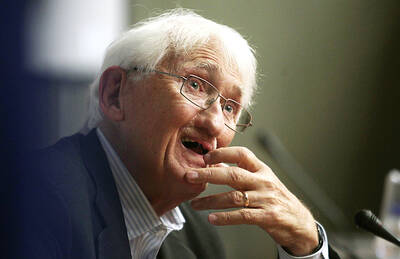
INFLUTENTIAL THEORIST: Habermas was particularly critical of the ‘limited interest’ shown by German politicians in ‘shaping a politically effective Europe Jurgen Habermas, whose work on communication, rationality and sociology made him one of the world’s most influential philosophers and a key intellectual figure in his native Germany, has died. He was 96. Habermas’ publisher, Suhrkamp, said he died on Saturday in Starnberg, near Munich. Habermas frequently weighed in on political matters over several decades. His extensive writing crossed the boundaries of academic and philosophical disciplines, providing a vision of modern society and social interaction. His best-known works included the two-volume Theory of Communicative Action. Habermas, who was 15 at the time of Nazi Germany’s defeat, later recalled the dawn of

The Chinese public maintains relatively warm sentiments toward Taiwan and strongly prefers non-military paths to improving cross-strait relations, a recent survey conducted by the Atlanta, Georgia-based Carter Center and Emory University showed. The “China Pulse” research project, which polled 2,506 adults between Oct. 27 last year and Jan. 1 this year, found that 86 percent of respondents support strengthening cultural ties, while 81 percent favor deepening economic interaction. The report, co-authored by political scientists at Emory University and advisors at the Carter Center, indicates that the Chinese public views Taiwan’s importance through a lens of shared history and culture rather than geopolitical

Cannabis-based medicines have shown little evidence of effectiveness for treating most mental health and substance-use disorders, according to a large review of past studies published in a major medical journal on Monday. Medical use of cannabinoids has been expanding, including in the US, Canada and Australia, where many patients report using cannabis products to manage conditions such as anxiety, post-traumatic stress disorder and sleep problems. Researchers reviewed data from 54 randomized clinical trials conducted between 1980 and May last year involving 2,477 participants for their analysis published in The Lancet. The studies assessed cannabinoids as a primary treatment for mental disorders or substance-use


 RSS
RSS