


Among the many strange mantras repeated by climate change deniers is the claim that even in an overheated, climate-altered planet, animals and plants will still survive by adapting to global warming. Corals, trees, birds, mammals and butterflies are already changing to the routine reality of global warming, it is argued.
Certainly, countless species have adapted to past climate fluctuations.
However, their rate of change turns out to be painfully slow, according to a study by John Wiens, a professor at the University of Arizona.
Using data from 540 living species, including amphibians, reptiles, birds and mammals, Wiens and colleagues compared their rates of evolution with the rates of climate change projected for the end of this century.
The results, published online in the journal Ecology Letters, show that most land animals will not be able to evolve quickly enough to adapt to the dramatically warmer climate expected by 2100, which means many species face extinction.
“We found that, on average, species usually adapt to different climatic conditions at a rate of only by about 1oC per million years,” Wiens said.
“But if global temperatures are going to rise by about four degrees over the next 100 years as predicted by the Intergovernmental Panel on Climate Change, that is where you get a huge difference in rates. What that suggests overall is that simply evolving to match these conditions may not be an option for many species,” he added.
The study indicates there is simply not enough time for species to change their morphologies, for example, by altering their bodies’ shapes so they hold less heat to compensate for rising heat levels.
Too many generations of evolutionary change are required. Nor is moving to a cooler habitat an option for many creatures.
“Consider a species living on the top of a mountain,” Wiens said. “If it gets too warm or dry up there, they can’t go anywhere.”
The crucial point of the study is that it stresses a fact that is often conveniently ignored by climate change deniers.
It is not just the dramatic nature of the changes that lie ahead, melting icecaps, rising sea levels and soaring temperatures, but the extraordinary speed at which they will occur.
Past transformations that saw planetary temperatures soar took millions of years to occur.
The one we are creating will take only a few generations to take place. Either evolution speeds up 10,000-fold, which is an unlikely occurrence, or there will be widespread extinctions.

FAKE NEWS? ‘When the government demands the press become a state mouthpiece under the threat of punishment, something has gone very wrong,’ a civic group said The top US broadcast regulator on Saturday threatened media outlets over negative coverage of the Middle East war, after US President Donald Trump slammed critical headlines from the “Fake News Media.” The US president since his first term has derided mainstream media as “fake news” and has sued major outlets over what he sees as unfair coverage. Brendan Carr, head of the US Federal Communications Commission — which oversees the nation’s radio, television and Internet media — said broadcasters risked losing their licenses over news coverage. “The law is clear. Broadcasters must operate in the public interest, and they will

INFLUTENTIAL THEORIST: Habermas was particularly critical of the ‘limited interest’ shown by German politicians in ‘shaping a politically effective Europe Jurgen Habermas, whose work on communication, rationality and sociology made him one of the world’s most influential philosophers and a key intellectual figure in his native Germany, has died. He was 96. Habermas’ publisher, Suhrkamp, said he died on Saturday in Starnberg, near Munich. Habermas frequently weighed in on political matters over several decades. His extensive writing crossed the boundaries of academic and philosophical disciplines, providing a vision of modern society and social interaction. His best-known works included the two-volume Theory of Communicative Action. Habermas, who was 15 at the time of Nazi Germany’s defeat, later recalled the dawn of
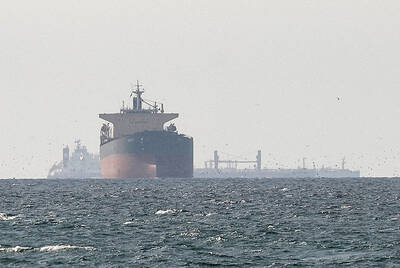
A ship that appears to be taking on the identity of a scrapped gas carrier exited the Strait of Hormuz on Friday, showing how strategies to get through the waterway are evolving as the Middle East war progresses. The vessel identifying as liquefied natural gas (LNG) carrier Jamal left the Strait on Friday morning, ship-tracking data show. However, the same tanker was also recorded as having beached at an Indian demolition yard in October last year, where it is being broken up, according to market participants and port agent’s reports. The ship claiming to be Jamal is likely a zombie vessel that

The Chinese public maintains relatively warm sentiments toward Taiwan and strongly prefers non-military paths to improving cross-strait relations, a recent survey conducted by the Atlanta, Georgia-based Carter Center and Emory University showed. The “China Pulse” research project, which polled 2,506 adults between Oct. 27 last year and Jan. 1 this year, found that 86 percent of respondents support strengthening cultural ties, while 81 percent favor deepening economic interaction. The report, co-authored by political scientists at Emory University and advisors at the Carter Center, indicates that the Chinese public views Taiwan’s importance through a lens of shared history and culture rather than geopolitical


 RSS
RSS