


Islamist cleric Abu Qatada yesterday pleaded not guilty to terror charges pressed by Jordanian military prosecutors just hours after his deportation from Britain, his lawyer said.
Abu Qatada, who had been in and out of British prisons since 2002 even though he was never convicted of any offence, had once been described as former al-Qaeda leader Osama bin Laden’s right-hand man in Europe.
“Abu Qatada pleaded not guilty,” defense lawyer Taysir Diab said after the closed-door hearing before a military tribunal. “I will appeal tomorrow [Monday] to the court to release him on bail.”
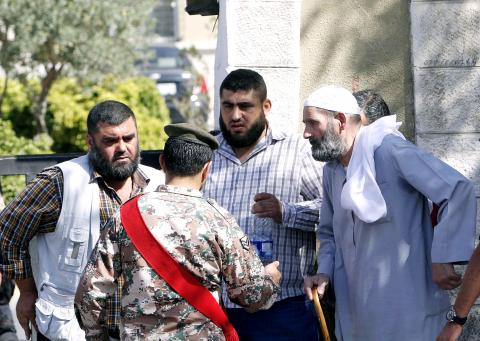
Photo: EPA
The Palestinian-born preacher was handed over to prosecutors straight after he landed at Marka military airport in east Amman.
He was later taken to a military courthouse near the airfield, where his father, brothers and other family members had been waiting for his arrival, a photographer reported.
“State security court prosecutors charged Abu Qatada with conspiracy to carry our terrorist acts,” a judicial official said. “He was remanded in judicial custody for 15 days in the Muwaqqar prison.”
Reporters were not allowed into the courtroom to hear the charges being read out despite a pledge by Jordanian Information Minister Mohammad Momani of “transparency” in Jordan’s handling of Abu Qatada’s retrial.
Earlier in the day Momani said Qutada’s retrial “would be conducted in line with international standards, protecting his rights and ensuring justice, fairness, credibility and transparency.”
A security official said that after his arrival “a team of doctors including the state coroner examined the suspect and made sure there were no signs of torture.”
Abu Qatada was condemned to death in absentia in 1999 for conspiracy to carry out terror attacks, including on the American school in Amman, but the sentence was immediately commuted to life imprisonment with hard labor.
In 2000, he was sentenced in his absence to 15 years for plotting to carry out terror attacks on tourists in Jordan during millennium celebrations.
Under Jordanian law, he has the right to a retrial in his presence.
Britain was finally able to expel the 53-year-old father-of-five after the two governments last month ratified a Treaty on Mutual Legal Assistance in Criminal Matters, guaranteeing that evidence obtained by torture would not be used in his retrial.
He was taken from prison in an armored police van to Royal Air Force Northolt base on the outskirts of London.
British Home Secretary Theresa May said his departure proved that the government’s efforts to deport him had been worth the £1.7 million (US$2.7 million) legal bill and would be “welcomed by the British public.”
“This dangerous man has now been removed from our shores to face the courts in his own country,” she said in a statement released seconds after Abu Qatada’s plane took off.
Television pictures showed Abu Qatada dressed in a white robe as he boarded the aircraft at the airbase.
He had earlier left high security Belmarsh jail in southeast London in a blue armored police van flanked by three police cars.
London had been trying to deport him since 2005.
British and European courts blocked his expulsion on the grounds that evidence might be used against him that had been obtained by torture.
However, after years of legal battles his lawyers in May unexpectedly said he would return there once the fair trial treaty was ratified by the Jordanian parliament.
“I am glad that this government’s determination to see him on a plane has been vindicated and that we have at last achieved what previous governments, parliament and the British public have long called for,” May said.
British Prime Minister David Cameron yesterday said he was happy the cleric had been deported.
“I was absolutely delighted. This is something this government said it would get done, and we have got it done,” Cameron told reporters. “It’s an issue that, like the rest of the country, has made my blood boil.”
Abu Qatada’s wife and five children are expected to remain in Britain, where he first sought asylum in 1993.
Born Omar Mahmud Mohammed Otman in Bethlehem in the now Israeli-occupied West Bank, Abu Qatada has Jordanian nationality because the town was part of Jordan at the time of his birth.
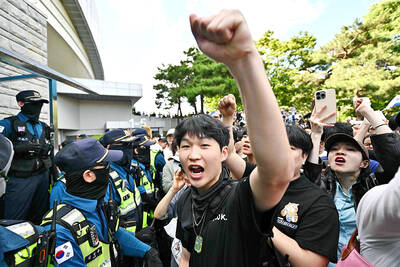
‘ABSURD MISTAKE’: The election commission said that there had been a failure to anticipate turnout after 14 polling stations ran short of ballot papers South Korean riot police yesterday cleared protesters from a Seoul polling station after a 35-hour blockade sparked by a shortage of ballot papers during local elections earlier this week. Wednesday’s election was the first nationwide vote since South Korean President Lee Jae-myung took office following the ouster of Yoon Suk-yeol over his short-lived martial law declaration. Lee’s ruling Democratic Party swept most races, but failed to flip the crucial Seoul mayoral seat. The South Korean National Election Commission apologized, blaming a failure to anticipate turnout after 14 polling stations in Seoul ran short of ballot papers. Some polling stations stayed open until 10pm to

France experienced its hottest spring on record, the French weather service said on Tuesday, after an exceptional early heat wave that also broke highs for the season in England and Wales. Meteo-France said the average nationwide temperature over March to May was 13.8°C — about 1.7°C above the norm, and surpassing records set in 2011 and 2020. “The warmest spring since records began in 1900,” it said in a bulletin. All three months were warmer than average, but the onset of an “unprecedented heatwave” late last month pushed the mercury to highs typically seen at the height of the summer. “Our country had never
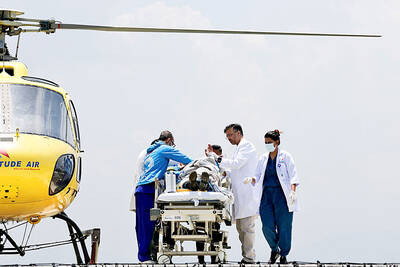
A Sherpa guide was found crawling to base camp on Mount Everest a week after he went missing and was reunited with his family, who had given up hope he would return. Dawa Sherpa was last seen on Friday last week descending the mountain, but he did not reach base camp even though his client did. The pair were among the last climbers on the mountain as the climbing season came to an end and the route was dismantled. Dawa was located by a cleaning crew on Thursday morning as he was crawling down the snowy slopes around the Khumbu Icefall, just above
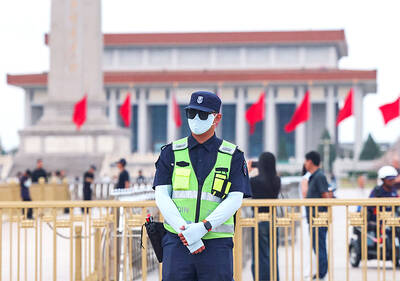
Chinese authorities are snuffing out any remembrance of the deadly 1989 military crackdown on student-led pro-democracy protests in Tiananmen Square, which happened 37 years ago yesterday, in a further tightening of a years-long campaign to erase what happened from public memory. Police told relatives of the victims they would not be allowed to visit a cemetery in Beijing on the anniversary of the crackdown, a person with knowledge of the matter said. Relatives of the victims visited the cemetery on the anniversary for more than 30 years to read memorial statements with police keeping watch, Amnesty International said. Hundreds of people,


 RSS
RSS