


Venezuelan authorities on Friday freed a judge who was arrested in 2009 after late Venezuelan president Hugo Chavez objected to one of her rulings. Her case became a cause celebre for the opposition and international human rights groups.
Dozens of supporters met Maria Lourdes Afiuni outside the apartment building where she has been under house arrest with cries of “freedom,” as she walked to the street without handcuffs or police escort for the first time in three-and-a-half years.
Amid a few tears, she thanked the well-wishers for coming out, but declined to comment further since she is still under a gag order not to discuss her case publicly. Instead the judge, her daughter and her lawyers went to a church to pray.
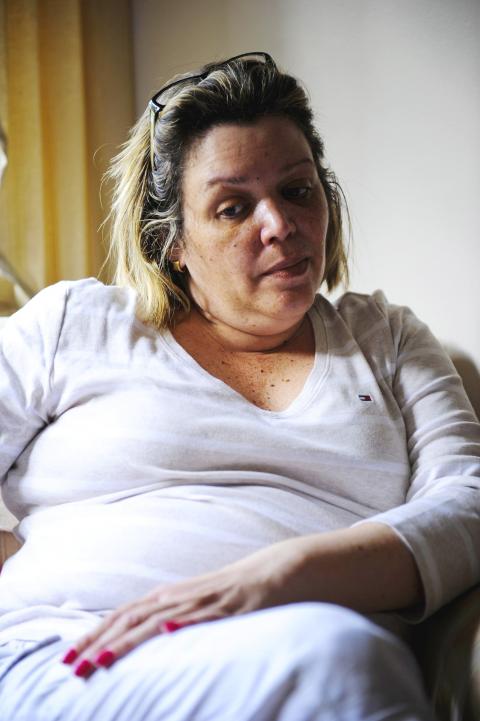
Photo: AFP
Thelma Fernandez, an attorney for the 50-year-old magistrate widely considered Venezuela’s most high-profile political prisoner, said a Caracas judge had released Afiuni from house arrest so she can seek treatment for health problems.
The ruling does not erase the charges of corruption, abuse of authority and aiding an inmate’s escape for which Chavez called for her to be jailed. There was no immediate comment from the government
Afiuni had crossed Chavez by freeing a banker accused of violating currency controls while he awaited trial. The banker fled the country and sought asylum in the US.
Chavez, who died of cancer on March 5, was livid after her order.
“A judge who frees a criminal is much, much, much more serious than the criminal himself,” he said in a televised speech. “This judge should get the maximum penalty, and whoever does this — 30 years in prison ... That judge has to pay for what she has done.”
Critics said the Afiuni case exemplified how Chavez had come to control the judiciary after increasing the size of courts and stocking them with friendly magistrates. Although Venezuela’s government says it holds no political prisoners, Afiuni was considered such by Amnesty International, Human Rights Watch and noted US intellectual Noam Chomsky, an early champion of Chavez for his anti-poverty programs.
After more than a year in a women’s prison, Afiuni was transferred to house arrest at her apartment in the capital in 2011.
In November last year, a court began trying her in absentia. She refused to attend, saying her rights were being violated and she did not recognize the court’s right to judge her.
Jose Amalio Graterol, another of Afiuni’s lawyers, said she will continue to boycott the proceedings, but comply with an order to check in with court officials every 15 days as a condition of her release. She is also barred from leaving the country.
Also last year, writer Francisco Olivares published a book saying Afiuni told him she was raped in prison in 2010, became pregnant and lost the fetus.
Venezuela’s head of prisons rejected that allegation as a “vile lie.”

Voters in Switzerland yesterday cast their ballots on an initiative championed by the top right-wing party to cap the Alpine country’s population at 10 million. As of press time last night, early results showed that Swiss voters were leaning against it. The populist Swiss People’s Party, which has the most seats in parliament, has stirred up and fostered anti-migration sentiment over the years, notably about an influx of workers from the neighboring EU. Critics called the bid a self-inflicted wound, saying the boom in migration over the past generation has brought foreign labor and skills to sectors such as healthcare, finance, pharmaceuticals

FOREIGN POLICY-FOCUSED: Academic Min Zin founded ISP Myanmar, which writes about China-Myanmar trade and is involved in exchanges with Chinese think tanks A US academic who writes about Myanmar and Chinese foreign policy was arrested by authorities in China on suspicion of spying, China’s Ministry of Foreign Affairs said on Friday. The academic, Min Zin, was suspected of “engaging in espionage activities that endanger China’s national security,” ministry spokesman Lin Jian (林劍) said. It is uncommon for Beijing to arrest a US citizen on national security allegations. The case comes just a month after US President Donald Trump met with Chinese President Xi Jinping (習近平) in Beijing as the two countries aim to reset a tumultuous relationship. A Burmese activist who knows Min Zin said

Kazakhstan signed accords with the start-up Firebird Inc on computing projects involving Nvidia Corp that could bring as much as US$10 billion in investment, as the Central Asian energy producer looks to position itself as an artificial intelligence (AI) hub. The pacts include a strategic cooperation agreement on developing AI infrastructure and terms for a planned large-scale project known as Data Center Valley in the country’s northeast, the Kazakh Ministry of Artificial Intelligence and Digital Development said in a statement. The plan envisages US$5 billion in investments in phase one — including US$1 billion provided by state-run Kazakhtelecom — with commercial operations

Growing up in Tahiti, Anna-Bella Failloux saw first-hand the threat posed by mosquitoes: Nearly one-third of adults on the picturesque island once had swollen limbs from elephantiasis caused by their bites. She has since dedicated her life to studying mosquitoes and the diseases they transmit — a concern that looms ever larger as climate change expands the area where the insects roam. “You have to accept being bitten by a mosquito from time to time,” the 63-year-old entomologist at France’s Pasteur Institute said. “But we have to avoid too many people getting sick and dying from the infections,” Failloux said, as she observed


 RSS
RSS