


Police detained about 15 anti-China protestors yesterday during a march in the Vietnamese capital that showed the domestic pressure the government faces when dealing with Beijing’s muscular approach to territorial claims in the South China Sea.
Scuffles broke out as police hauled ringleaders or especially vocal protesters into buses during the rally, a rare show of dissent in the tightly controlled one-party state.
Some members of the ruling Vietnamese Communist Party fear that popular anger over China, its ideological ally and biggest trading partner, could easily bleed into a broader protest movement against its rule.
The party already faces growing calls for reform because of economic malaise, corruption and the free spread of information critical toward it over the Internet.
Yesterday’s protest was advertised via Internet blogs and Facebook pages.
It took place in the heart of the city near the Hoan Kiem Lake, a popular Sunday morning spot for locals and foreign tourists to walk and sip coffee in cafes.
“Down with the henchmen of China, down with the traitors,” one detainee shouted through the window of a government bus taking him away.
Authorities warned via loudspeakers that those marching should disperse, but also said the government was determined to defend its sovereignty against China.
Uniformed and plainclothes security officers outnumbered the approximately 150 protesters, which included men, women and children, some holding banners calling China a “bully.”
It was unclear whether those detained would be charged. Typically, people detained at protests like this are released after a few hours.
“The government is not doing enough, it must do more [against China],” said Nguyen Quang A, a well-known economist who took part in the march.
Vietnam and China have long sparred over who owns the South China Sea, a dispute that Taiwan, the Philippines, Malaysia and Brunei are also parties to.
Over the past two years, the US’ diplomatic tilt to Southeast Asia and energy-hungry China’s growing assertiveness in the waters has focused international attention on the issue.
Last week, the Vietnamese government alleged a Chinese vessel had rammed into a Vietnamese fishing boat, damaging it.
China said it had done nothing wrong.
The deputies of the National Assembly urged the government to take stronger action to defend the country’s sovereignty and protect its fishermen.
In Singapore yesterday, Vietnamese Deputy Minister of National Defense Colonel-General Nguyen Chi Vinh told a security conference that the region has not enjoyed stability and called for protection for fishermen and to “avoid the use of force against the fishermen by all means.”
In the summer of 2011, there were two months of weekly anti-Chinese protests in Hanoi, an unprecedented show of popular anger in the country.
Last year, there also demonstrations against Beijing, which police dispersed, gradually using more force as it became clear they were becoming a source of domestic opposition to the party.
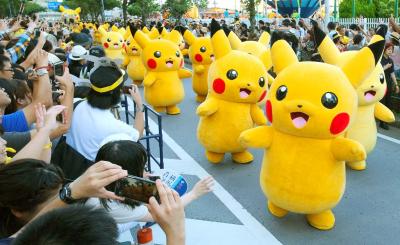
China’s military news agency yesterday warned that Japanese militarism is infiltrating society through series such as Pokemon and Detective Conan, after recent controversies involving events at sensitive sites. In recent days, anime conventions throughout China have reportedly banned participants from dressing as characters from Pokemon or Detective Conan and prohibited sales of related products. China Military Online yesterday posted an article titled “Their schemes — beware the infiltration of Japanese militarism in culture and sports.” The article referenced recent controversies around the popular anime series Pokemon, Detective Conan and My Hero Academia, saying that “the evil influence of Japanese militarism lives on in

DIPLOMATIC THAW: The Canadian prime minister’s China visit and improved Beijing-Ottawa ties raised lawyer Zhang Dongshuo’s hopes for a positive outcome in the retrial China has overturned the death sentence of Canadian Robert Schellenberg, a Canadian official said on Friday, in a possible sign of a diplomatic thaw as Canadian Prime Minister Mark Carney seeks to boost trade ties with Beijing. Schellenberg’s lawyer, Zhang Dongshuo (張東碩), yesterday confirmed China’s Supreme People’s Court struck down the sentence. Schellenberg was detained on drug charges in 2014 before China-Canada ties nosedived following the 2018 arrest in Vancouver of Huawei chief financial officer Meng Wanzhou (孟晚舟). That arrest infuriated Beijing, which detained two Canadians — Michael Spavor and Michael Kovrig — on espionage charges that Ottawa condemned as retaliatory. In January

A sign hanging from a rusty ice-green shipping container installed by Thai forces on what they say is the border with Cambodia reads: “Cambodian citizens are strictly prohibited from entering this area.” On opposite sides of the makeshift barricade, fronted by coils of barbed wire, Cambodians lamented their lost homes and livelihoods as Thailand’s military showed off its gains. Thai forces took control of several patches of disputed land along the border during fighting last year, which could amount to several square kilometers in total. Cambodian Kim Ren said her house in Chouk Chey used to stand on what is now the Thai
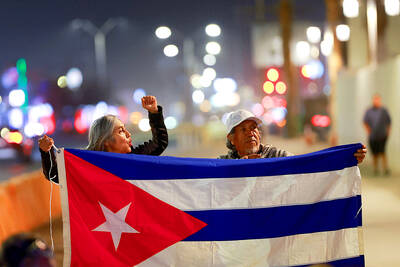
NEW RULES: There would be fewer school days, four-day workweeks, and a reduction in transportation services as the country battles a crisis exacerbated by US pressure The Cuban government on Friday announced emergency measures to address a crippling energy crisis worsened by US sanctions, including the adoption of a four-day work week for state-owned companies and fuel sale restrictions. Cuban Deputy Prime Minister Oscar Perez-Oliva Fraga blamed Washington for the crisis, telling Cuban television the government would “implement a series of decisions, first and foremost to guarantee the vitality of our country and essential services, without giving up on development.” “Fuel will be used to protect essential services for the population and indispensable economic activities,” he said. Among the new measures are the reduction of the working week in


 RSS
RSS