


Ethnic minorities in Xinjiang are far more fond of dancing, singing and being good hosts than making trouble, a top official said yesterday, dismissing the idea that the far western region is a hotbed of unrest.
Many Uighurs, a Turkic-speaking Muslim people who live in energy-rich Xinjiang, chafe at Chinese restrictions on their culture, language and religion, and the region is frequently the scene of deadly ethnic violence.
Last month, 21 people were killed in clashes in the heavily ethnic Uighur part of Xinjiang near the old Silk Road city of Kashgar, the deadliest unrest since July 2009, when nearly 200 people were killed in riots in the Xinjiang capital of Urumqi.
China says it offers broad freedoms in Xinjiang, though few Chinese officials make the effort to learn the Uighur language or understand much about Islam.
Speaking to reporters in Beijing, Xinjiang Deputy Governor Shi Dagang (史大剛) said he had worked in southern Xinjiang for more than a decade and never had to carry a gun or have a police escort.
This was the common experience of government officials who are members of the majority Han Chinese ethnicity, many of whom work in areas heavily populated by minorities, he said.
“There is mutual respect by Han cadres and ethnic minorities, and we are friends. When we go into their houses as guests, we are treated to meat and wine, with song and dance,” Shi said.
“The ethnic minorities are simple-hearted and honest, very kind and unaffected. They love guests,” he added. “I hope people don’t have misapprehensions and go to Xinjiang and see for themselves.”
China dismisses accusations its policies are connected to unrest, saying armed Uighur groups have links to Central Asian and Pakistani Islamist militants, and of carrying out attacks to establish an independent state they call East Turkistan.
“Those minority of people, the violent terrorists, ethnic splittists and religious extremists who want to cause trouble, their organizations are all outside the country, as are their backers behind the scenes,” Shi said. “How could we let this minority of people split Xinjiang off from the rest of the country and destroy this peaceful and harmonious society? It’s impossible.”
Many rights groups say China has long overplayed the threat posed to justify its tough controls in Xinjiang.

When a hiker fell from a 55m waterfall in wild New Zealand bush, rescuers were forced to evacuate the badly hurt woman without her dog, which could not be found. After strangers raised thousands of dollars for a search, border collie Molly was flown to safety by a helicopter pilot who was determined to reunite the pet and the owner. A week earlier, an emergency rescue helicopter found the woman with bruises and lacerations after a fall at a rocky spot at the waterfall on the South Island’s West Coast. She was airlifted on March 24, but they were forced to

CONFIDENCE BOOSTER: ’After parkour ... you dare to do a lot of things that you think only young people can do,’ a 67-year-old parkour enthusiast said In a corner of suburban Singapore, Betty Boon vaults a guardrail, crawls underneath a slide, executes forward shoulder rolls and scales a steep slope, finishing the course to applause. “Good job,” the 69-year-old’s coach cheers. This is “geriatric parkour,” where about 20 retirees learned to tackle a series of relatively demanding exercises, building their agility and enjoying a sense of camaraderie. Boon, an upbeat grandmother, said learning parkour has aided her confidence and independence as she ages. “When you’re weak, you will be dependent on someone,” she said after sweating it out with her parkour classmates in suburban Toa Payoh,
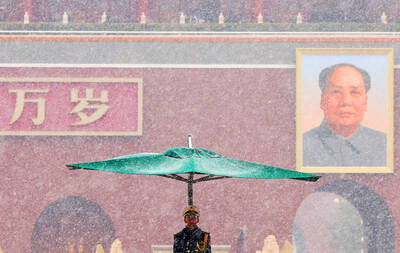
Chinese dissident artist Gao Zhen (高兟), famous for making provocative satirical sculptures of former Chinese leader Mao Zedong (毛澤東), was tried on Monday over accusations of “defaming national heroes and martyrs,” his wife and a rights group said. Gao, 69, who was detained in 2024 during a visit from the US, faces a maximum three-year prison sentence, said his wife, Zhao Yaliang (趙雅良), and Shane Yi, a researcher at the Chinese Human Rights Defenders group which operates outside the nation. The closed-door, one-day trial took place at Sanhe City People’s Court in Hebei Province neighboring the capital, Beijing, and ended without a

‘TOXIC CLIMATE’: ‘I don’t really recognize Labour anymore... The idea that you can implement far-right ideas in order to stop the far right is nonsense,’ a protester said Tens of thousands of people on Saturday marched through central London to protest against the far right, weeks ahead of local elections and six months after Britain saw one of its largest far-right demonstrations. Organized by hundreds of civic groups, including trade unions, anti-racism campaigners and Muslim representative bodies, Saturday’s Together Alliance event was billed as the biggest in UK history to counter right-wing extremism. A separate pro-Palestinian march had also converged with the main rally. While organizers claimed 500,000 had turned out in total, the police gave a figure of about 50,000. Protesters carrying placards with slogans such as


 RSS
RSS