


A US federal judge ruled on Friday that the office of the US’ self-proclaimed toughest sheriff systematically singled out Latinos in its trademark immigration patrols, marking the first finding by a court that the agency racially profiles people.
The ruling marks a thorough repudiation of the immigration patrols that have made Arizona’s Maricopa County Sheriff Joe Arpaio a national political figure. It backs up allegations that critics have made for years that Arpaio’s officers violate the constitutional rights of Latinos by relying on race in their immigration enforcement.
Known for jailing inmates in tents and making prisoners wear pink underwear, Arpaio started doing immigration enforcement in 2006 as Arizona voters grew frustrated with the state’s role as the nation’s busiest illegal entryway.
US District Judge Murray Snow also ruled Arpaio’s deputies unreasonably prolonged the detentions of people who were pulled over.
The ruling represents a victory for those who pushed the lawsuit.
They were not seeking monetary damages but rather a declaration that Arpaio’s office engages in racial profiling and an order that would require it to make policy changes.
“For too long the sheriff has been victimizing the people he’s meant to serve with his discriminatory policy,” said Cecillia Wang, director of the American Civil Liberties Union’s Immigrants’ Right Project.
The sheriff, who has repeatedly denied the allegations, will not face jail time or fines as a result of the ruling.
Arpaio, who turns 81 next month, was elected in November last year to his sixth consecutive term as sheriff in Arizona’s most populous county.
A small group of Latinos alleged in their lawsuit that Arpaio’s deputies pulled over some vehicles only to make immigration status checks. The group asked Snow to issue injunctions barring the sheriff’s office from discriminatory policing and the judge ruled that more remedies could be ordered in the future.
The group also accused the sheriff of ordering some immigration patrols not based on reports of crime but rather on letters and e-mails from Arizonans who complained about people with dark skin congregating in an area or speaking Spanish. The group’s attorneys said that Arpaio sent thank-you notes to some people who wrote the complaints.
The sheriff said his deputies only stop people when they think a crime has been committed and that he was not the person who picked the location of the patrols. His lawyers also said there was nothing wrong with the thank-you notes.
The ruling used Arpaio’s own words in interviews, news conferences and press releases against him as he trumpeted his efforts in cracking down on immigrants.
“Ours is an operation, whether it’s the state law or the federal, to go after illegals, not the crime first, that they happen to be illegals,” the ruling quoted Arpaio as saying. “My program, my philosophy is a pure program. You go after illegals. I’m not afraid to say that. And you go after them and you lock them up.”

A humanoid robot that won a half-marathon race for robots in Beijing on Sunday ran faster than the human world record in a show of China’s technological leaps. The winner from Honor, a Chinese smartphone maker, completed the 21km race in 50 minutes and 26 seconds, said a WeChat post by the Beijing Economic-Technological Development Area, also known as Beijing E-Town, where the race began. That was faster than the human world record holder, Ugandan Jacob Kiplimo, who finished the same distance in about 57 minutes in March at the Lisbon road race. The performance by the robot marked a significant step forward
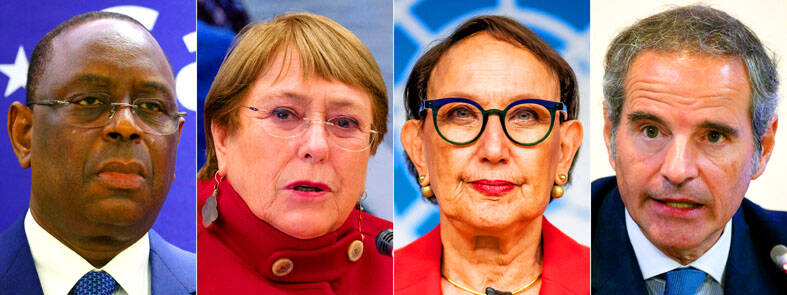
Four contenders are squaring up to succeed Antonio Guterres as secretary-general of the UN, which faces unprecedented global instability, wars and its own crushing budget crisis. Chile’s Michelle Bachelet, Argentina’s Rafael Grossi, Costa Rica’s Rebeca Grynspan and Senegal’s Macky Sall are each to face grillings by 193 member states and non-governmental organizations for three hours today and tomorrow. It is only the second time the UN has held a public question-and-answer, a format created in 2016 to boost transparency. Ultimately the five permanent members of the UN’s top body, the Security Council, hold the power, wielding vetoes over who leads the

South Korea’s air force yesterday apologized for a 2021 midair collision involving two fighter jets, a day after auditors said the pilots were taking selfies and filming during the flight and held them responsible for the accident. “We sincerely apologize to the public for the concern caused by the accident that occurred in 2021,” an air force spokesman told a news conference, adding that one of the pilots involved had been suspended from flying duties, received severe disciplinary action and has since left the military. The apology followed a report released on Wednesday by the South Korean Board of Audit and Inspection,

An earthquake registering a preliminary magnitude of 7.7 off northern Japan on Monday prompted a short-lived tsunami alert and the advisory of a higher risk of a possible mega-quake for coastal areas there. The Cabinet Office and the Japan Meteorological Agency said there was a 1% chance for a mega-quake, compared to a 0.1% chance during normal times, in the next week or so following the powerful quake near the Chishima and Japan trenches. Officials said the advisory was not a quake prediction but urged residents in 182 towns along the northeastern coasts to raise their preparedness while continuing their daily lives. Prime


 RSS
RSS