


The virus has already killed her mother and Kelly Gu’s father lies critically ill with H7N9 avian influenza in a Shanghai hospital bed — the only couple both infected in China’s outbreak of the disease.
As her mother lay dying, Gu was urgently summoned back to Shanghai from her doctoral studies in chemistry in France, but she was too late, missing the chance to say goodbye by a day.
In her first interview with Western media, she said she knew her mother was dead when her father, already showing symptoms of fatigue and fever, told her by telephone: “It’s just like winning a lottery, it’s a lottery of very bad luck.”
The Gu family’s experience portrays a government-run health system battling a new disease, while sometimes showing a lack of empathy for victims and their kin.
The H7N9 strain of bird flu has sickened 130 people in China and killed 35 of them, according to the latest available national figures.
The government and the WHO have repeatedly said there is no evidence of sustained human-to-human transmission, but Gu’s parents could be a rare “family cluster.”
Experts at the US government’s Centers for Disease Control say such clusters could represent limited spread between people caused by prolonged, unprotected exposure.
If the virus were to mutate into a form easily transmissible among humans it could trigger a pandemic.
Gu, 26, said her father, who works in a property management office, was sad about his only child living overseas — a fact that may have saved her life.
Her mother, a 52-year-old housewife she described as an optimist with a knack for technology, was probably infected on her daily trip to the market near their home in western Shanghai.
She had already been ill for five days by the time the central government revealed the H7N9 outbreak, going twice to a district-level hospital.
The next day, having trouble breathing and suffering from fever, she went to one of Shanghai’s finest hospitals, Huashan, but the emergency room doctor sent her home, ordering three days rest. She was dead in two.
Beijing has been praised by the WHO for openness over H7N9, in contrast to its coverup a decade ago of SARS, which originated in China and killed 800 people globally, but critics question why it took the government three weeks to make an announcement after the first deaths, despite Internet postings describing a mysterious illness at a Shanghai hospital.
The case of Gu’s parents — she declined to give their full names — reflects how the government-run health system struggled in the early stages.
“[The doctor] hadn’t seen the scanning result of my mother’s lung and he hadn’t asked her to take another one. He just judged it was a normal fever and sent her back home,” Gu said.
Her mother died on April 3 of acute respiratory distress and was confirmed to have the H7N9 virus a day later, one of Shanghai’s earliest cases. Her father had started showing symptoms on April 1.
There are only two other such “family clusters,” a father and two sons in Shanghai, and another father and son in Shandong Province.
Gu’s father has defied doctors’ expectations by clinging to life, but is under sedation on a respirator and does not respond when she tries to talk with him on a video link.
She makes a daily trek to see him at an isolation hospital in southwest Shanghai, where green lawns give it the atmosphere of a country club, and to consult with doctors who say there is little they can do.
In desperation, she sneaked into a press conference with a visiting WHO team last month to ask about possible treatment for her father, but Shanghai officials cut her off before she could complete her question.
“Even though the doctor said the possibility was zero, I never gave up,” she said. “If he can recover, I’ll stay with him. I’ll take the place of my mother and take care of him.”
However, her father had seen the rapid deterioration in his wife’s health and the symptoms described by a public health poster in Huashan hospital. As he fell ill, he recognized the symptoms in himself.
“When my mother passed away, my father just held her hand and said: ‘Wait for me. I’ll be there to accompany you,’” Gu said.
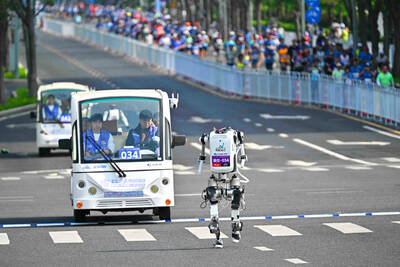
A humanoid robot that won a half-marathon race for robots in Beijing on Sunday ran faster than the human world record in a show of China’s technological leaps. The winner from Honor, a Chinese smartphone maker, completed the 21km race in 50 minutes and 26 seconds, said a WeChat post by the Beijing Economic-Technological Development Area, also known as Beijing E-Town, where the race began. That was faster than the human world record holder, Ugandan Jacob Kiplimo, who finished the same distance in about 57 minutes in March at the Lisbon road race. The performance by the robot marked a significant step forward
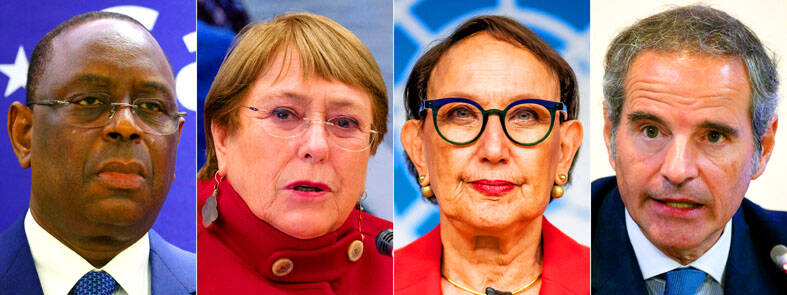
Four contenders are squaring up to succeed Antonio Guterres as secretary-general of the UN, which faces unprecedented global instability, wars and its own crushing budget crisis. Chile’s Michelle Bachelet, Argentina’s Rafael Grossi, Costa Rica’s Rebeca Grynspan and Senegal’s Macky Sall are each to face grillings by 193 member states and non-governmental organizations for three hours today and tomorrow. It is only the second time the UN has held a public question-and-answer, a format created in 2016 to boost transparency. Ultimately the five permanent members of the UN’s top body, the Security Council, hold the power, wielding vetoes over who leads the
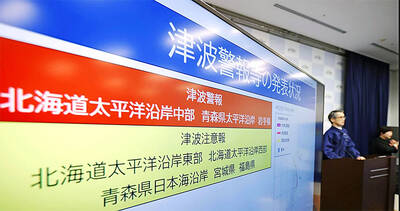
An earthquake registering a preliminary magnitude of 7.7 off northern Japan on Monday prompted a short-lived tsunami alert and the advisory of a higher risk of a possible mega-quake for coastal areas there. The Cabinet Office and the Japan Meteorological Agency said there was a 1% chance for a mega-quake, compared to a 0.1% chance during normal times, in the next week or so following the powerful quake near the Chishima and Japan trenches. Officials said the advisory was not a quake prediction but urged residents in 182 towns along the northeastern coasts to raise their preparedness while continuing their daily lives. Prime
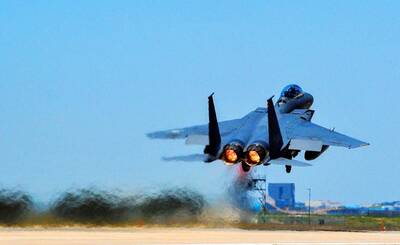
South Korea’s air force yesterday apologized for a 2021 midair collision involving two fighter jets, a day after auditors said the pilots were taking selfies and filming during the flight and held them responsible for the accident. “We sincerely apologize to the public for the concern caused by the accident that occurred in 2021,” an air force spokesman told a news conference, adding that one of the pilots involved had been suspended from flying duties, received severe disciplinary action and has since left the military. The apology followed a report released on Wednesday by the South Korean Board of Audit and Inspection,


 RSS
RSS