


Former Egyptian president Hosni Mubarak appeared in court yesterday to face a new trial for complicity in the murder of hundreds of protesters during the 2011 uprising.
The 85-year-old Mubarak, who was taken into court in a wheelchair dressed in white and wearing sunglasses, is on trial along with his former interior minister, Habib al-Adly, and six security chiefs.
He also faces corruption charges with his two sons, Alaa and Gamal.
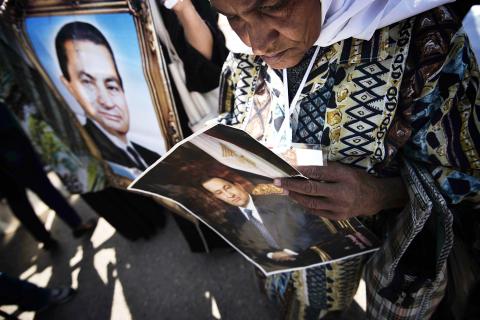
Photo: AFP
All defendants pleaded “not guilty” to the charges leveled against them.
Amid a raucous start to proceedings, lawyers for the victims’ families taunted Alaa and Gamal, as they stood in the dock, with chants of: “The people want the execution of the murderer.”
However, the Mubaraks appeared unfazed by the chants, as the judge struggled to keep control of the courtroom with lawyers clambering to the front to speak.
Mubarak was granted a retrial after his appeal against a life sentence was accepted due to procedural failings the first time round.
The retrial was meant to begin on April 13, but the judge in that instance recused himself in a hearing that lasted just seconds.
At yesterday’s hearing, Judge Mahmoud al-Rashidi issued an emotional appeal for order, telling the court he understood their “frustration” with the process.
Before ordering a 30-minuted recess, he confirmed that there would be new evidence presented in the case, which now includes 55,000 pages of documents.
Outside the court, a handful of victims’ families and Mubarak supporters had turned up amid a heavy security presence.
Sanaa Said, who lost her 20-year-old son during the uprising, said she would keep fighting for justice, though like many, she has become dispirited by the process.
“I am clinging on to hope even though I think if the trial were real, we would have seen a result,” by now, she said.
In other news, Egypt’s prosecutor general on Friday ordered a prominent youth leader detained for four days pending an investigation into accusations he incited anti-government violence, a security official said, in the latest case of a pro-democracy activist being held over similar charges.
The detention sparked a wave of anger among activists and the April 6 youth movement, which was at the forefront of the country’s 2011 uprising, called for nationwide protests, including one in front of Egyptian President Mohammed Morsi’s house.
The security official said Ahmed Maher, a leader of April 6, was arrested at the Cairo airport as he returned from a trip to the US.
According to the official, who spoke on condition of anonymity because he was not authorized to talk to the media, Maher is accused of “incitement” for actions at a March demonstration against the country’s interior minister, when protesters hurled underwear at the minister’s house to oppose a police crackdown on the activist group.
Maher was later taken to a heavily fortified prison in the Egyptian capital, the state-run MENA news agency said.
Also late Friday, clashes broke out in downtown Cairo between rock-throwing protesters and security troops who fired tear gas at the demonstrators. The protesters were trying to bring down a cement wall blocking the entrance of a street leading up to the interior ministry building.
Maher’s April 6 group was one of Morsi’s top allies during his presidential campaign last year against a rival who was a Mubarak-era official the group feared would restore the former regime. However, since Morsi became president in June last year, April 6, like the rest of the liberal opposition, has been increasingly frustrated with the new government’s practices and with what they see as the president serving his Islamist group’s agenda in trying to monopolize power in the country.

An American scientist convicted of lying to US authorities about payments from China while he was at Harvard University has rebuilt his research lab in Shenzhen, China, to pursue technology the Chinese government has identified as a national priority: embedding electronics into the human brain. Charles Lieber, 67, is among the world’s leading researchers in brain-computer interfaces. The technology has shown promise in treating conditions such as amyotrophic lateral sclerosis and restoring movement in paralyzed people. It also has potential military applications: Scientists at the Chinese People’s Liberation Army have investigated brain interfaces as a way to engineer super soldiers by boosting

Indonesian police have arrested 13 people after shocking images of alleged abuse against small children at a daycare center went viral, sparking outrage across the nation, officials said on Monday. Police on Friday last week raided Little Aresha, a daycare center in Yogyakarta on Java island, following a report from a former employee. CCTV footage circulating on social media showed children, most younger than two, lying on the floor wearing only diapers, their hands and feet bound with rags. The police have confirmed that the footage is authentic. Police said they also found 20 children crammed into a room just 3m by 3m. “So
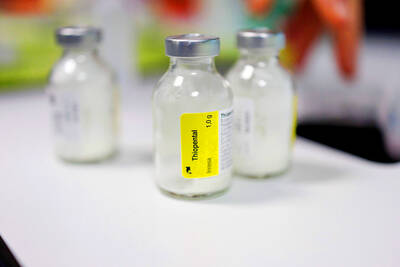
A grieving mother has ended her life at a clinic in Switzerland four years after the death of her only child. Wendy Duffy, 56, a physically healthy woman, died at the Pegasos clinic in Basel after struggling to cope with the death of her 23-year-old son, Marcus. The former care worker, from the West Midlands, England, had previously attempted to take her own life. The case comes as assisted dying would not become law in England and Wales after proposed legislation, branded “hopelessly flawed” by opponents, ran out of time. Ruedi Habegger, the founder of Pegasos, described Duffy’s death as
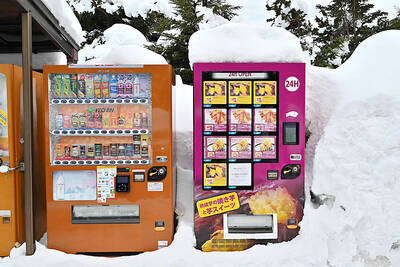
From post offices and parks to stations and even the summit of Mount Fuji, Japan’s vending machines are ubiquitous, but with the rapid pace of inflation cooling demand for their drinks, operators are being forced to rethink the business. Last month beverage giant DyDo Group Holdings announced it would remove about 20,000 vending machines — about 7 percent of their stock nationwide — by January next year, to “reconstruct a profitable network.” Pokka Sapporo Food & Beverage, based in Nagoya, also said last month it would sell its 40,000-machine operation to Osaka-based Lifedrink Co. “The strength of the vending machine


 RSS
RSS