


Indian Prime Minister Manmohan Singh said yesterday he believes a border dispute over an alleged incursion by Chinese soldiers can be resolved, the Press Trust of India reported.
“It is a localized problem, we do believe it can be solved,” Singh was quoted as saying by the news agency after Chinese soldiers were accused of intruding across the disputed border in the Ladakh region earlier this month.
The incident has marked a renewal of tensions between the Asian neighbors, whose relations are often prickly — a legacy of a 1962 border war.
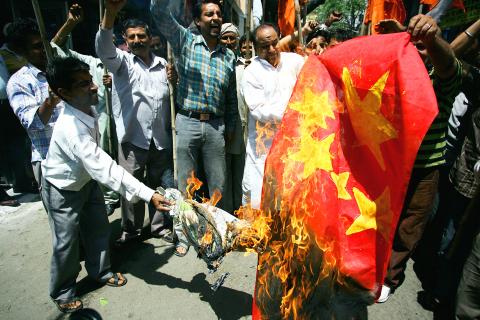
Photo: EPA
Singh’s statement came after Indian Defense Secretary Shashi Kant Sharma presented a report on the incursion to a parliamentary watchdog on Friday in which local media said he alleged Chinese soldiers had advanced nearly 20km into Indian-claimed territory.
The prime minister’s comments, his first on the dispute, echoed statements of other government ministers playing down the alleged incursion in the western part of Indian-held Kashmir’s Ladakh region and insisting it can be settled amicably.
“We have a plan, we do not want to accentuate the situation,” Singh said, without elaborating.
Lower-level talks between military officials have so far failed to break the impasse.
According to officials in New Delhi, a platoon of Chinese troops set up a camp inside Indian territory on April 15.
Indian Foreign Minister Salman Khurshid announced earlier in the week that he would head for China on May 8, saying both countries had a mutual interest in not allowing the dispute to “destroy” long-term progress in ties.
A foreign ministry official has said new Chinese Premier Li Keqiang (李克強) is due to travel to New Delhi late next month, without giving an exact date.
India has called on the Chinese soldiers to withdraw, while China has denied any wrongdoing.
In 1962, China gave India a bloody nose in the war fought in the Himalayan regions of Ladakh and Arunachal Pradesh.
The de facto border separating China and India is known as the Line of Actual Control (LAC). While it has never been formally demarcated, the countries signed two accords to maintain peace in frontier areas in 1993 and 1996.
Small incursions are not uncommon across the LAC, but it is rare for either country to set up camps in disputed territory.
In recent years, the two neighbors have increased their military presence on each side of the border and hold frequent meetings to defuse tensions. Despite the border tensions, trade between the Asian giants has soared in recent years.

An American scientist convicted of lying to US authorities about payments from China while he was at Harvard University has rebuilt his research lab in Shenzhen, China, to pursue technology the Chinese government has identified as a national priority: embedding electronics into the human brain. Charles Lieber, 67, is among the world’s leading researchers in brain-computer interfaces. The technology has shown promise in treating conditions such as amyotrophic lateral sclerosis and restoring movement in paralyzed people. It also has potential military applications: Scientists at the Chinese People’s Liberation Army have investigated brain interfaces as a way to engineer super soldiers by boosting

Indonesian police have arrested 13 people after shocking images of alleged abuse against small children at a daycare center went viral, sparking outrage across the nation, officials said on Monday. Police on Friday last week raided Little Aresha, a daycare center in Yogyakarta on Java island, following a report from a former employee. CCTV footage circulating on social media showed children, most younger than two, lying on the floor wearing only diapers, their hands and feet bound with rags. The police have confirmed that the footage is authentic. Police said they also found 20 children crammed into a room just 3m by 3m. “So
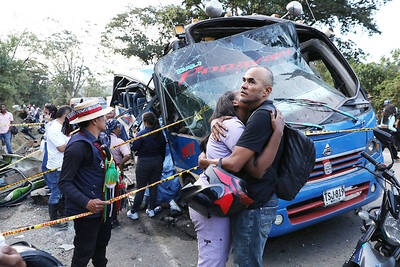
A highway bomb attack in a restive region of southwestern Colombia on Saturday killed 14 people and injured at least 38, the latest spate of violence ahead of next month’s presidential election. Authorities blamed the attack in the Cauca department — a conflict-ridden, coca-growing region — on dissidents of the now-disbanded FARC guerrilla army, who have been sowing violence across the country. “Those who carried out this attack ... are terrorists, fascists and drug traffickers,” Colombian President Gustavo Petro said on social media. “I want our very best soldiers to confront them,” he added. The leftist leader blamed the bombing
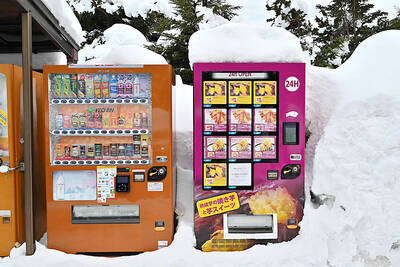
From post offices and parks to stations and even the summit of Mount Fuji, Japan’s vending machines are ubiquitous, but with the rapid pace of inflation cooling demand for their drinks, operators are being forced to rethink the business. Last month beverage giant DyDo Group Holdings announced it would remove about 20,000 vending machines — about 7 percent of their stock nationwide — by January next year, to “reconstruct a profitable network.” Pokka Sapporo Food & Beverage, based in Nagoya, also said last month it would sell its 40,000-machine operation to Osaka-based Lifedrink Co. “The strength of the vending machine


 RSS
RSS