


Soaring tensions on the Korean Peninsula have seen dire North Korean threats met with an unusually assertive US response that analysts warn could take a familiar game into dangerous territory.
By publicly highlighting its recent deployment of nuclear-capable B-52 and stealth bombers over South Korea, Washington has at times almost appeared to be purposefully goading an already apoplectic Pyongyang.
“There certainly seems to be an element of ‘let’s show we’re taking the gloves off this time’ about the US stance,” said Paul Carroll, program director at the Ploughshares Fund, a US-based security policy think tank.
The North has responded in kind, declaring on Saturday that it is now in a “state of war” with South Korea.
Security crises on the Korean Peninsula have come and gone over the decades and have tended to follow a similar pattern of white-knuckle brinkmanship that threatens, but finally pulls back from catastrophic conflict.
North Korean founding leader Kim Il-sung and his son and successor Kim Jong-il were both considered skilled practitioners of this high-stakes game of who-blinks-first diplomacy.
They ensured that Pyongyang had enough form to lend its threats credibility, having engineered provocations that ranged from blowing up a South Korean civilian airliner in 1987 to shelling a South Korean island in 2010.
The current crisis, with Pyongyang lashing out at a combination of a new round of UN sanctions and South Korea-US military exercises, diverges from precedent in terms of the context and the main characters involved.
It follows the two landmark events that triggered the UN sanctions and redrew the strategic balance on the peninsula: the North’s successful long-range rocket launch in December last year and its third — and largest — nuclear test in February this year.
Both may have emboldened North Korea to overplay its hand, while at the same time prompting Washington to decide there was already too much at stake to consider folding.
“Rhetorical salvos are one thing, while rocket launches and nuclear tests are quite another,” Carroll said.
In addition, both North and South Korea have new, untested leaders with a strong domestic motivation to prove their mettle in any showdown.
Bruce Klingner, a Korea expert at the conservative Heritage Foundation in Washington, believes the danger of “miscalculation” is especially high from young North Korean leader Kim Jong-un.
Kim Jong-un was not only emboldened by the successful rocket and nuclear tests, but “also by the knowledge that Seoul and Washington have never struck back in any significant way after previous deadly attacks.”
However, this time around, South Korea has signaled it would respond with interest, and the message sent by the B-52 and stealth bomber flights is that it has the US firmly in its corner.
Peter Hayes, who heads the Nautilus Institute, an Asia-focused think tank, said that the B-52 deployment carried a particular and potentially dangerous resonance.
After a bloody border incident in 1976 left two US soldiers dead, the US spent weeks sending B-52 flights up the Korean Peninsula, veering off just before they entered the North’s air space.
Then-US secretary of state Henry Kissinger said that he had “never seen the North Koreans so scared.”
Hayes warned that replaying the B-52 threat could prove to be “strategically stupid” by reviving the North’s historic and deep-rooted fear of a US nuclear strike.
“The B-52 deployment also declares loudly and clearly that they have forced the US to play the game of nuclear war with North Korea,” Hayes said. “It tells them it has reached the hallowed status of a nuclear-armed state that matters enough to force a simulated nuclear-military response.”
The possible end-game scenarios to the current crisis are numerous, but none point to an obvious path for defusing the situation peacefully.
Most analysts rule out the prospect of a full-scale war on the grounds that North Korea knows it would lose, just as it knows that launching any sort of nuclear strike would be suicidal.
However, after threatening everything from an artillery assault to nuclear Armageddon, there is also a sense that Kim Jong-un has pushed himself into a corner and must do something to avoid a damaging loss of face and credibility.
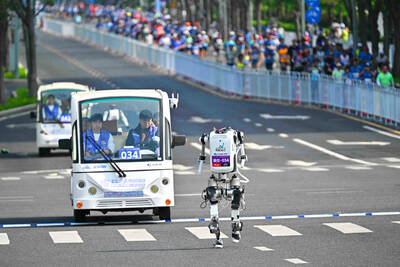
A humanoid robot that won a half-marathon race for robots in Beijing on Sunday ran faster than the human world record in a show of China’s technological leaps. The winner from Honor, a Chinese smartphone maker, completed the 21km race in 50 minutes and 26 seconds, said a WeChat post by the Beijing Economic-Technological Development Area, also known as Beijing E-Town, where the race began. That was faster than the human world record holder, Ugandan Jacob Kiplimo, who finished the same distance in about 57 minutes in March at the Lisbon road race. The performance by the robot marked a significant step forward
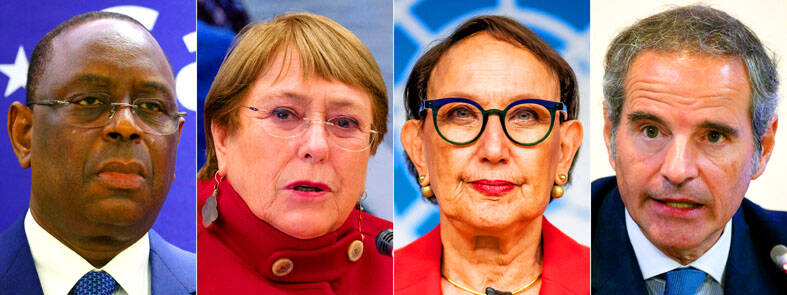
Four contenders are squaring up to succeed Antonio Guterres as secretary-general of the UN, which faces unprecedented global instability, wars and its own crushing budget crisis. Chile’s Michelle Bachelet, Argentina’s Rafael Grossi, Costa Rica’s Rebeca Grynspan and Senegal’s Macky Sall are each to face grillings by 193 member states and non-governmental organizations for three hours today and tomorrow. It is only the second time the UN has held a public question-and-answer, a format created in 2016 to boost transparency. Ultimately the five permanent members of the UN’s top body, the Security Council, hold the power, wielding vetoes over who leads the
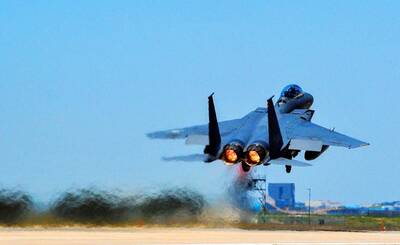
South Korea’s air force yesterday apologized for a 2021 midair collision involving two fighter jets, a day after auditors said the pilots were taking selfies and filming during the flight and held them responsible for the accident. “We sincerely apologize to the public for the concern caused by the accident that occurred in 2021,” an air force spokesman told a news conference, adding that one of the pilots involved had been suspended from flying duties, received severe disciplinary action and has since left the military. The apology followed a report released on Wednesday by the South Korean Board of Audit and Inspection,
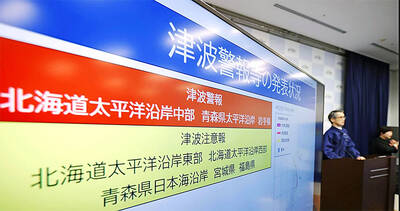
An earthquake registering a preliminary magnitude of 7.7 off northern Japan on Monday prompted a short-lived tsunami alert and the advisory of a higher risk of a possible mega-quake for coastal areas there. The Cabinet Office and the Japan Meteorological Agency said there was a 1% chance for a mega-quake, compared to a 0.1% chance during normal times, in the next week or so following the powerful quake near the Chishima and Japan trenches. Officials said the advisory was not a quake prediction but urged residents in 182 towns along the northeastern coasts to raise their preparedness while continuing their daily lives. Prime


 RSS
RSS