


US President Barack Obama arrived in Israel yesterday, without any new peace initiative to offer disillusioned Palestinians and facing deep Israeli doubts over his pledge to prevent a nuclear-armed Iran.
Making his first official visit as president, Obama hopes to use the trip to reset his often fraught relations with both the Israelis and Palestinians in a choreographed three-day stay that is high on symbolism, but low on expectations.
He was met at Ben Gurion Airport in Tel Aviv by Israeli Prime Minister Benjamin Netanyahu and Israeli President Shimon Peres after Air Force One stopped next to a huge red carpet laid out down the tarmac.
Obama was to hold lengthy talks with Netanyahu later in the day, with the two set to hold a news conference at 8:10pm. He is to travel to the occupied West Bank today to meet Palestinian President Mahmoud Abbas.
US officials say Obama will try to coax the Palestinians and Israelis back to peace talks. He will also seek to reassure Netanyahu he is committed to preventing Iran from getting a nuclear bomb and discuss ways of containing Syria’s ongoing civil war.
However, the White House has deliberately minimized hopes of any major breakthroughs, a reversal from Obama’s first four years in office, when aides said he would visit the Jewish state only if he had something concrete to accomplish.
Workers have hung hundreds of US and Israel flags on lamp posts across Jerusalem, as well as banners that boast of “an unbreakable alliance.” However, the apparent lack of any substantial policy push has bemused many diplomats and analysts.
“This seems to me to be an ill-scheduled and ill-conceived visit,” said Gidi Grinstein, president of Tel Aviv-based think tank the Reut Institute. “On the Iranian situation, Israel and the USA don’t seem to have anything new to say to each other. On Syria, the Americans don’t have a clear outlook and on the Palestinian issue, they are taking a step back and their hands off.”
With both Obama and Netanyahu just starting new terms and mindful that they will have to work together on volatile issues for years to come, they will be looking to avoid the kind of public confrontation that has marked past encounters.
“To tell the truth, they can’t stand one another,” a commentator for Israel’s Channel 10 TV said in a live broadcast from the airport as Air Force One came to a halt.
Signaling the emphasis being placed on symbolic gestures, the US president is to inspect an Iron Dome anti-missile battery at the Tel Aviv airport before flying to Jerusalem by helicopter for the start of his official meetings.
Seeking to connect directly with an often skeptical Israeli public, Obama is to make a speech to a group of carefully screened students today, where he is expected to touch on major topics of concern, including Iran.
Obama, who has said he is coming to listen, will fly by helicopter the short distance between Jerusalem and the West Bank city of Ramallah to meet Abbas, avoiding having to cross the Israeli separation barrier that divides the two entities.

Four contenders are squaring up to succeed Antonio Guterres as secretary-general of the UN, which faces unprecedented global instability, wars and its own crushing budget crisis. Chile’s Michelle Bachelet, Argentina’s Rafael Grossi, Costa Rica’s Rebeca Grynspan and Senegal’s Macky Sall are each to face grillings by 193 member states and non-governmental organizations for three hours today and tomorrow. It is only the second time the UN has held a public question-and-answer, a format created in 2016 to boost transparency. Ultimately the five permanent members of the UN’s top body, the Security Council, hold the power, wielding vetoes over who leads the
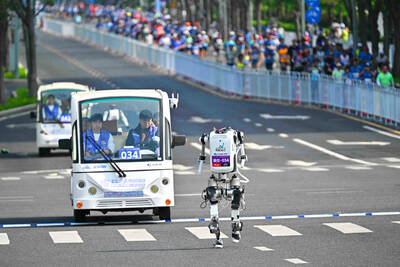
A humanoid robot that won a half-marathon race for robots in Beijing on Sunday ran faster than the human world record in a show of China’s technological leaps. The winner from Honor, a Chinese smartphone maker, completed the 21km race in 50 minutes and 26 seconds, said a WeChat post by the Beijing Economic-Technological Development Area, also known as Beijing E-Town, where the race began. That was faster than the human world record holder, Ugandan Jacob Kiplimo, who finished the same distance in about 57 minutes in March at the Lisbon road race. The performance by the robot marked a significant step forward

An earthquake registering a preliminary magnitude of 7.7 off northern Japan on Monday prompted a short-lived tsunami alert and the advisory of a higher risk of a possible mega-quake for coastal areas there. The Cabinet Office and the Japan Meteorological Agency said there was a 1% chance for a mega-quake, compared to a 0.1% chance during normal times, in the next week or so following the powerful quake near the Chishima and Japan trenches. Officials said the advisory was not a quake prediction but urged residents in 182 towns along the northeastern coasts to raise their preparedness while continuing their daily lives. Prime
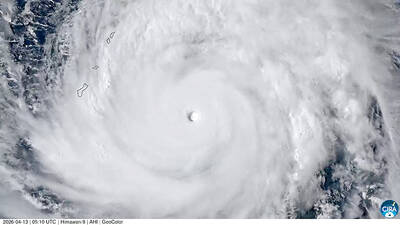
HAZARDOUS CONDITION: The typhoon’s sheer size, with winds extending 443km from its center, slowed down the ability of responders to help communities, an official said The US Coast Guard was searching for six people after losing contact with their disabled boat off the coast of Guam following Typhoon Sinlaku. The crew of the 44m dry cargo vessel, the US-registered Mariana, on Wednesday notified the coast guard that the boat had lost its starboard engine and needed assistance, Petty Officer 3rd Class Avery Tibbets said yesterday. The coast guard set up a one-hour communication schedule with the vessel, but lost contact on Thursday. A Coast Guard HC-130 Hercules aircraft was launched to search for the six people on board, but it had to return to Guam because of


 RSS
RSS