


More than a fourth of all North Korean children are stunted from chronic malnutrition, and two-thirds of the country’s 24 million people do not know where their next meal is coming from, the UN said on Friday.
The report illustrates a major domestic challenge for North Korea’s young leader, Kim Jong-un.
A team from the UN’s Office for the Coordination of Humanitarian Affairs (OCHA), reporting from North Korea, found that 2.8 million North Koreans “are in need of regular food assistance amidst worrying levels of chronic malnutrition and food insecurity.”
It said 4 percent of North Korean children are acutely malnourished.
The report did not directly mention North Korea’s recent threats against South Korea, its threat of a pre-emptive nuclear strike against the US or Pyongyang’s claim to have abolished the Korean War armistice as of Monday.
However, the report said humanitarian aid should be neutral and impartial “and must not be contingent on political developments.”
The OCHA team also found that much of North Korea’s support structure is crumbling under the third generation of Kim family rule.
“Supplies of medicine and equipment are inadequate; water and heating systems need repair and the infrastructure of schools and colleges is deteriorating rapidly,” the report said.
With little arable land, harsh weather and chronic shortages of fuel and equipment, North Korea has struggled for decades to feed its 24 million people.
Its new leader, who took over in December 2011, has made improving the economy a priority and has pledged to improve North Koreans’ standards of living.
In autumn last year, a UN team visited all nine agricultural provinces of the communist state during the main cereal harvest and estimated that North Korea would need to import 507,000 tonnes of cereals to meet its basic food needs this year.
That UN team’s report recommended that North Korean farmers be allowed to sell or barter their surplus food at market, rather than turn their excess over to the state. Such incentives should encourage farmers to boost production, according to the joint report last year from the World Food Program and UN Food and Agriculture Organization.
However, the survey also made clear that the problems that have long kept North Koreans undernourished remain: insufficient and inefficient tractors and chronic shortages of fuel, spare parts and tires necessary to run them.
Agriculture is North Korea’s lifeblood, contributing a quarter of the nation’s economy and engaging a third of the population. However, many northern farms rely on ox and manual labor because there are not enough tractors and equipment to go around. Foreign food aid and imports make up for the shortfalls.
North Korea also suffered a severe famine in the mid and late 1990s.

SPEAKING OUT: After Siranudh Scott’s allegations surfaced, celebrities and public figures took to social media to share their own experiences of sexual misconduct and abuse A high-profile alleged sexual abuse case within a wealthy Thai beer brewing family has prompted a wave of painful accounts from survivors of unconnected abuse in the conservative nation. Siranudh Scott, a member of the billionaire Thai family that founded the ubiquitous Singha beer brand, posted an emotional video this month accusing his elder brother Sunit of repeatedly abusing him when he was a teenager. Sunit, who is in his 30s, later denied the allegations in a video posted online, but Singha parent Boonrawd dismissed him from his executive role with the company on Tuesday last week. “I felt I needed to speak

SEEKING ORDER: Rodrigo Paz said that ‘anyone who wants to destroy the nation will have to deal with this president and the full force of the constitution’ Bolivian President Rodrigo Paz on Wednesday said that the nation was at a “breaking point” after nearly a month of protests that have caused shortages of food, fuel and medicine. Paz, who took office six months ago amid the worst economic crisis there in four decades, is battling a groundswell of fury over his policies. The political capital, La Paz, has been besieged by low-income workers and members of the indigenous majority calling for his resignation. “The country needs order and is reaching breaking point,” the 58-year-old said at a public event in La Paz, renewing his appeal for dialogue. On Tuesday, the Bolivian
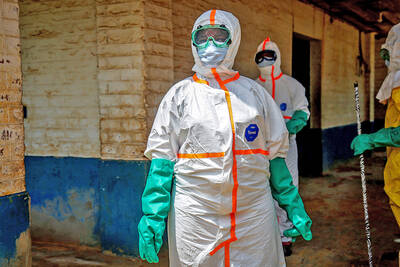
COMMUNITY CONFLICT: Concerns about disease spread from corpses has run up against friends and families’ desire to bury their dead as infection spreads in the area Angry residents of a town at the epicenter of the Ebola outbreak in the Democratic Republic of the Congo (DR Congo) attacked and burned a tent that was part of a health center where people are being treated for the virus, the staff there said Saturday. It was the second such attack in the region in a week. No one was hurt in the attack, according to reports but as patients ran out to escape the fire, 18 people with suspected Ebola infections fled the facility and are unaccounted for, a hospital director said. Angry residents arrived at the clinic in the

Forecasters in Europe yesterday warned of exceptional heat as record temperatures driven by a “heat dome” push temperatures well above seasonal norms across the continent. The surge follows a record-breaking Monday, with France logging its hottest day in the month of May on record, its weather agency said, and the UK also posting unprecedented highs. A so-called “heat dome” of warm air from northern Africa trapped under a high-pressure system over western Europe is behind the high temperatures not usually seen until high summer. Restrictions on outdoor work were imposed in parts of Italy, beaches in southwest France filled earlier than usual and


 RSS
RSS