


Former Italian prime minister Silvio Berlusconi’s resurgence and the rise of a foul-mouthed populist comedian have thrown Italy’s weekend election wide open, with deep uncertainty over whether the poll can produce the strong government the country needs.
Italy, the eurozone’s third-biggest economy, is deep in its longest recession for 20 years. Successive governments have failed to revive an economy stagnant for two decades.
Public fury over record unemployment — especially among the young — tax increases and economic pain, combined with a recent rash of high-level corruption cases, has fanned support for comic Beppe Grillo’s anti-establishment Five-Star Movement.
A skillful Internet user, Grillo has been the most active on the hustings, touring Italy in a camper van on a “tsunami tour,” shouting himself hoarse with obscenity-laced insults at a discredited political class, winning roars of approval from large crowds.
Some analysts say his could be the third-biggest single party in the vote tomorrow and on Monday, with about 20 percent support, ahead of Berlusconi’s People of Freedom (PDL) party.
Berlusconi, 76, spent most of last year in the shadows — undermined by a lurid sex scandal — after he was ignominiously bundled out of power and replaced by technocrat Italian Prime Minister Mario Monti in November 2011 as Italy faced a grave debt crisis.
Monti imposed austerity policies and brought borrowing back under control, winning plaudits from Italy’s European partners, but the billionaire media magnate burst back in December last year in an extraordinary blitz of TV appearances, belying his age, that halved center-left Pier Luigi Bersani’s 10-point poll lead over the former prime minister’s center-right coalition.
Berlusconi, a born showman and master communicator, backed by a television empire, has won back voters by attacking a hated housing tax imposed by Monti and offering to pay it back, something his opponents say is an impossible vote-buying trick.
Bersani, a worthy but dull former minister, and his Democratic Party have seemed stuck in their tracks, complacent about their lead and unable to respond dynamically to the threat from Berlusconi and Grillo.
Monti has disappointed European partners and investors who would like to see him return to office to continue his reform agenda. Analysts said on Thursday his centrist support was draining and he may fall below 12 percent.
Pollsters still believe the most likely outcome is a center-left government headed by Bersani and backed by Monti, but the rise of Grillo and Berlusconi, and the outgoing prime minister’s weak performance, are causing jitters about whether the election would produce a strong government committed to reform.
Latest published polls before a legal blackout on Feb. 9 showed the center-left about 5 points ahead and analysts believe this still holds, with perhaps a slight decline in support.
Italy may lose momentum on reforms vital to revive growth if no clear winner emerges from the election, credit ratings agency Standard & Poor’s said on Wednesday.
Bersani’s opponents also say he would be unable to agree on reforms with Monti, and would be hobbled by trade unions and leftists, something party officials deny.
Grillo owes much of his success to rage at the failure of lawmakers to keep their promises to transform the economy, change a badly flawed electoral law, cut the privileges of a pampered political class and combat rampant corruption.
Critics say his policies are vague and impractical, and hardly anything is known about the Five-Star candidates, whom Grillo keeps out of the limelight and under iron control.
A bloc of more than 100 Five-Star members of parliament, or a sixth of the lower chamber, could be deeply disruptive and further delay reforms.
“The Five-Star Movement is providing an outlet for rage and frustration. The traditional parties are incapable of indicating any other course,” author Beppe Severgnini said in a front-page editorial in the Corriere della Sera daily on Thursday.

KINGPIN: Marset allegedly laundered the proceeds of his drug enterprise by purchasing and sponsoring professional soccer teams and even put himself in the starting lineups Notorious Latin American narco trafficker Sebastian Marset, who eluded police for years, was handed over to US authorities after his arrest on Friday in Bolivia. Marset, a Uruguayan national who was on the US most-wanted list, was passed to agents of the US Drug Enforcement Administration at Santa Cruz airport in Bolivia, then put on a US airplane, Bolivian state television showed. “The arrest and deportation were carried out pursuant to a court order issued by the US justice system,” Bolivian Minister of Government Marco Antonio Oviedo told reporters. The alleged kingpin was arrested in an upscale neighborhood of Santa
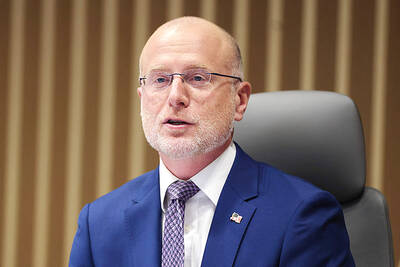
FAKE NEWS? ‘When the government demands the press become a state mouthpiece under the threat of punishment, something has gone very wrong,’ a civic group said The top US broadcast regulator on Saturday threatened media outlets over negative coverage of the Middle East war, after US President Donald Trump slammed critical headlines from the “Fake News Media.” The US president since his first term has derided mainstream media as “fake news” and has sued major outlets over what he sees as unfair coverage. Brendan Carr, head of the US Federal Communications Commission — which oversees the nation’s radio, television and Internet media — said broadcasters risked losing their licenses over news coverage. “The law is clear. Broadcasters must operate in the public interest, and they will

SCANDAL: Other images discovered earlier show Andrew bent over a female and lying across the laps of a number of women, while Mandelson is pictured in his underpants A photograph of former British prince Andrew and veteran politician Peter Mandelson sitting in bathrobes alongside late sex offender Jeffrey Epstein was unearthed on Friday in previously published documents. The image is believed to be the first known photograph of the two men with Epstein. They are currently engulfed in scandal in the UK over their ties to their mutual friend. The undated photograph, first reported by ITV News, shows King Charles III’s disgraced brother and former British ambassador to the US sitting barefoot outside on a wooden deck. They appear to have mugs with a US flag on them
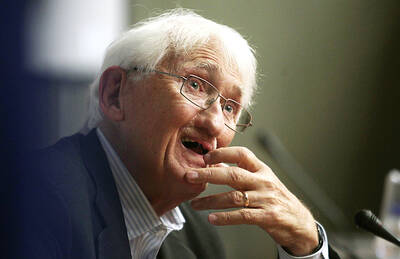
INFLUTENTIAL THEORIST: Habermas was particularly critical of the ‘limited interest’ shown by German politicians in ‘shaping a politically effective Europe Jurgen Habermas, whose work on communication, rationality and sociology made him one of the world’s most influential philosophers and a key intellectual figure in his native Germany, has died. He was 96. Habermas’ publisher, Suhrkamp, said he died on Saturday in Starnberg, near Munich. Habermas frequently weighed in on political matters over several decades. His extensive writing crossed the boundaries of academic and philosophical disciplines, providing a vision of modern society and social interaction. His best-known works included the two-volume Theory of Communicative Action. Habermas, who was 15 at the time of Nazi Germany’s defeat, later recalled the dawn of


 RSS
RSS