


Iran took a “big step” toward sending astronauts into space by 2020, successfully launching a monkey above the Earth’s atmosphere, Iranian Defense Minister Ahmad Vahidi told state television.
Washington however said if the report on the launch was true, then Iran might have violated a UN resolution banning it from any activity relating to ballistic missile technology.
Arabic-language channel al-Alam and other Iranian news agencies said the monkey returned alive on Monday after travelling in a capsule to an altitude of 120km for a sub-orbital flight.
“This success is the first step toward man conquering space and it paves the way for other moves,” Vahidi said, but added that the process of putting a human into space would be a lengthy one.
“Today’s successful launch follows previous successes we had in launching [space] probes with other living creatures [on board],” he said, referring to the launch in the past of a rat, turtles and worms into space.
“The monkey which was sent in this launch landed safely and alive and this is a big step for our experts and scientists,” Vahidi said.
Iranian state television showed still pictures of the capsule and of a monkey being fitted with a vest and then placed in a device similar to a child’s car seat.
A previous attempt in 2011 by the Islamic republic to put a monkey into space failed. No official explanation was ever given.
A defense ministry statement quoted by Iranian media said earlier that Iran had “successfully launched a capsule, codenamed Pishgam (Pioneer), containing a monkey and recovered the shipment on the ground intact.”
It did not give details on the timing or location of the launch.
Earlier this month Iran announced its intention to launch a monkey into orbit as part of “preparations for sending a man into space,” which it aims to do by 2020.
Iranian President Mahmud Ahmadinejad has indicated on several occasions the intention to launch an astronaut for “observation” purposes by Iran’s scientists.
A deputy minister for science, Mohammad Mehdinejad-Nouri, said in October 2011 that human space flight was a “strategic priority” for the country.
In Washington, US State Department spokeswoman Victoria Nuland said she could not confirm whether the launch had really taken place.
“Our concern with Iran’s development of space launch vehicle technologies are obviously well-known,” she said.
“Any space launch vehicle capable of placing an object in orbit is directly relevant to the development of long-range ballistic missiles ... and they’re all virtually identical and interchangeable,” Nuland said.
UN resolution 1929 prohibited Iran from any such work, she added.
Iran’s space program unsettles Western nations, which fear it could be used to develop missiles capable of carrying nuclear warheads.
The UN Security Council has imposed on Iran an almost total embargo on nuclear and space technologies since 2007.
Tehran has repeatedly denied that its nuclear and scientific programs mask military ambitions.
Iran’s previous satellite launches — Omid in February 2009, Rassad in June 2011 and Navid in February last year — were met by condemnation from the West which accused Tehran of “provocation.”

School bullies in Singapore are to face caning under new guidelines, but the education minister on Tuesday said it would be meted out only as a last resort with strict safeguards. Human rights groups regularly criticize Singapore for the use of corporal punishment, which remains part of the school and criminal justice systems, but authorities have defended it as a deterrent to crime and serious misconduct. Caning was discussed in the parliament after legislators asked how it would be used in relation to bullying in schools. The debate followed stricter guidelines on serious student misconduct, including bullying, unveiled by the Singaporean Ministry of

As evening falls in Fiji’s capital, a steady stream of people approaches a makeshift clinic that is a first line of defense against one of the world’s fastest-growing HIV epidemics. In the South Pacific nation — a popular tourist destination of just under a million people — more than 2,000 new HIV cases were recorded last year, a 26 percent increase from 2024. The government has declared an HIV outbreak and described it as a national crisis. “It’s spreading like wildfire,” said Siteri Dinawai, 46, who came to be tested. The Moonlight Clinic, a converted minibus parked in a suburban cul-de-sac in Suva, is
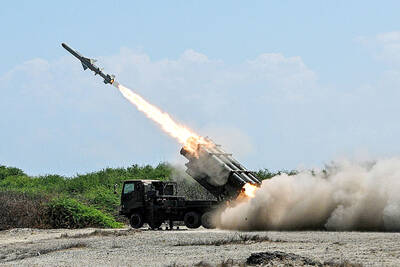
A MESSAGE: Japan’s participation in the Balikatan drills is a clear deterrence signal to China not to attack Taiwan while the US is busy in the Middle East, an analyst said The Japan Self-Defense Forces yesterday fired a Type 88 anti-ship missile during a joint maritime exercise with US, Australian and Philippine forces, hitting a decommissioned Philippine Navy ship in waters facing the disputed South China Sea, in drills that underscore Tokyo’s rising willingness to project military power on China’s doorstep. The drill took place as Manila and Tokyo began talks on a potential defense equipment transfer, made possible by Japan’s decision to scrap restrictions on military exports. The discussions include the possible early transfer of Abukuma-class destroyers and TC-90 aircraft to the Philippines, Japanese Minister of Defense Shinjiro Koizumi said. Philippine Secretary of

‘GROSS NEGLIGENCE?’ Despite a spleen typically being significantly smaller than a liver, the surgeon said he believed Bryan’s spleen was ‘double the size of what is normal’ A Florida surgeon who is facing criminal charges after allegedly removing a patient’s liver instead of his spleen has said he is “forever traumatized” by that person’s death. In a deposition from November last year that was recently obtained by NBC, 44-year-old Thomas Shaknovsky described the death of 70-year-old William Bryan as an “incredibly unfortunate event that I regret deeply.” Bryan died after the botched surgery; and last month, a grand jury in Tallahassee indicted Shaknovsky on a charge of manslaughter. “I’m forever traumatized by it and hurt by it,” Shaknovsky added, also saying that wrong-site surgeries can happen “during


 RSS
RSS