


As many as 100 people were missing and some feared dead yesterday after wildfires swept through the Australian island state of Tasmania, forcing thousands to flee as residents described trees exploding in the heat.
Acting Tasmania police commissioner Scott Tilyard said officers were investigating several reports of missing persons after fires ravaged the south of the state.
“I am fearful that someone may have died in this fire ... it is a very distinct possibility still and I think people need to brace themselves that that may occur,” Tilyard told reporters, saying there were grave fears in a “handful” of cases.
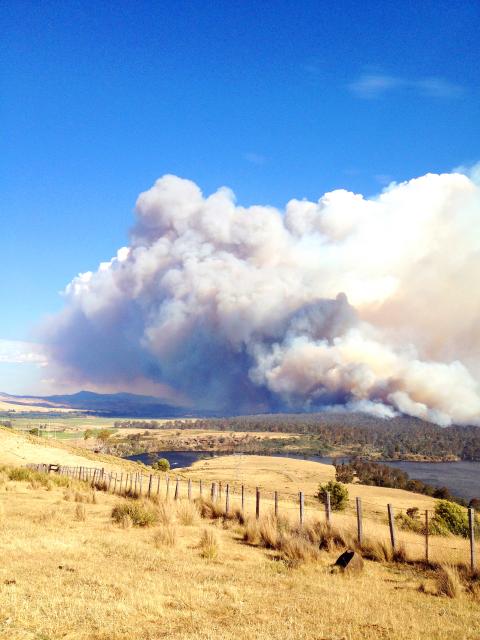
Photo: EPA
“Whilst we have had no known deaths associated with these fires at this particular point in time, I want to make it quite clear that it is still far too early to confirm that that is not the case,” he added.
Police and troops were going door to door in the worst-hit town of Dunalley to search for the missing and confirm no lives had been lost in conditions officials had described as catastrophic.
About 70 homes were destroyed and the main street was razed, with the local school reduced to ashes and trees exploding in the heat.
“The trees just went off. They were like firecrackers — 20, 30 feet [6m, 9m] high, the flames,” Dunalley resident Tony Young said.
Australian Prime Minister Julia Gillard will tour the devastated town on today. The government also warned of further danger across the nation from extreme heat predicted in several states this week.
Britain’s Queen Elizabeth II, Australia’s head of state, sent her condolences to Tasmania, expressing “deep concern” at the destruction and offering her sympathy to those who had lost homes and livelihoods.
“I offer my support and admiration for the firefighters, volunteers and emergency services officers who have been working tirelessly to contain the situation,” the monarch said in a written message published by the Australian Associated Press.
About 3,000 people were evacuated from their homes and many were stranded yesterday in emergency shelters as the fires raged to the east and west of the state capital Hobart, cutting off roads.
Residents returning to the wreckage of their homes described the devastation as “armageddon,” while others recounted desperate moments as the fire tore through, forcing them to take shelter in the Dunalley canal.
One family was saved by a water-bombing aircraft which arrived overhead as flames surrounded their waterfront caravan. They were armed only with buckets.
The Tasmania Fire Service downgraded two major blazes from emergency to watch-and-act status, with calmer conditions bringing a much-needed reprieve for crews ahead of worsening fire weather expected later in the week.
Tasmania Fire Service chief Mike Brown estimated that there were “hundreds of kilometers of uncontrolled fire” still burning in heavily forested areas that are difficult to access.
“We have got a lot of work ahead,” Brown said. “We are going to be in this situation for a number of days yet.”
High winds which fanned the worst of the blazes had dropped off, giving crews a valuable opportunity to contain some 20 fires still active before conditions were expected to worsen again, Tasmania Fire Service spokesman John Holloway said.
“[Crews will be] doing some more active firefighting rather than just property protection,” Holloway said. “We’re looking at some warmer weather again through on Thursday, so if we’ve got this window to work on these fires and get some form of control around them, we’re going to take that opportunity when we can.”
Hot and dry summer conditions have seen fires start in a number of Australian states this month, with heatwaves in several major cities. Wildfires are a fact of life in arid Australia, where 173 people perished in the 2009 Black Saturday firestorm, the nation’s worst natural disaster of modern times.

School bullies in Singapore are to face caning under new guidelines, but the education minister on Tuesday said it would be meted out only as a last resort with strict safeguards. Human rights groups regularly criticize Singapore for the use of corporal punishment, which remains part of the school and criminal justice systems, but authorities have defended it as a deterrent to crime and serious misconduct. Caning was discussed in the parliament after legislators asked how it would be used in relation to bullying in schools. The debate followed stricter guidelines on serious student misconduct, including bullying, unveiled by the Singaporean Ministry of

As evening falls in Fiji’s capital, a steady stream of people approaches a makeshift clinic that is a first line of defense against one of the world’s fastest-growing HIV epidemics. In the South Pacific nation — a popular tourist destination of just under a million people — more than 2,000 new HIV cases were recorded last year, a 26 percent increase from 2024. The government has declared an HIV outbreak and described it as a national crisis. “It’s spreading like wildfire,” said Siteri Dinawai, 46, who came to be tested. The Moonlight Clinic, a converted minibus parked in a suburban cul-de-sac in Suva, is
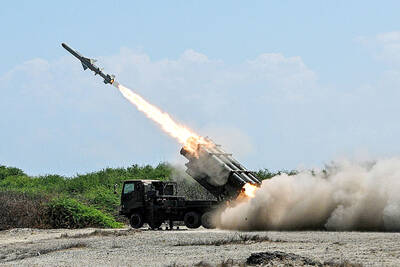
A MESSAGE: Japan’s participation in the Balikatan drills is a clear deterrence signal to China not to attack Taiwan while the US is busy in the Middle East, an analyst said The Japan Self-Defense Forces yesterday fired a Type 88 anti-ship missile during a joint maritime exercise with US, Australian and Philippine forces, hitting a decommissioned Philippine Navy ship in waters facing the disputed South China Sea, in drills that underscore Tokyo’s rising willingness to project military power on China’s doorstep. The drill took place as Manila and Tokyo began talks on a potential defense equipment transfer, made possible by Japan’s decision to scrap restrictions on military exports. The discussions include the possible early transfer of Abukuma-class destroyers and TC-90 aircraft to the Philippines, Japanese Minister of Defense Shinjiro Koizumi said. Philippine Secretary of
Separatists in Alberta are preparing to submit a petition tomorrow that they said has enough signatures to force a referendum on independence for the oil-rich Canadian province. Polls indicate the pro-independence camp remains a minority among Alberta’s 5 million people, but has hit a historic high of roughly 30 percent. Alberta separatists are also closer than ever to forcing a referendum, riding momentum fueled by intensifying grievances over Ottawa’s control of the provincial oil industry. They have also undeniably gotten a boost from the return to power of US President Donald Trump. After launching a petition in January, Stay Free Alberta, the group


 RSS
RSS